
Choose nearshore when your project needs live collaboration, evolving requirements, and daily contact with a product owner. Choose offshore when the work is stable, well-documented, and can be handed off in discrete batches without constant back-and-forth. The right call comes down to project fit and total delivered cost, not the hourly rate on a vendor’s rate card. Before committing to either, run a short paid pilot to see how the model actually performs with your team.
TL;DR:
- Nearshore projects require continuous live collaboration, making they ideal for Agile workflows and dynamic requirements that evolve during development.
- Offshore teams often operate with minimal overlap, making them better suited for stable, clearly defined tasks that can be executed asynchronously.
- Total project costs depend heavily on factors like rework, onboarding, travel, and management effort, not just the vendor’s hourly rate.
- Running a short paid pilot with actual engineers provides a clear picture of compatibility and delivery quality, reducing the risk of long-term misalignment.
- Effective security and IP protection depend on clear contractual controls and oversight during the pilot, regardless of region.
Table of Contents
- Nearshore vs Offshore: What Each Model Really Means
- What Nearshore and Offshore Really Cost You
- Nearshore vs Offshore: Tradeoffs That Actually Matter
- When to Pick Nearshore vs Offshore for Your Project
- How to Shortlist, Pilot, and Govern a Nearshore or Offshore Partner
- Supply-Chain and IP Risks You Can’t Afford to Ignore
- Regional Strengths: Latin America, Eastern Europe, and Asia
- Why the Pilot Matters More Than the Pitch
- Get Senior Engineers Without the Local Hiring Cost
- Sources
- FAQ
Nearshore vs Offshore: What Each Model Really Means
Nearshore outsourcing means working with development teams in countries close enough to your own time zone that a normal workday overlaps by several hours. For a US company, that typically means Latin America. Offshore outsourcing means partnering with teams eight, ten, or twelve time zones away, most often in South or Southeast Asia, where overlap is minimal or occurs only in the early morning or late evening.
The distinction is not geography for its own sake. It’s about how many hours a day two teams can talk in real time, and that number changes how you run a project. A study from Oxford surveying 80 outsourcing customers found nearshore engagements scored higher on overall success, required less project-management effort, held to schedules better, and produced fewer communication breakdowns than far-offshore engagements, particularly on Agile projects. Agile ceremonies like stand-ups, sprint planning, and retrospectives depend on synchronous conversation. When your engineering partner is asleep during your sprint review, that ceremony either gets skipped, delayed, or converted into asynchronous notes that lose most of their value.
A separate field study of Brazil-North America teams found that shared working hours support voice coordination and relationship-building. Researchers described the effect of intense overlap as something close to “real-time simulated co-location”, meaning teams could function almost as if they sat in the same office, according to the ICSE study.
Region-type examples help, but they’re a proxy, not a guarantee:
- Latin America: strong US overlap, moderate travel distance, growing engineering talent pools.
- Eastern Europe: deep senior engineering talent with several overlap hours against US East Coast mornings.
- South and Southeast Asia: large talent pools and lower rates, with overlap typically limited to narrow windows.
A team in the right region with the wrong delivery discipline will still underperform. The label tells you what’s operationally likely, not what’s guaranteed.
What Nearshore and Offshore Really Cost You
Hourly rate is the number every vendor leads with, and it’s the number that misleads the most buyers. A $25 hourly rate that requires an extra project manager, generates rework from missed requirements, and delays a launch by six weeks is more expensive than a $55 hourly rate that ships correctly the first time. Practitioner guidance and GAO’s outsourcing framework both stress that outsourcing success depends on the full lifecycle of the engagement, not the rate quoted at signing.
To calculate what a project actually costs, add up these components for each option you’re comparing:
- Vendor hourly or monthly rate
- Internal project-management and oversight time
- Onboarding and ramp-up time before the team is fully productive
- Travel costs for kickoff meetings or periodic check-ins
- Rework caused by miscommunication or unclear handoffs
- Compliance and security review overhead
- Replacement risk if a key engineer leaves mid-project
Domestic hiring sets the baseline for comparison. The Bureau of Labor Statistics reports a median annual salary of $133,080 for software developers, a figure worth keeping in mind when a vendor pitches “cheap” offshore rates that only look cheap in isolation. For a full breakdown of what a US hire actually costs once benefits and overhead are included, see this cost comparison.
Here’s a simplified way to frame total delivered cost (TDC) across two scenarios:
| Cost Component | Nearshore Scenario | Offshore Scenario |
|---|---|---|
| Hourly rate | Moderate | Lower |
| PM overhead | Lower (overlap reduces friction) | Higher (async coordination) |
| Onboarding time | Faster (live walkthroughs) | Slower (documentation-dependent) |
| Rework risk | Lower | Higher on ambiguous specs |
| Travel cost | Lower (shorter flights) | Higher (longer flights, fewer trips) |
Pro Tip: Track cost per shipped feature or per completed sprint, not cost per hour billed. A team that bills fewer hours but ships less useful work in each sprint is not actually cheaper.
Nearshore vs Offshore: Tradeoffs That Actually Matter
Every outsourcing decision trades something for something else. Nearshore buys you collaboration speed; offshore buys you rate leverage. Neither wins outright, but each wins for different project shapes.
Nearshore advantages:
- Real-time overlap supports daily stand-ups and live requirement changes
- Shorter flights make in-person kickoffs and check-ins realistic
- Cultural and business-hour alignment reduces miscommunication on urgent issues
Nearshore drawbacks:
- Hourly rates run higher than farshore alternatives
- Talent pools, while growing, are smaller than in established offshore hubs
Offshore advantages:
- Lower hourly rates and access to very large talent pools
- Well-suited to modular, well-specified work that doesn’t need constant input
Offshore drawbacks:
- Minimal overlap forces asynchronous workflows and heavier documentation
- Agile ceremonies lose real-time value, requiring redesigned processes
| Factor | Nearshore | Offshore |
|---|---|---|
| Time-zone overlap | High (several hours daily) | Low (narrow or none) |
| Agile ceremony fit | Strong | Requires redesign |
| Documentation burden | Lower | Higher |
| Talent pool size | Moderate | Large |
| Typical hourly rate | Moderate to high | Low to moderate |
Security is not a differentiator between the two models on its own. Both nearshore and offshore vendors can meet strict security requirements when contracts specify subcontractor disclosure, repository access controls, and incident notification. The risk comes from skipping those controls, not from picking one region over another.
When to Pick Nearshore vs Offshore for Your Project
Match the model to how the work actually gets built, not to which option looks cheaper on paper.
- Choose nearshore when your project needs live discovery. If requirements are still forming and a product owner needs to answer questions in real time, overlap hours are not optional.
- Choose nearshore for iterative, Agile release cycles. Sprint reviews, backlog grooming, and daily stand-ups all lose effectiveness when half the team is offline.
- Choose offshore when the work is stable and modular. A well-specified backend migration, a defined API build, or a batch of QA test scripts can move through asynchronous handoffs without much loss.
- Choose offshore when documentation discipline is already strong. Teams that already write detailed tickets and acceptance criteria lose less in translation across time zones.
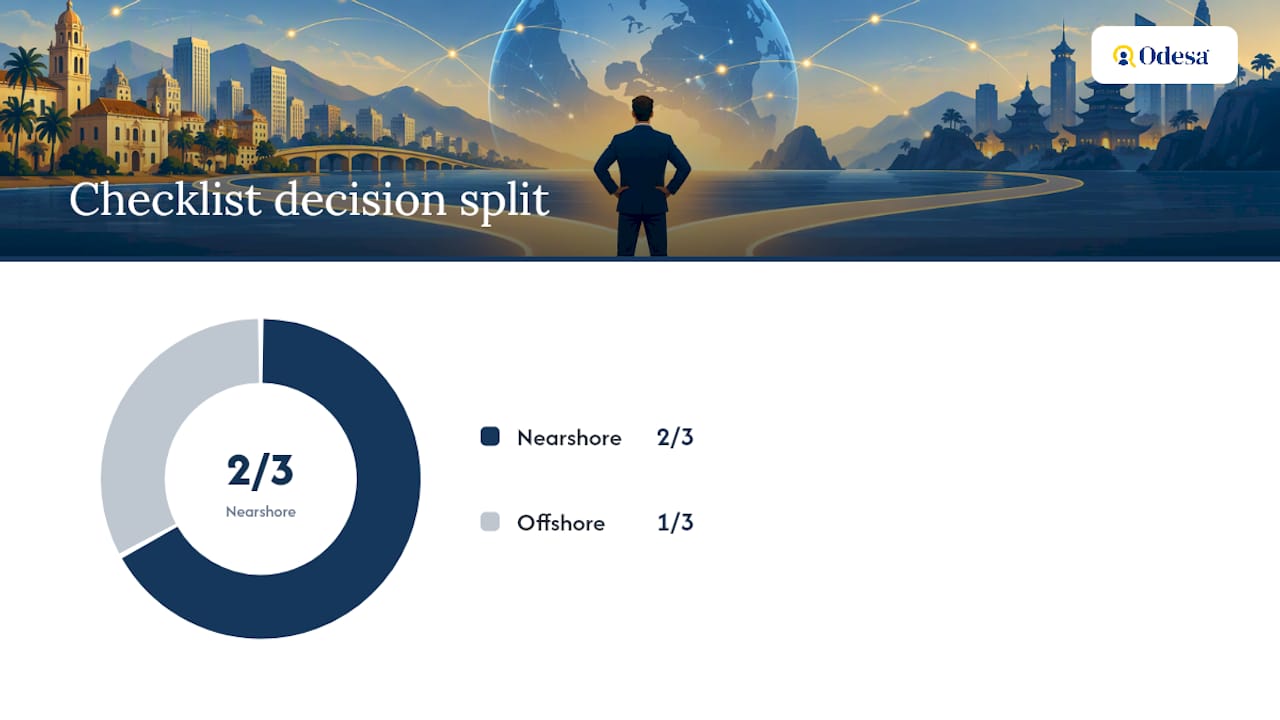
- Run a short checklist before deciding: Does this project change direction weekly? Does it need a product owner in daily conversations? Can tasks be fully specified up front? Answering yes to the first two points toward nearshore; yes to the third points toward offshore.
Pro Tip: If you’re unsure which category your project falls into, look at your last three sprints. If more than half the tickets changed scope mid-sprint, you need overlap. If they mostly shipped as originally written, you can tolerate distance.
Comparative research on cross-border sourcing backs this up: execution efficiency tends to drop when projects cross country boundaries, unless the buyer brings strong risk-management planning and disciplined Agile practices to the table.
How to Shortlist, Pilot, and Govern a Nearshore or Offshore Partner
Picking a model is step one. Picking the right partner inside that model is where most projects actually succeed or fail.
- Define required overlap and outcomes before you source anyone. Write down the minimum daily overlap hours you need and the specific deliverables that define success in the first 90 days.
- Shortlist based on seniority and delivery evidence, not marketing decks. Ask for examples of similar projects, and verify the engineers proposed are the ones who will actually do the work.
- Interview the proposed engineers directly. A vendor’s sales team is not who will write your code. Talk to the individuals assigned to your project before signing anything.
- Run a paid pilot on a real, bounded task. Two to four weeks of actual delivery tells you more than any reference call. Measure velocity, code quality, and communication responsiveness.
- Formalize governance only after the pilot proves out. Set cadence for check-ins, define escalation paths, and confirm reporting expectations in writing.
Before you sign a longer contract, insist on these terms:
- Clear IP ownership assigning all work product to you, not the vendor
- Subcontractor disclosure so you know who actually touches your code
- An exit and knowledge-transfer clause defining what happens if you end the engagement
- Service-level agreements covering response time, uptime, and defect resolution
If you’re weighing staff augmentation against a direct hire for this decision, this comparison of staff augmentation and recruitment walks through the tradeoffs. And if offshore ends up being the right fit, learning to manage an offshore team without micromanaging will save you months of friction.
Supply-Chain and IP Risks You Can’t Afford to Ignore
Outsourcing introduces a supply chain, and supply chains can be opaque. The GAO’s review of ICT supply-chain risk documents how limited visibility into subcontractors and foreign access points increases exposure to both security incidents and IP leakage. This applies to nearshore and offshore engagements alike. Distance doesn’t create the risk; unclear contracts and weak access controls do.
GAO’s guidance points to a specific gap: many buyers don’t know who else has access to their code, infrastructure, or data once a vendor brings in subcontractors of its own.
Concrete mitigations worth building into every contract:
- Enforce least-privilege access so engineers only reach the systems their task requires
- Require multi-factor authentication on every account touching your codebase
- Set repository controls that log every commit and access event
- Demand subcontractor disclosure in writing, updated whenever the vendor’s staffing changes
- Include incident notification clauses with a defined response window, not a vague “promptly”
Verify these controls during the pilot phase, not after you’ve scaled the engagement. A vendor that resists disclosing subcontractors during a two-week pilot will resist it far more once you’re dependent on them. For a broader rundown of failure modes, see this breakdown of offshore development risks and how to close them before they become expensive.
Regional Strengths: Latin America, Eastern Europe, and Asia
Region shapes what’s operationally realistic, even though it never replaces evaluating the actual team.
- Latin America gives US buyers strong time-zone overlap and short flights, making it a natural nearshore choice for iterative, Agile-heavy work. The ICSE research on Brazilian teams found this overlap directly supports the kind of voice coordination that keeps sprints on track.
- Eastern Europe sits further out on the clock but still offers workable morning overlap with US teams, paired with deep senior engineering talent built around strong computer science education systems.
- South and Southeast Asia offer some of the largest developer pools in the world at lower rates, but overlap is typically limited to narrow windows, which pushes projects toward asynchronous design by necessity.
None of these regional patterns override the fundamentals. A senior team in any region beats a junior team in the “right” time zone. Evaluate the engineers and the delivery process first; use region as a planning input, not a decision rule. This regional comparison of Eastern Europe and Latin America breaks down the practical differences in more depth.
Why the Pilot Matters More Than the Pitch
The decision rule is simple even when the outsourcing market makes it sound complicated: pick nearshore for work that needs live collaboration and evolving requirements, pick offshore for stable and modular work, and judge both by total delivered cost rather than the number on a rate card.
Where most buyers go wrong isn’t the model they choose. It’s skipping the pilot and jumping straight to a multi-month contract based on a sales call. A two to four week paid trial, with the actual proposed engineers doing real work, exposes mismatches that no reference check or portfolio review ever will. Run the shortlist, run the pilot, and let the results decide the rest.
— Editorial Team
Get Senior Engineers Without the Local Hiring Cost
This service provides access to senior, pre-vetted engineers from Eastern Europe, matched personally rather than selected from an automated bench. The approach emphasizes a pilot-first methodology, with governance and IP terms defined before the engagement scales.

If your project needs senior talent integrated fast, staff augmentation starts at $45 an hour with engineers who can join an existing sprint cycle without a lengthy ramp. Prefer to own the employment relationship directly? The tech recruitment service works on a flat $7,999 fee per successful hire. Either way, the next step is the same one this article has argued for throughout: request a scoped pilot, watch how the engineers actually perform on real work, and decide from there.
Sources
The claims in this guide draw on GAO’s federal supply-chain and outsourcing-practice reports, an Oxford-affiliated study on temporal distance in global software development, an ICSE field study on Brazilian time-zone overlap, and BLS wage data for domestic hiring benchmarks.
- Outsourcing in global software development: effects of temporal location and methodologies – ORA (Oxford)
- Software developers — Occupational Outlook Handbook (BLS)
FAQ
What is the difference between offshoring and nearshoring?
Offshoring means working with a team many time zones away, usually with little to no daily overlap, while nearshoring means working with a team close enough in time zone to overlap for most of a normal workday. That overlap difference is the main driver behind the higher project success and lower communication problems nearshore projects report in the Oxford study.
What is onshore, offshore, and nearshore?
Onshore means hiring within your own country, offshore means hiring in a distant country with minimal time-zone overlap, and nearshore means hiring in a nearby country with substantial overlap. Each model trades cost, talent access, and collaboration ease differently, and the right choice depends on how your project needs to be managed day to day.
Can you give me an example of nearshore outsourcing?
A US company hiring a development team in Latin America to build a customer-facing app, with daily stand-ups and a product owner available for live questions, is a typical nearshore example. Odesa.co’s own model, pairing US clients with senior Eastern European engineers who still hold meaningful morning overlap, follows the same logic even though the geography differs.
What is meant by nearshore?
Nearshore describes an outsourcing arrangement where the vendor team works in a country close enough in time zone to allow real-time collaboration during a normal business day. It’s distinct from offshore, where minimal overlap forces most collaboration into asynchronous handoffs.
How much does it cost to hire through Odesa.co?
Staff augmentation through Odesa.co starts at $45 per hour, and direct recruitment is a flat $7,999 fee per successful hire. Custom development pricing is available on request through Odesa’s services page.