

A dedicated development team is a long-term, exclusive group of engineers who work only on your product, functioning as an extension of your own staff. The model suits growth-stage companies that need continuous product development without building an in-house team from scratch. It delivers speed and continuity, but only when paired with real governance: clear acceptance criteria, an onshore liaison, and a vendor with a documented retention record.
TL;DR:
- Dedicated teams should be chosen for long-term, evolving roadmaps involving complex products, rather than short-term, fixed-scope projects or one-off tasks.
- A typical dedicated team needs several weeks of ramp-up time and is billed monthly, offering flexibility to adapt priorities without renegotiation.
- Core roles include a product owner, project manager, developers, QA, DevOps, and potentially UX designers, with team composition tailored to the product stage.
- Risks like high turnover and governance issues can be mitigated through vendor due diligence, clear communication structures, and explicit contract clauses on knowledge transfer.
- Selecting a vendor involves structured evaluation, technical vetting, reference checks, and clear governance agreements to ensure alignment and continuity.
Table of Contents
- What a dedicated development team is and how it differs from other engagement models
- When to choose a dedicated development team
- Typical dedicated team composition and roles
- Benefits of the dedicated development team model
- Risks and common failure modes
- How to hire and vet a dedicated development team provider
- Managing and governing a dedicated development team
- Why Odesa: evidence and case studies that demonstrate delivery and retention
- Pragmatic rules for choosing a dedicated team versus hiring in-house
- How Odesa helps: staffing a dedicated development team
- Sources
- FAQ
What a dedicated development team is and how it differs from other engagement models
A dedicated development team is a group of engineers, and often a product owner, QA specialist, or designer, who work exclusively on one client’s product for the length of the engagement. Unlike freelancers or short-term contractors, this team does not rotate between projects. It reports into your roadmap, attends your standups, and builds domain knowledge over months or years rather than weeks.
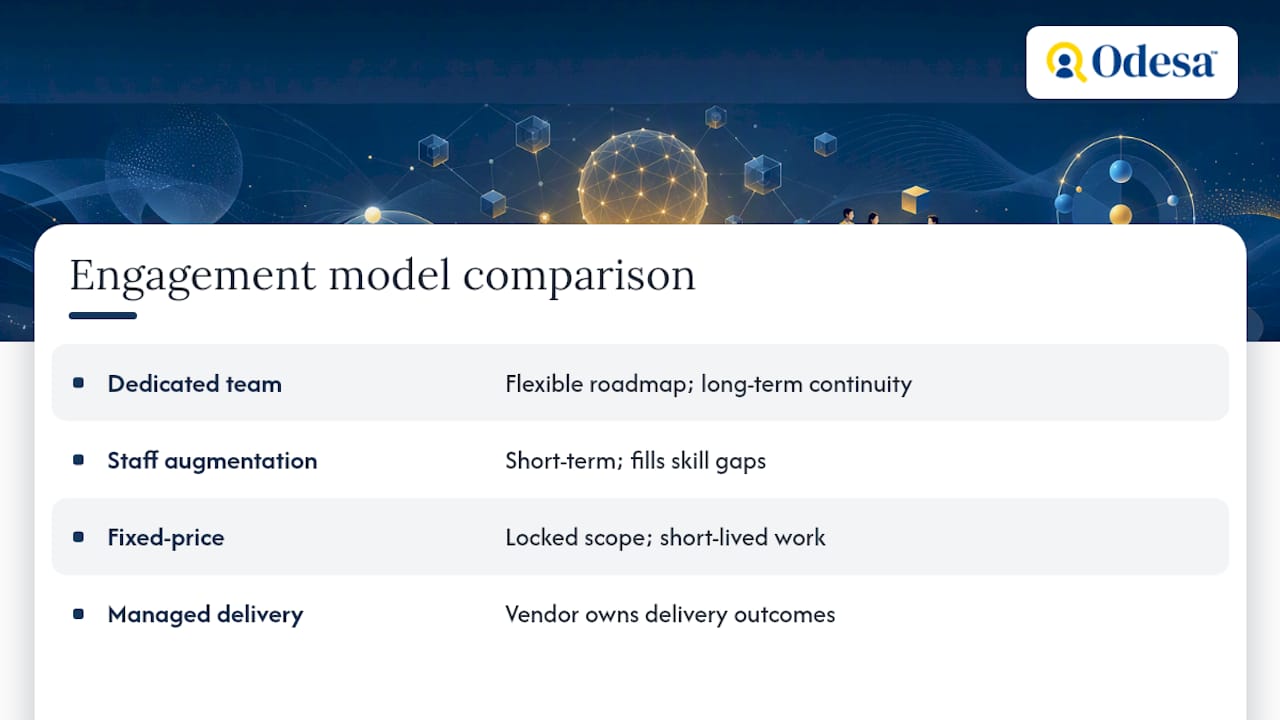
That exclusivity is what separates a dedicated team from staff augmentation. Staff augmentation fills specific skill gaps on a flexible, often shorter-term basis. You might bring in two backend engineers for a three-month sprint to hit a deadline, then release them once the work is done. A dedicated team, by contrast, is built for continuity: the same people stay on your product across multiple release cycles, which matters when the roadmap is long and undefined.
Fixed-price projects sit at the other end of the spectrum. A vendor quotes a set price for a defined scope, typically for well-specified, short-lived work like building a single feature or launching a static marketing site. There is little flexibility once the contract is signed, which makes fixed-price a poor fit for products that will change direction based on user feedback.
Managed product delivery, sometimes called outcome-based delivery, hands the vendor responsibility for shipping specific results, not just staffing hours. The vendor owns process, quality, and timeline; you own the business requirements. This model works when you want a hands-off partner but still need someone accountable for outcomes rather than headcount.
A practical way to choose: if your backlog is long and evolving, pick a dedicated team. If you need a narrow skill for a fixed window, pick staff augmentation. If the scope is locked and small, a fixed-price contract is faster to arrange. If you want an outside party to own the whole delivery outcome, managed delivery fits best.
When to choose a dedicated development team
A dedicated team model makes the most sense when a few signals line up. An open-ended, evolving roadmap is the clearest one: if you are iterating on a product for the next year or more rather than shipping one release and moving on, exclusivity pays off because the team accumulates context you would otherwise lose every time a contractor rotates out.
Deep product ownership is the second signal. Complex products, ones with intricate business logic, regulatory constraints, or a large existing codebase, benefit from engineers who understand the full system rather than a narrow ticket. A long, growing backlog is the third: teams handling continuous feature requests, technical debt, and bug fixes in parallel need people embedded in the product, not cycling through onboarding every quarter.
The contra-indicators are just as important. A one-off project with a tightly specified scope, a landing page redesign, a data migration, a single integration, rarely justifies the ramp-up time a dedicated team requires. Fixed-price or short-term staff augmentation will usually be faster and cheaper for that kind of work.
Ramp time deserves a realistic estimate before you commit. Expect several weeks for a new dedicated team to reach full productivity on an unfamiliar codebase, even with strong engineers, because domain knowledge takes time regardless of skill level. Billing for dedicated teams typically runs as a monthly retainer or time-and-materials arrangement rather than a fixed quote, since the scope of ongoing work is not fully known at the start. That billing shape gives you flexibility to reprioritize the backlog without renegotiating a contract every time priorities shift, but it also means you carry more responsibility for managing scope and pace than you would under a fixed-price deal.
Typical dedicated team composition and roles
A dedicated team’s size and shape should match the stage of the product, not a generic template. The core roles that appear across most engagements are:
- Product owner (PO): owns the backlog, prioritizes features, and represents business requirements to the engineering team.
- Project manager or Scrum Master: runs the day-to-day process, coordinates sprints, and removes blockers.
- Frontend and backend developers: build the application itself, split by the technology stack the product requires.
- QA engineer: tests releases, writes automated test suites, and catches regressions before they reach users.
- DevOps engineer: manages infrastructure, deployment pipelines, and uptime.
- UX or UI designer: shapes the interface and user flows, often shared across multiple features rather than dedicated full time.
The right blend depends on what you are building. An early-stage MVP typically needs a lean team: one or two full-stack developers, a part-time designer, and a product owner who can also handle light project management. A product in steady iteration usually adds dedicated frontend and backend specialists, a full-time QA engineer, and a DevOps resource once release frequency increases. A team focused on scaling and maintenance shifts weight toward DevOps, security, and QA, since the priority moves from building new features to keeping an established system reliable under growing load.
Splitting responsibility between client and vendor matters as much as headcount. The client side should own product vision, prioritization, and final acceptance of work. The vendor side should own technical execution, code quality, and day-to-day team management. A practitioner guideline worth following is roughly one onshore liaison for every 20 offshore team members, which keeps communication and knowledge transfer manageable without requiring a liaison for every small team. For most dedicated engagements below that size, a single point of contact on each side is enough to keep decisions moving without adding coordination overhead.
Benefits of the dedicated development team model
The main draw of a dedicated team is access to senior engineering talent without the overhead of a full in-house hire. Recruiting, interviewing, and onboarding a senior engineer domestically can take months and carries the fixed costs of benefits, equipment, and office space. A dedicated team lets you add that same caliber of talent on a timeline measured in weeks, without the long-term liabilities of a direct employment contract.
Continuity is the second major benefit, and it compounds over time. A team that stays on your product for a year or more builds institutional knowledge that shortens the path from bug report to fix and from feature request to shippable code. That knowledge retention shows up directly in time-to-market: fewer handoffs, fewer repeated explanations of how a legacy module works, fewer regressions introduced by someone unfamiliar with the codebase’s quirks.
Cost efficiency is the third factor, though it works differently than it looks on the surface. A dedicated team does not eliminate cost, it reshapes it. Instead of carrying fixed costs for salaries, benefits, and office overhead whether or not the workload justifies them, you pay a variable rate tied to actual capacity. That shift matters most for growth-stage companies whose engineering needs fluctuate with funding cycles and product milestones, since it lets you scale the team up during a push and hold steady without severance costs or idle payroll during a quieter quarter. The same shift also opens access to talent pools priced differently from your local market, which is part of why staff augmentation and dedicated team arrangements have become a standard tool for software developer budgeting once local hiring costs are factored in.
Risks and common failure modes
The most cited risk in dedicated team arrangements is turnover. High turnover on the vendor side resets the continuity benefit that makes the model worth choosing in the first place, and offshore development in particular can see high turnover that drives schedule delays and repeated onboarding costs. Before signing a contract, ask the vendor directly about retention rates, average engineer tenure, and how they train replacements when someone leaves.
Governance failures are the second common breakdown. A few patterns show up repeatedly:
- No onshore liaison, leaving daily communication to drift across time zones with no clear owner.
- Contracts written for fixed-price work applied awkwardly to open-ended, evolving product development.
- Acceptance criteria left vague, so the client and vendor disagree about whether a sprint’s work is actually done.
Requirements and knowledge-integration problems round out the list. When the client’s business context is not shared clearly, or when the vendor’s technical decisions are not surfaced back to the client, the two sides end up building slightly different mental models of the product. That gap grows quietly until a release reveals it. Reviewing offshore development risks before signing a contract is a practical way to spot these patterns early rather than after a missed deadline.
Pro Tip: Ask a prospective vendor for their average engineer tenure and their process for replacing a departing team member before you sign, not after.
How to hire and vet a dedicated development team provider
Selecting a vendor works best as a defined process rather than an ad hoc conversation, and the CMU outsourcing handbook frames success around clear requirements, a structured RFP, and an in-house team that continues to monitor vendor performance after the contract starts.
- Define goals and success metrics before writing an RFP. Decide what “working well” looks like in concrete terms, release cadence, defect rate, or feature throughput, so you can compare vendors on the same basis.
- Build a vendor evaluation checklist. Cover retention metrics, hiring and onboarding practices, sample code from past projects, security practices, and whether the vendor provides onshore support for your time zone.
- Run technical vetting beyond a resume review. Pairing sessions and small sample tasks reveal more about how a candidate actually works than a portfolio does, and structured, objective candidate scorecards reduce bias in that comparison.
- Check references from past clients directly. Ask specifically about turnover during the engagement and how the vendor handled a difficult stretch, not just whether the project shipped.
- Negotiate contract essentials before signing. Governance cadence, acceptance criteria for each sprint or milestone, ramp-up and notice periods, and intellectual property and knowledge-transfer clauses should all be explicit in writing.
The PMI guidance on third-party software development frames the vendor relationship as an integration challenge, not just a procurement decision: successful engagements depend on active monitoring and formal acceptance of deliverables, treating the supplier as an extension of the client rather than an arm’s-length contractor. That framing matters most in the interview stage. A dedicated team engagement is closer to hiring than to buying a service, so the vetting process should look more like a hiring pipeline: structured interviews, working sessions, and reference checks that test collaboration style as much as raw technical skill. Reviewing a practical guide to hiring remote developers alongside your own checklist helps calibrate what a strong technical interview should actually cover.
Contract clauses deserve particular attention because they are hard to renegotiate mid-engagement. Ramp and notice periods protect both sides if the relationship needs to wind down. Knowledge-transfer clauses ensure that if a key engineer leaves or the contract ends, documentation and codebase knowledge stay with you rather than walking out the door.
Managing and governing a dedicated development team
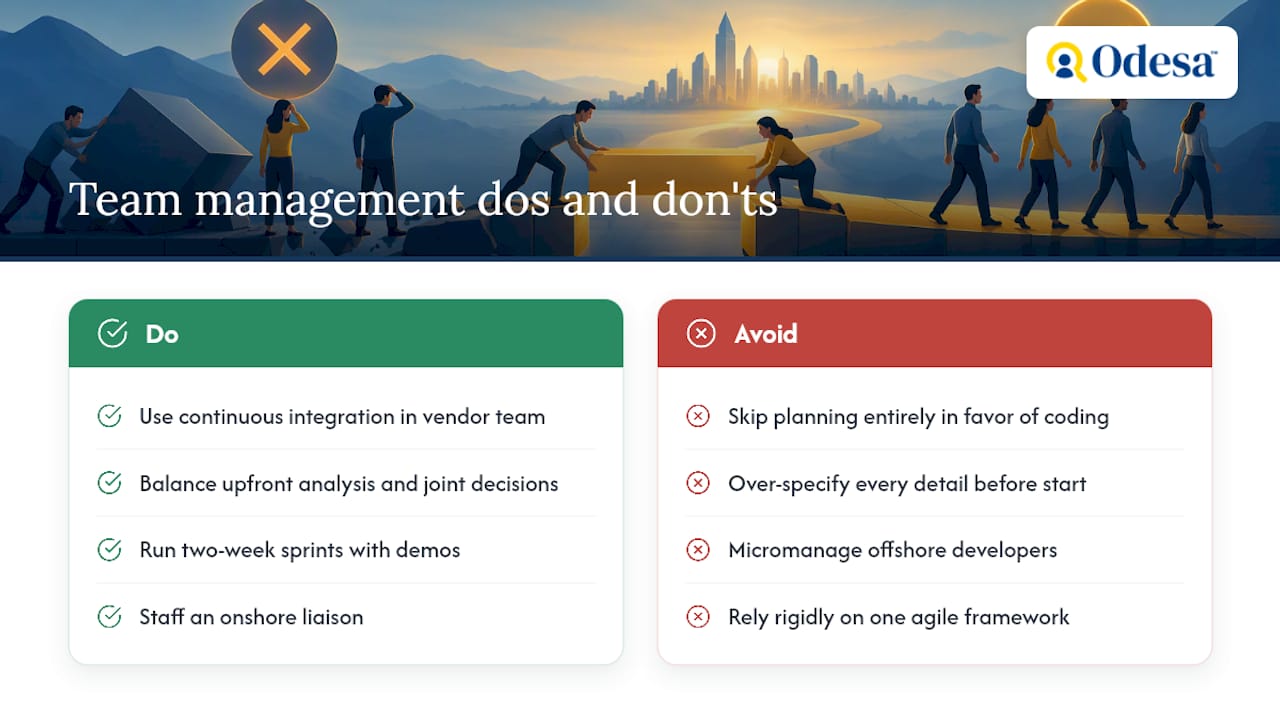
Running a dedicated team well depends on a specific combination of practices. Research on outsourced agile projects finds that continuous integration within the vendor team, combined with targeted upfront analysis and joint decision-making between client and vendor, improves the odds of a successful outcome. In practice, that means neither skipping planning entirely in favor of “just start coding,” nor over-specifying every detail before development begins. The right mix depends on how well-understood the requirements already are: well-understood work benefits from more upfront analysis, while exploratory or fast-changing work benefits from shorter cycles and more frequent joint decisions.
A few cadences tend to work across most dedicated engagements: two-week sprints, a demo at the end of each sprint so stakeholders see working software regularly, and a recurring backlog grooming session to keep priorities current. For larger engagements involving multiple teams, a metascrum-style coordination meeting, where representatives from each team align on cross-team dependencies, becomes useful once managerial coordination needs shift as a program scales beyond a single team.
Knowledge integration is the piece that separates a well-run dedicated team from one that quietly drifts out of sync with the client’s intent. There is no single agile framework proven to guarantee success on its own; what tends to matter more is flexibility and knowledge-sharing between the client and vendor rather than rigid adherence to any one methodology. Favor upfront planning when requirements are stable and well documented. Favor continuous analysis and shorter feedback loops when the product direction is still being discovered through user feedback.
Staffing an onshore liaison, someone on your side who understands both the business context and enough of the technical picture to translate between the two, is one of the more reliable investments here, especially as team size grows. Lightweight tooling, shared documentation, a visible backlog, and recorded demos, does more to close the knowledge gap than any single process framework. Practical guidance on running that liaison relationship without slipping into micromanaging offshore developers is worth reviewing before the team’s first sprint, not after friction shows up.
Why Odesa: evidence and case studies that demonstrate delivery and retention
Odesa Co builds dedicated teams around personalized matching: the founder is directly involved in understanding a client’s technical needs and pairing them with senior engineers drawn from a pre-vetted network based in Eastern Europe. That direct involvement is part of how Odesa positions its matching process against larger, more automated staffing vendors.
Clients have used Odesa for a range of dedicated engagements, from rebuilding legacy platforms to scaling engineering capacity during rapid growth. Clients report savings on hiring costs compared to local rates, and some vendors offer guarantees on long-term engineer retention to address turnover risk common in offshore arrangements.
Readers evaluating whether a dedicated team fits their own roadmap can review the staff augmentation service directly, or look at recruitment and Human QA options for related staffing needs.
Pragmatic rules for choosing a dedicated team versus hiring in-house
The decision usually comes down to two variables: company stage and how settled the product direction is. Early-stage companies with an unproven product should lean toward smaller, flexible engagements, staff augmentation or a small dedicated team, because committing to a large exclusive team before the roadmap stabilizes locks in cost and coordination overhead before you know what you are actually building.
Growth-stage companies with a validated product and a growing backlog are the clearest fit for a full dedicated team, since the continuity benefit only compounds once there is a roadmap worth being continuous about. The governance investment scales with team size, not company size: a two-person dedicated team can run on weekly syncs and a shared backlog, while anything beyond that benefits from a named onshore liaison and the coordination cadences covered earlier in this guide.
Re-evaluate the engagement model whenever the product’s direction changes meaningfully, a pivot, a new funding stage, or a shift from building to maintaining. The model that fit a fast-moving MVP a year ago is not automatically the right one once the product settles into steady-state maintenance.
— Editorial Team
How Odesa helps: staffing a dedicated development team
If the signals in this guide point toward a dedicated team, the practical bottleneck is usually speed: finding senior engineers, vetting them properly, and getting them integrated without months of delay. Odesa’s model centers on personal matching between the founder and the client, paired with a pre-vetted pool of senior Eastern European engineers, which shortens that path considerably compared to running a full hiring pipeline from scratch.
A few services map directly onto the stages covered in this guide:
- Staff augmentation adds senior engineers to your existing team without a long-term employment contract.
- Tech recruitment fits when you decide to bring a role in-house permanently.
- Ongoing Human QA supports release quality once a dedicated team is shipping regularly.
- White Label Development gives agencies a dedicated engineering bench without adding headcount.
The most practical next step is a discovery call to scope a pilot engagement, since a short trial period reveals more about fit than any reference check. Start with the staff augmentation page to see current availability and pricing.
Sources
- Agile software development practices and success in outsourced projects: the moderating role of requirements risk
- Management of third-party software development – Outsourcing projects (PMI)
- Project management issues in IT offshore outsourcing
- Keys to successful software project outsourcing (CMU outsourcing handbook)
FAQ
What is a dedicated development team?
A dedicated development team is a group of engineers who work exclusively on one client’s product over a long-term engagement, functioning as an extension of the client’s own staff rather than a rotating pool of contractors. This exclusivity supports continuity and deep product knowledge that shorter engagements do not build.
What is the role of a development team?
A development team’s core role is to design, build, test, and maintain software according to the product owner’s priorities, typically including frontend and backend developers, a QA engineer, and often a DevOps specialist. Roles shift depending on project stage, with early teams leaning lean and mature teams adding specialized QA and infrastructure roles.
How much does it cost to hire dedicated developers?
Costs vary by region, seniority, and engagement type, and billing for dedicated teams typically runs as a monthly retainer or time-and-materials rate rather than a fixed quote. Odesa’s staff augmentation service, for example, starts from $45 per hour, which reflects one publicly available reference point for senior engineering capacity.
How do you hire a dedicated development team?
Hiring a dedicated development team starts with defining goals and success metrics, then evaluating vendors on retention practices, hiring standards, and security, followed by technical vetting through pairing sessions or sample tasks. Contract terms covering governance, acceptance criteria, and knowledge-transfer clauses should be settled before the engagement begins, following the structured approach outlined in the CMU outsourcing handbook.
Recommended
- Hiring a Senior React Developer: A Founder’s Checklist
- How to Choose a Remote Staffing Agency
- How to Manage Offshore Developers Without Micromanaging
- Vantex AI Case Study: 4-Engineer Pod, 52% Below US Cost
This article may have used AI tools in the writing process. Facts, figures, and recommendations can be wrong or out of date. Do not treat this as professional advice.