
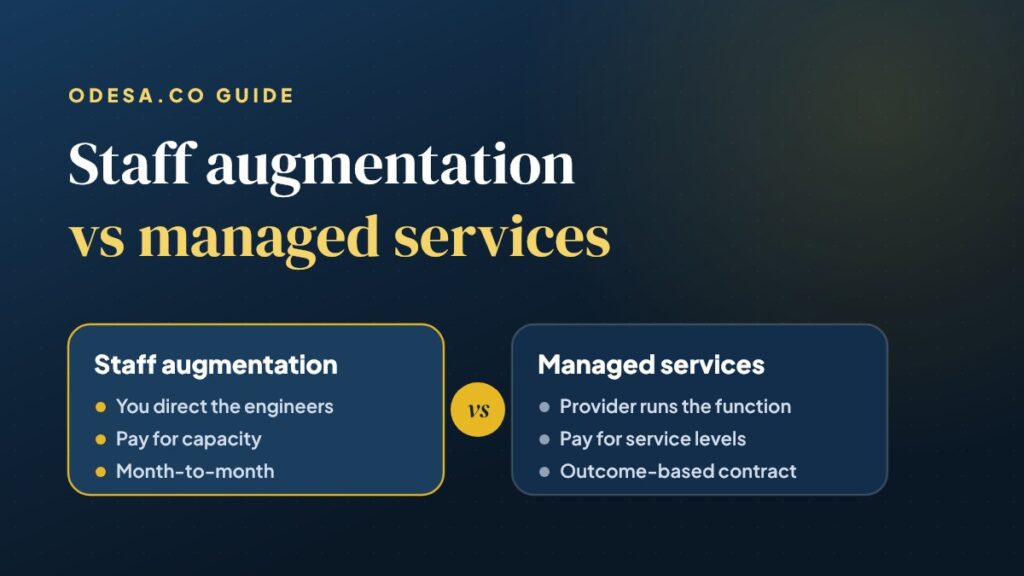
Staff augmentation adds engineers to your team who work under your direction, while managed services hand an entire function to a provider that is accountable for the results. Choose staff augmentation when you have the roadmap and the leaders and need more senior hands or a specific skill. Choose managed services when you want a provider to run an ongoing function, such as IT support, infrastructure monitoring or security operations, against agreed service levels. The deciding question is simple: who should own the work day to day, your team or the provider?
TL;DR:
- Staff augmentation buys capacity: engineers join your standups, tools and sprints, and your team directs the work.
- Managed services buy an outcome: the provider runs a defined function and answers to service-level agreements (SLAs).
- Augmentation fits product and engineering work that changes week to week; managed services fit stable, repeatable operations.
- Compare total cost, not rate cards: count your management time, onboarding, SLA penalties, tooling and the cost of switching providers.
- Many teams combine both: a managed provider for operations and augmented engineers for the product roadmap.
What is staff augmentation?
Staff augmentation is a way to add engineers to your team without running a full hiring cycle. A partner sources and vets the engineers, handles the contract and stays involved, while the engineers work inside your team: same tools, same code review, same priorities. You decide what they build and how. You pay for their time, usually by the hour or month, and you can typically add or remove capacity as your roadmap changes.
It works best when you already know what needs to be built and have someone to lead the work. The augmented engineer extends your team; the accountability for delivery stays with you.
What are managed services?
With managed services, you hand responsibility for a function to a managed service provider (MSP). The provider decides how to staff it, runs the processes and tools, and commits to measurable service levels such as response times, uptime or resolution targets. You pay for the service, often as a fixed monthly fee or a price per user, device or ticket, rather than for individual people.
Common examples are IT helpdesk and end-user support, cloud infrastructure monitoring, network management, security operations and application maintenance. The provider is accountable for outcomes, and you manage the relationship through the contract and regular service reviews rather than day-to-day direction.
Staff augmentation vs managed services, side by side
| Staff augmentation | Managed services | |
|---|---|---|
| Who directs the work | Your team sets priorities and reviews the work | The provider decides how the work gets done |
| What you pay for | Engineer time and capacity | A defined service and its outcomes |
| Typical pricing | Hourly or monthly per engineer | Fixed monthly fee, or per user, device or ticket |
| Accountability | You own delivery; the partner owns the placement | The provider owns results against SLAs |
| Best for | Product development, roadmap work, specialist skills | Stable, repeatable operations |
| Knowledge | Stays inside your team and codebase | Sits largely with the provider |
| Flexibility | Add or remove engineers as priorities change | Changes usually go through the contract |
| Your management effort | Higher: standups, reviews, direction | Lower day to day; governance through reviews |
When staff augmentation is the better fit
- You are building a product. Requirements shift sprint to sprint, and you need engineers who adapt with your team rather than a fixed statement of work.
- You have leads with bandwidth. Someone on your side can set priorities, review code and give feedback.
- You need a specific skill quickly. A React, Python, DevOps or AI/ML engineer for a feature or a quarter, without a months-long hiring process.
- You want the knowledge to stay in-house. The engineer works in your repositories and documentation, so what they learn stays with your team.
- Your needs will change. Month-to-month capacity lets you scale up for a launch and back down after it.
When managed services are the better fit
- The function is operational and repeatable. Helpdesk, patching, monitoring and backups follow known processes that a provider can run to a service level.
- You need coverage you cannot staff. Round-the-clock monitoring or on-call support is hard to cover with a small in-house team.
- You want predictable costs. A fixed monthly fee for a defined scope is easier to budget than variable hours.
- No one on your team should manage it. Your leaders want to focus on the product, not on running IT operations.
Odesa.co
Not sure which model fits?
Odesa places senior engineers inside your team from $45/hr, month-to-month, with a two-week trial. See how staff augmentation, direct recruitment and custom development compare on price, control and commitment.
How to compare the cost fairly
An hourly engineer rate and a monthly managed-service fee are not directly comparable. To compare them, estimate the total cost of each model for the same body of work over the same period:
- Your management time. Augmented engineers need direction and review from your leads. Count those hours.
- Onboarding and ramp-up. Both models take time to learn your systems. Ask how each provider handles it.
- Service levels and remedies. For managed services, check what the SLA actually guarantees and what happens when it is missed.
- Tooling and licenses. Clarify who pays for monitoring, ticketing and development tools.
- Exit costs. Ask how knowledge, documentation and access transfer if you change providers or bring the work in-house.
Can you combine both models?
Yes, and many growing companies do. A common setup is a managed provider for IT operations and infrastructure, and augmented engineers for the product roadmap. The two do not compete: one keeps the lights on under service levels, the other adds capacity to the work that differentiates your product. Keep the boundaries clear in both contracts so responsibilities do not overlap.
Questions to ask before you sign
- Who will direct the work day to day, and who is accountable if it slips?
- How are engineers or service staff vetted, and can we interview them?
- What are the notice periods, and how do we scale up or down?
- Is there a trial period or a replacement guarantee?
- Who owns the code, documentation and intellectual property?
- How do handoffs work if we end the engagement?
Where Odesa fits
Odesa does not run managed IT services. We help growth-stage companies add engineering capacity in three ways, all under a US contract with Odesa.co, based in Lighthouse Point, Florida:
- Staff augmentation: senior engineers from Latin America and Europe join your team from $45/hr, month-to-month, starting with a two-week trial.
- Direct recruitment: a permanent hire on your payroll for a flat $7,999 per successful hire, with a 90-day replacement guarantee.
- Custom development: a scoped project with milestones, where Odesa runs delivery.
If you are weighing augmentation against an outsourced build instead, read our guide to staff augmentation vs outsourcing.
Frequently asked questions
What is the main difference between staff augmentation and managed services?
Control and accountability. With staff augmentation, engineers work under your direction and you own delivery. With managed services, the provider runs the function and is accountable for results against service levels.
Is staff augmentation cheaper than managed services?
It depends on the work. Augmentation often costs less for product development because you pay only for the capacity you use, but it requires your team’s management time. Managed services can cost less for stable operations that a provider runs across many clients. Compare the total cost of the same scope over the same period.
Can a managed service provider do software development?
Some offer application development or maintenance as a managed service with defined deliverables. For evolving product work, most teams prefer augmented engineers they can direct, or a scoped custom development project.
How quickly can augmented engineers start?
It varies by provider and role. Odesa reports an average of 4.2 days from contract to first interview across its engagements; this is an average, not a guaranteed start date.