
If you need to keep product control and retain institutional knowledge, staff augmentation is usually the better choice. If you need a turnkey outcome with minimal day-to-day management, outsourcing tends to fit better. Many complex programs end up blending both, pairing an outsourced module with in-house augmented specialists.
TL;DR:
- Staff augmentation provides faster onboarding and maintains institutional knowledge within your team but requires managing daily work and performance.
- Outsourcing offers lower management overhead and clearer scope delivery but reduces daily visibility and may risk loss of internal knowledge.
- Short-term projects or clearly scoped deliverables favor outsourcing, while long-term platform maintenance and knowledge retention favor augmentation.
- Successful onboarding involves early access, clear documentation, communication plans, and rigorous security requirements, especially for outsourcing.
- Conduct a short pilot, define explicit contract terms for IP and knowledge transfer, and assess your control needs to choose the right engagement model.
Table of Contents
- Staff Augmentation and Outsourcing: Core Definitions
- Pros and Cons of Staff Augmentation vs Outsourcing
- Comparing the Models on Time, Cost, Control, and IP
- When to Use Each Model: Use Cases and Hybrids
- Onboarding, Integration, and Security Risk
- A Decision Checklist for Choosing Between the Two
- The Practical Recommendation
- An Editorial Note on Matching Senior Engineers
- How Odesa Can Help With Staff Augmentation
- FAQ
- Sources
Staff Augmentation and Outsourcing: Core Definitions
Staff augmentation means hiring individual engineers who slot into your existing team and work under your management, your processes, and your tools. You direct the day-to-day work, set priorities, and own the output. Outsourcing shifts that responsibility: a vendor takes a defined deliverable, manages the people and process behind it, and is accountable for the result rather than the hours worked.
Both sit on a wider spectrum of engagement models:
- Staff augmentation: individual contractors or contract engineers report into your team and processes.
- Dedicated teams: a vendor assembles a team that works exclusively for you, often with a team lead who reports to your side, blending augmentation with some vendor oversight.
- Outsourcing (project or managed services): the vendor owns scope, staffing, and delivery against agreed outcomes.
- Hybrid models: a combination, such as an outsourced platform build supported by augmented in-house specialists for integration or domain knowledge.
Understanding where a contract falls on this spectrum matters before signing, because the vendor’s legal accountability for outcomes changes substantially from one end to the other.
Pros and Cons of Staff Augmentation vs Outsourcing
Staff augmentation gives you direct control over priorities and code quality, and it is usually faster to start since you are adding capacity, not negotiating a scope of work. The tradeoff is management overhead: you still run sprint planning, code review, and performance conversations.
Outsourcing removes much of that overhead because the vendor manages delivery, which suits teams without spare management bandwidth, making an outsourced IT department for SMBs a practical choice. The tradeoff is less day-to-day visibility and, in some arrangements, weaker retention of institutional knowledge once the engagement ends.
Staff augmentation
- Pro: faster onboarding into existing sprints and tools.
- Pro: knowledge stays inside your team as the engagement continues.
- Con: you carry the management load, including reviews and context setting.
Outsourcing
- Pro: lower management burden since the vendor owns execution.
- Pro: often better suited to clearly scoped, self-contained deliverables.
- Con: less visibility into daily decisions and code-level tradeoffs.
- Con: knowledge transfer at handoff needs explicit planning or it gets lost.
Pro Tip: Before comparing hourly rates, add up onboarding time, manager hours spent reviewing work, and the context-switching cost of pulling senior staff into oversight. That hidden cost often changes which model is actually cheaper.
Comparing the Models on Time, Cost, Control, and IP
The two models diverge most clearly on four practical axes: timeline, cost shape, control, and intellectual property.
Staff augmentation typically moves faster at the start: you can bring in a vetted engineer within days and bill hourly against actual work performed. Outsourcing usually requires a scoping phase to fix requirements before a fixed-price or milestone-based contract is signed, which adds lead time but caps cost exposure once terms are set.
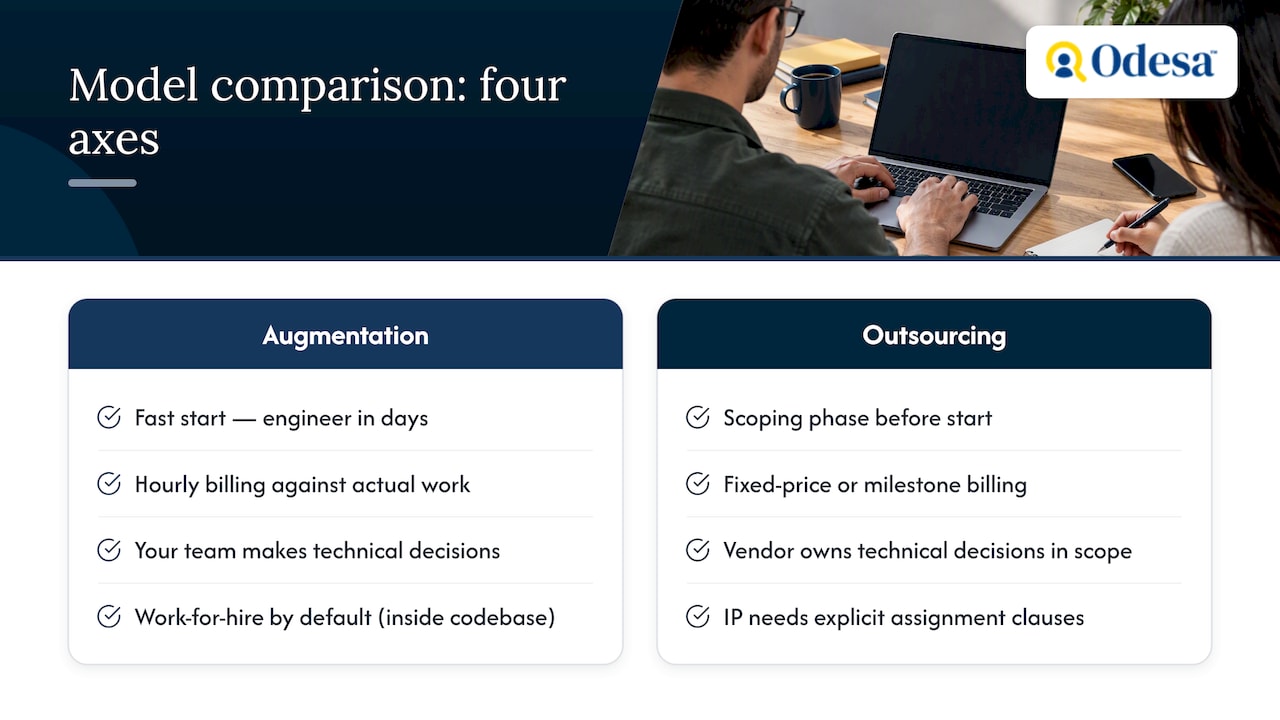
Control follows a similar pattern. With augmentation, your team makes the architecture and process decisions, and the added engineer works inside those decisions. With outsourcing, the vendor usually owns technical decisions within the agreed scope, which is efficient when you trust the vendor’s judgment but limits your ability to redirect mid-project without a change order.
Ownership of deliverables and intellectual property depends entirely on contract language in both models, but the default assumptions differ: augmented staff generally produce work-for-hire that belongs to you by default since they operate inside your codebase and processes, while outsourced work needs explicit IP assignment clauses because the vendor’s own tooling, frameworks, or subcontractors may be involved.
A short-term integration fix with a hard deadline tends to favor outsourcing’s fixed scope, while a multi-year platform where your team needs to understand every architectural decision tends to favor augmentation’s shared control.
When to Use Each Model: Use Cases and Hybrids
Matching the model to the job reduces both cost and risk. Common patterns include:
- Short-term feature work: a single well-defined feature with a clear spec fits outsourcing, since the vendor can own the deliverable end to end.
- MVP or early-stage product: augmentation fits better here because requirements shift quickly and you need engineers embedded in daily decisions, not locked into a fixed scope.
- Long-term platform maintenance: augmentation usually wins, since retaining institutional knowledge of a growing codebase matters more than speed on any single release.
- Non-core services: payment processing integrations, internal tooling, or QA automation often suit outsourcing or white-label development, since these are self-contained and don’t require deep product context.
Hybrid patterns reduce risk on complex programs: outsourcing a well-scoped module (say, a reporting dashboard) while augmenting your core team with a senior engineer who owns integration points between the two. This limits vendor dependency on the parts that matter most to your roadmap while still offloading commodity work.
Onboarding, Integration, and Security Risk
Whichever model you choose, onboarding quality determines whether the engagement actually saves time. A practical checklist:
- Provision access (repos, environments, communication tools) before day one, not during week one.
- Share documentation and architecture context upfront rather than relying on ad hoc explanation.
- Set a communication cadence (daily standups for augmentation, weekly checkpoints for outsourced milestones).
- Define a knowledge transfer plan in writing, especially for outsourced work that will eventually be handed back in-house.
Security deserves the same rigor. NIST’s supply chain risk management guidance treats outsourcing relationships as multi-tier supply chains and recommends due diligence plus detailed technical and security requirements written into the contract, including supplier evidence such as ISO 27001 certification, code-signing practices, and software bills of materials for third-party components.
The median annual wage for software developers in the United States is $131,450, with employment projected to grow substantially from 2024 to 2034, according to the Bureau of Labor Statistics. That growth signals sustained competition for senior engineering talent, which makes deliberate workforce planning, rather than reactive hiring, increasingly worth the effort.
A Decision Checklist for Choosing Between the Two
Work through these questions before signing anything, ideally as part of an RFP or vendor call:
- How much day-to-day control do we need over technical decisions?
- Is our budget better suited to hourly billing or a fixed scope?
- What is our realistic timeline, including ramp-up?
- Do we have spare management bandwidth to run contractors directly?
- Does this work need to leave intellectual property inside our team long-term?
- What SLA metrics (defect rate, uptime, delivery cadence) will we hold the vendor to?
- What security evidence (ISO 27001, SBOMs, test reports) will we require as contract deliverables?
Contract language should assign IP explicitly, specify a knowledge transfer deliverable before project close, and tie payment milestones to measurable SLA metrics rather than vague satisfaction clauses. SHRM’s guidance on integrating contingent workers recommends structured planning and a vendor management system for visibility across both augmented and outsourced engagements.
Pro Tip: Run a 4 to 8 week pilot before committing to a long-term contract of either type. A short pilot surfaces integration friction and hidden costs while the exposure is still small.
The Practical Recommendation
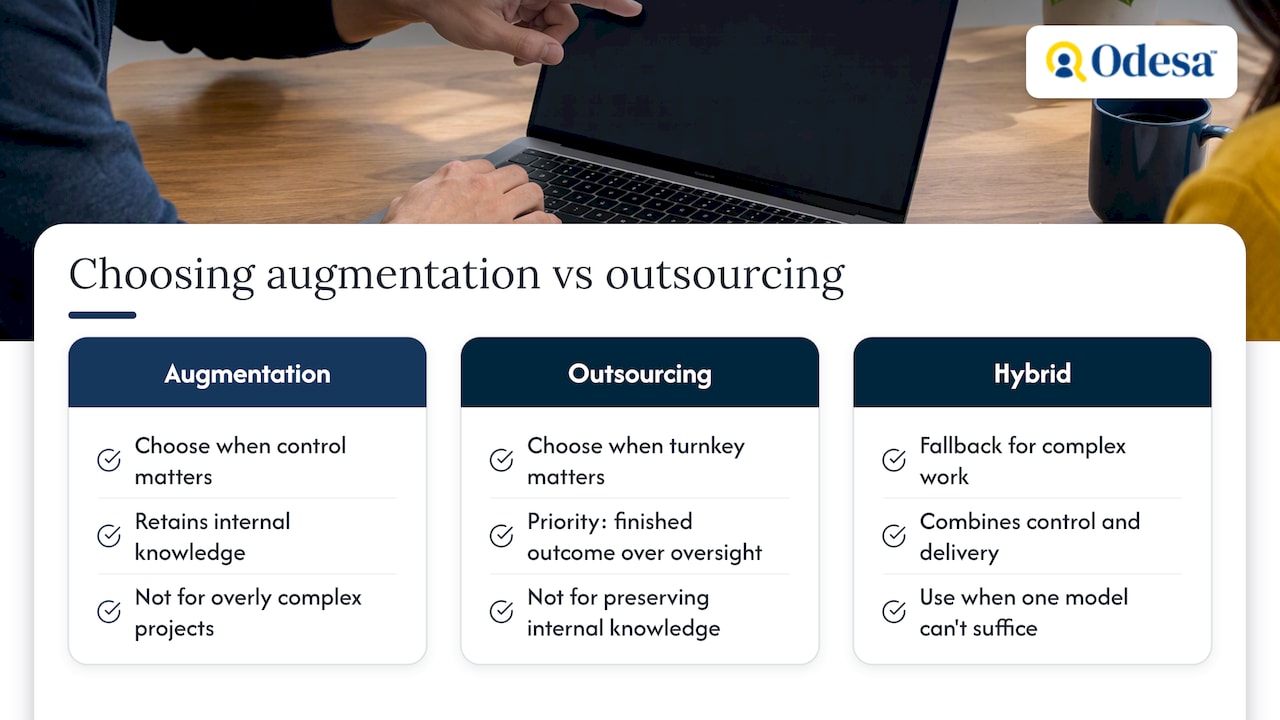
The heuristic holds up well across most engineering decisions: choose staff augmentation when control and retained knowledge matter most, choose outsourcing when a turnkey outcome matters more than oversight, and treat a hybrid as the fallback for anything too complex for a single model.
Immediate next steps: run a short pilot (4 to 8 weeks) before a full commitment, write exit and knowledge-transfer terms into the contract from the start, and define success metrics before work begins rather than after.
An Editorial Note on Matching Senior Engineers
Retention depends less on contract type than on fit. Matching a senior engineer to a specific team’s stack and working style, with direct founder involvement in the process, tends to reduce the ramp-up friction that makes augmentation feel risky in the first place. Case studies and author credentials for this piece are not publicly listed at this time.
— Editorial Team
How Odesa Can Help With Staff Augmentation
If control and retained knowledge are what matter for your current project, staff augmentation is likely your answer, and that happens to be where we focus. We are personally involved in matching engineers to your stack and team culture, rather than handing you a resume list and stepping back.
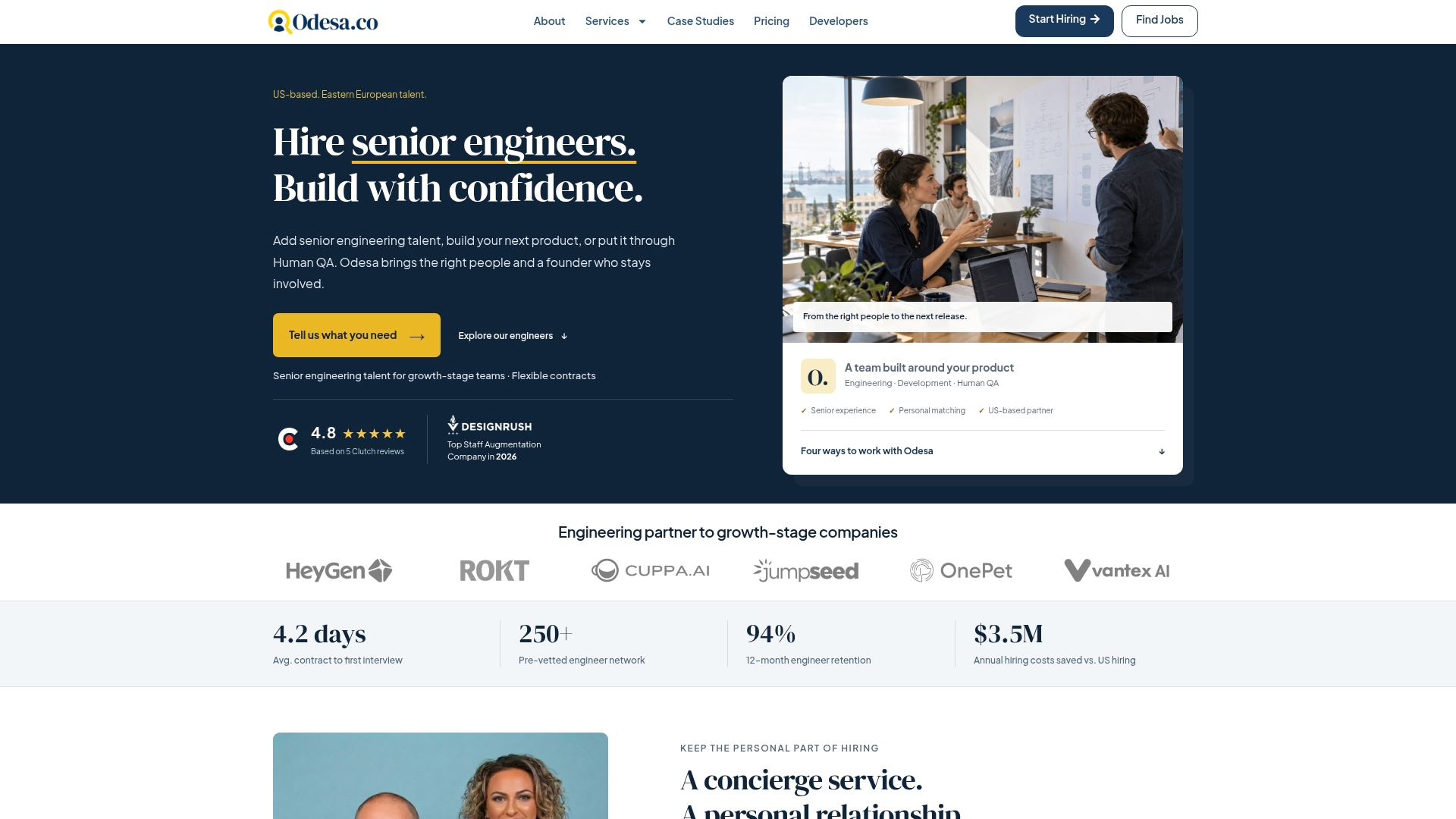
- Senior Eastern European engineers, pre-vetted before they ever reach a client call.
- Transparent hourly rates.
- Short pilot engagements so you can test fit before committing long-term.
- Direct founder involvement in matching, not a sales handoff to account management.
Our staff augmentation service starts from $45 per hour, and we can walk through your specific needs on a call to see whether a pilot makes sense for your team.
FAQ
What is the difference between outsourcing and augmentation?
Staff augmentation adds individual engineers to your existing team under your management, while outsourcing hands a defined deliverable to a vendor who manages the work and is accountable for the outcome. The practical difference shows up in who makes day-to-day technical decisions.
What is the difference between staff augmentation and software outsourcing?
Staff augmentation extends your team’s headcount without transferring ownership of the work, so your processes and standards still apply. Software outsourcing transfers execution to a vendor who typically applies its own methodology and is contractually responsible for the delivered result.
What is the difference between outsourcing and staffing?
“Staffing” usually refers to filling roles, whether through direct hires or augmented contractors who work inside your structure, while outsourcing refers to handing off a function or deliverable entirely. Staffing keeps management inside your company, outsourcing moves it to the vendor.
What is considered staff augmentation?
Staff augmentation covers any arrangement where an external engineer or specialist joins your team temporarily, works under your management, and uses your tools and processes, as opposed to a vendor-managed project. It is commonly used to fill skill gaps quickly without a long-term hire.
Sources
- Software developers, quality assurance analysts, and testers – U.S. Bureau of Labor Statistics
- Cybersecurity Supply Chain Risk Management Practices for Systems and Organizations (NIST SP 800-161r1)
- Contingent workforce management: How to integrate independent experts into core teams – SHRM
Recommended
- Staff Augmentation vs Recruitment: How to Choose
- 7 Toptal Alternatives: Compare Developer Hiring Options
- IT Staff Augmentation | Senior Engineers From $45/hr
- Cost of Hiring a US Software Developer
This article may have used AI tools in the writing process. Facts, figures, and recommendations can be wrong or out of date. Do not treat this as professional advice.