
A reliable software release checklist guarantees that releases are secure, verifiable, observable, and recoverable, covering security and governance, monitoring, ALM readiness, and rollback planning, as outlined in Microsoft’s safe deployment practices. The checklist belongs in your CI/CD pipeline or runbook repository, not in a wiki page nobody opens on launch day. We break down each pillar below with the specific checks engineering and QA teams need before, during, and after a release.
TL;DR:
- Require unit, integration, contract, behavior, and security tests, plus staging validation that mirrors production, before promotion; quarantine flaky tests and review quality signals daily.
- Choose canary releases for high risk changes, blue green deployments when instant rollback matters, and require named approval before expanding each rollout tier.
- Set bake time to include peak traffic on at least one business day, tracking P95 and P99 latency, saturation, and a feature linked KPI.
- Page critical alerts rather than relying on email, and roll back in order, using the least disruptive layer: traffic, application, data, then infrastructure.
- Sign release artifacts, preserve provenance in immutable storage, and log every approval and deployment action under a retention policy that outlasts the release.
Table of Contents
- Core pre-release checklist: what to confirm before you approve a deployment
- Testing and verification gates: what must pass before code reaches production
- Deployment and rollout strategy: progressive exposure and bake time
- Monitoring, observability, and the rollback runbook
- Security, release integrity, and artifact management
- Where to store and maintain the checklist so it stays usable
- When a human release check or outside engineers reduce launch risk
- Get a release audit before your next deployment
- FAQ
- Sources
Core pre-release checklist: what to confirm before you approve a deployment
Before any release gets a green light, a short set of checks separates a controlled deployment from a guess. These checks should be visible to everyone involved in the approval, not buried in one engineer’s head.
- Confirm documented release criteria, sign-off roles, and a named approver are recorded for this specific release.
- Verify automated pipelines are passing and that build artifacts are versioned and archived, following SSDF guidance to secure release files before they ship.
- Check environment parity: environment variables, secrets, and feature flag defaults match what staging validated.
- Confirm dependency integrity and that known vulnerabilities have been patched or accepted with a documented exception.
- Validate the database migration plan, confirm current backups exist, and review capacity for expected post-release load.
Each item here maps to a pillar Microsoft identifies as foundational to a production release checklist: security and governance, monitoring, ALM readiness, and rollback strategy. Skipping one doesn’t just add risk, it removes your ability to answer a basic question during an incident: what changed, and can we prove it was safe when it shipped.
Testing and verification gates: what must pass before code reaches production
A release checklist is only as strong as the gates behind it. Automated suites need clear pass thresholds, not a general sense that “tests look fine.”
- Run unit and integration tests with a required pass rate before merge, not after.
- Run contract and behavior tests against dependent services to catch breaking API changes early.
- Execute smoke tests in a staging environment that mirrors production configuration and data shape.
- Run static and dynamic security scans (SAST/DAST) plus software composition analysis (SCA) on new dependencies.
- Validate staging with shadow traffic or production-like data before promoting the build.
Microsoft’s safe deployment guidance warns against treating these gates as boxes to check once and forget: quality signals should be monitored daily, like a pulse, rather than used only to green-light a single release. Teams that skip this discipline tend to approve releases on stale data.
Pro Tip: Quarantine flaky tests into a separate suite with its own owner, so a single unreliable test never blocks (or silently passes) a release decision.
Deployment and rollout strategy: progressive exposure and bake time
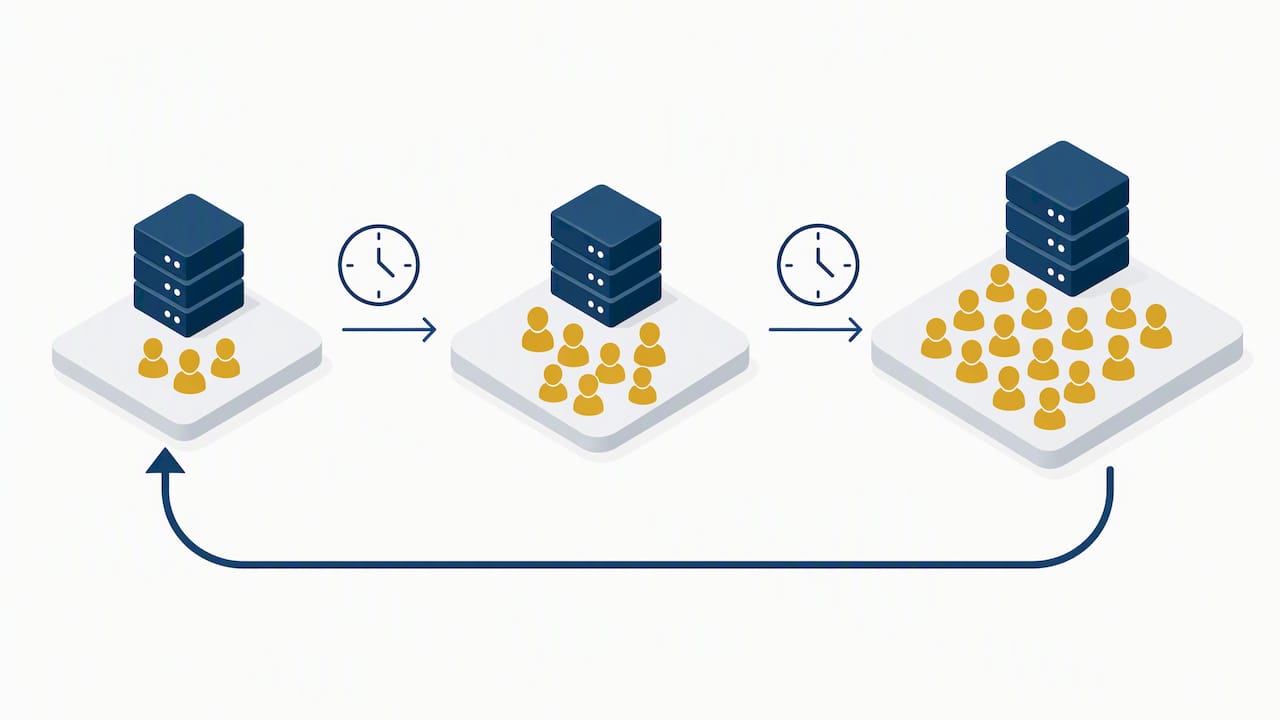
Shipping code and exposing it to users are two different decisions. Canary releases send a small percentage of traffic to the new version first, blue-green deployments run both versions in parallel and switch traffic at once, and tiered rollouts expand access gradually by region or customer segment. Pick the pattern based on blast radius: canary for high-risk changes, blue-green when instant rollback matters most.
Feature flags separate deployment from exposure, which means code can sit live in production, dark, until you’re ready to expose it. Retire flags once a feature is fully rolled out so technical debt doesn’t accumulate.
- Pre-configure traffic routing and health checks before the rollout window opens, not during it.
- Set bake time to cover at least one full business-day peak, since that’s when latent bugs tend to surface.
- Define explicit approval gates for each rollout tier, including who can approve expansion to the next tier.
- Document an emergency hotfix path that bypasses standard gates only with named sign-off.
Monitoring, observability, and the rollback runbook
A release isn’t done when it deploys. It’s done when you’ve confirmed it behaves correctly under real traffic, which requires watching the right signals and having a rollback plan ready before you need it.
- Track error rate, latency at P95 and P99, resource saturation, and at least one business KPI tied to the feature.
- Route critical alerts to paging and incident channels, not email. Email-only alerting lets critical issues sit unacknowledged, while paging converts them into trackable, owned incidents. A tool like Uptime Beacon can confirm failures from multiple locations before paging, which cuts down on false alarms.
- Apply a layered rollback rubric: traffic first, then application, then data, then infrastructure, choosing the least disruptive layer that resolves the failure.
- Follow a fixed runbook sequence: stop new changes, communicate the decision and expected timeline, verify metrics, execute the rollback, then monitor closely.
- Run a post-rollback root cause analysis and update the checklist with whatever gap allowed the issue through.
Google’s SRE team advises curating a launch checklist tailored to your own infrastructure, built from architecture review, capacity planning, and known failure modes, rather than adopting a generic template wholesale. For disaster recovery specifically, backup and restore planning deserves its own tested procedure, not just a checkbox confirming backups exist.
Security, release integrity, and artifact management
Release integrity means you can prove, after the fact, exactly what shipped and who approved it. The SSDF framework recommends verifying dependencies and posting cryptographic hashes for release files so tampering is detectable.
- Verify all dependencies against known vulnerability databases and update anything with an available fix.
- Sign release artifacts and store them with provenance metadata in immutable storage for later forensic review.
- Log every deployment approval and action with a retention policy that survives longer than the release cycle itself.
- Apply role-based access and minimal-permission principles to anyone who can trigger a deployment or rollback.
- Verify backups are immutable and periodically test restores, not just confirm that a backup job completed. Hardening configuration and access controls before release reduces the surface area an attacker or a bad deploy can exploit.
Where to store and maintain the checklist so it stays usable
A checklist that lives outside your delivery pipeline goes stale fast. Store it as code: embedded in pipeline gates, linked from runbook pages, and versioned alongside the services it governs.
- Keep canonical copies in the repo as runbook markdown, with automated checks enforcing what can be enforced.
- Link manual steps directly to the scripts or playbooks that execute them, not to a description of what to do.
- Assign explicit ownership for the checklist itself, with a review cadence tied to each quarter or major release.
- Review and trim items regularly. Google SRE notes that checklist items should be justified by prior incidents, which keeps the list practical instead of bloated.
When a human release check or outside engineers reduce launch risk
Tight timelines, thin QA bandwidth, or a complex migration are the situations where an outside release check earns its cost. A dedicated external review verifies runbook steps, tests with real users, and audits approval gates without the blind spots an internal team can develop after months on the same codebase. Our matching process involves experienced engineers and careful onboarding designed for moments like this.
— Editorial Team
Get a release audit before your next deployment
We run a Human Release Check for teams that want an outside set of eyes on exactly the gaps covered above: ALM readiness, rollback verification, and whether your quality signals are actually being watched or just checked off.

- Our Human Release Check is a one-off engagement built to catch what internal reviews miss before a launch window opens.
- Release Check + Real Users adds live user validation on top of the standard audit for releases carrying more risk.
- Ongoing Human QA works as a recurring engagement for teams that want continuous release coverage rather than a single check.
Engagements run as a fixed-scope check or as ongoing support, whichever matches your release cadence. If your team is stretched thin heading into a major release, request a release audit and we’ll scope it around your checklist.
FAQ
What should a software release checklist always include?
At minimum, it should cover documented release criteria and approvals, passing automated tests, environment and dependency verification, a rollout plan with defined gates, and a rollback runbook. Microsoft’s safe deployment guidance frames these as four pillars: security and governance, monitoring, ALM readiness, and rollback strategy.
How long should bake time last before full rollout?
Bake time should generally span enough time to cover typical usage patterns, including periods where latent bugs and edge-case traffic patterns tend to surface, according to Microsoft’s feature flag guidance. Shorter windows risk promoting a release before real usage patterns have tested it.
What’s the right order for executing a rollback?
A layered approach works best: start with traffic-level changes, then application rollback, then data restoration, then infrastructure, using the least disruptive layer that resolves the issue, as described in Microsoft’s rollback strategy guidance. The runbook sequence should stop new changes, communicate the decision, verify metrics, execute the rollback, and then monitor closely.
Should every team use the same release checklist template?
No single template fits every infrastructure, since checklist items need to reflect your own architecture, dependencies, and prior incidents. Chainguard’s overview of the SSDF and Google’s SRE guidance both emphasize tailoring the checklist rather than copying a generic list.
When does it make sense to bring in outside help for a release?
External help tends to pay off when timelines are tight, QA bandwidth is limited, or a migration adds unusual complexity to the rollout. A focused outside review can verify runbook steps and test gates without the blind spots that build up inside a team working on the same system for months.
Sources
- Safe deployment practices – Microsoft Learn
- NIST Special Publication 800-218, Secure Software Development Framework (SSDF)
- Reliable product launches — Google SRE book
Recommended
- 5 Offshore Development Risks and How to Reduce Them
- How to Manage Offshore Developers Without Micromanaging
- Why Remote Developer Hiring Fails and How to Fix It
This article may have used AI tools in the writing process. Facts, figures, and recommendations can be wrong or out of date. Do not treat this as professional advice.