
Onboarding to a legacy codebase works when you treat it as a structured program, not a reading assignment. Give the new engineer a map of the system, a safe way to make small changes, a named mentor, and a first-month plan that widens from orientation to ownership. Skip any of these and the usual result follows: a slow first month, a risky first big change, or an engineer who quietly stops touching the hard parts.
This guide is written for engineering leads, founders and project managers who are bringing someone new into code that nobody fully understands anymore. It also helps the engineer on the receiving end.
TL;DR
- Define “legacy” by risk, not age: code you cannot change with confidence, usually because tests and context are missing.
- Start with a map of the system and a working local environment before any ticket work.
- Pin down current behavior with characterization tests before refactoring anything.
- Pair the new engineer with a mentor. Documentation alone does not transfer the reasons behind the code.
- Use a 30-day arc: orient, locate, understand intent, then own a small change end to end.
Table of Contents
- What legacy code means for onboarding
- Why onboarding stalls on legacy systems
- Before day one: what the team should prepare
- A 30-day onboarding plan
- Characterization tests: make changes safe before making them
- Mentoring is part of the system
- Deciding what to fix, and what to leave
- Common mistakes to avoid
- When to bring in outside senior engineers
- Our perspective
- Getting senior help for a legacy codebase
- FAQ
- Sources
What legacy code means for onboarding
Michael Feathers’ widely cited definition, summarized in Martin Fowler’s discussion of mocking tools, centers on code without tests rather than code that is old. That framing is useful for onboarding. A ten-year-old service with a solid test suite is easy to join. A two-year-old service written fast by a departed contractor may be far harder.
For a new engineer, legacy code usually means some combination of:
- No automated tests, or tests nobody trusts.
- Missing or stale documentation.
- Original authors gone, so the reasons behind odd decisions are lost.
- Dependencies between modules, databases and services that are not written down anywhere.
- Production traffic that makes every mistake expensive.
The fourth and fifth points explain why onboarding here differs from joining a clean greenfield project. The cost of a wrong guess is higher, and the information needed to avoid it is scattered.
Why onboarding stalls on legacy systems
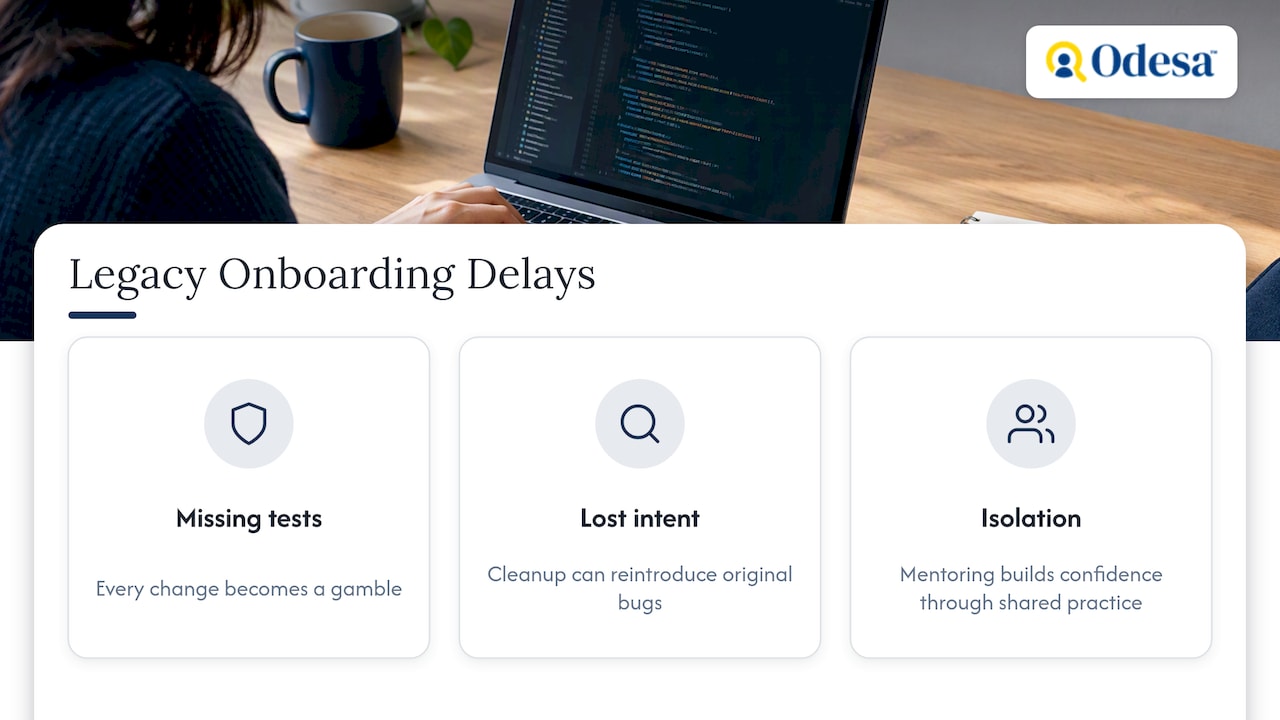
The obstacle is rarely raw difficulty. Three patterns cause most delays.
No safety net. Without tests, every change is a gamble, so careful engineers slow down and less careful ones break things. Neither outcome is what you hired for.
Lost intent. An odd workaround may be a deliberate fix for a real bug. An engineer without that context tends to “clean it up” and reintroduce the original problem. One onboarding guide from a code-intelligence vendor makes the same point: recovering intent is what turns a fast first commit into a safe one.
Isolation. Onboarding to a legacy system is a social challenge as much as a technical one. Research on how Google trains new engineers, a case study of apprenticeship-style learning, emphasizes mentoring in shared coding practices so newcomers build confidence instead of working alone.
Before day one: what the team should prepare
A new engineer’s first week goes far better when the team has done a small amount of preparation. None of it needs weeks of work.
- A working environment recipe. One command, or a short checklist, that gets the application running locally. If this takes more than a day, fix it before anything else. It is the best single investment in onboarding.
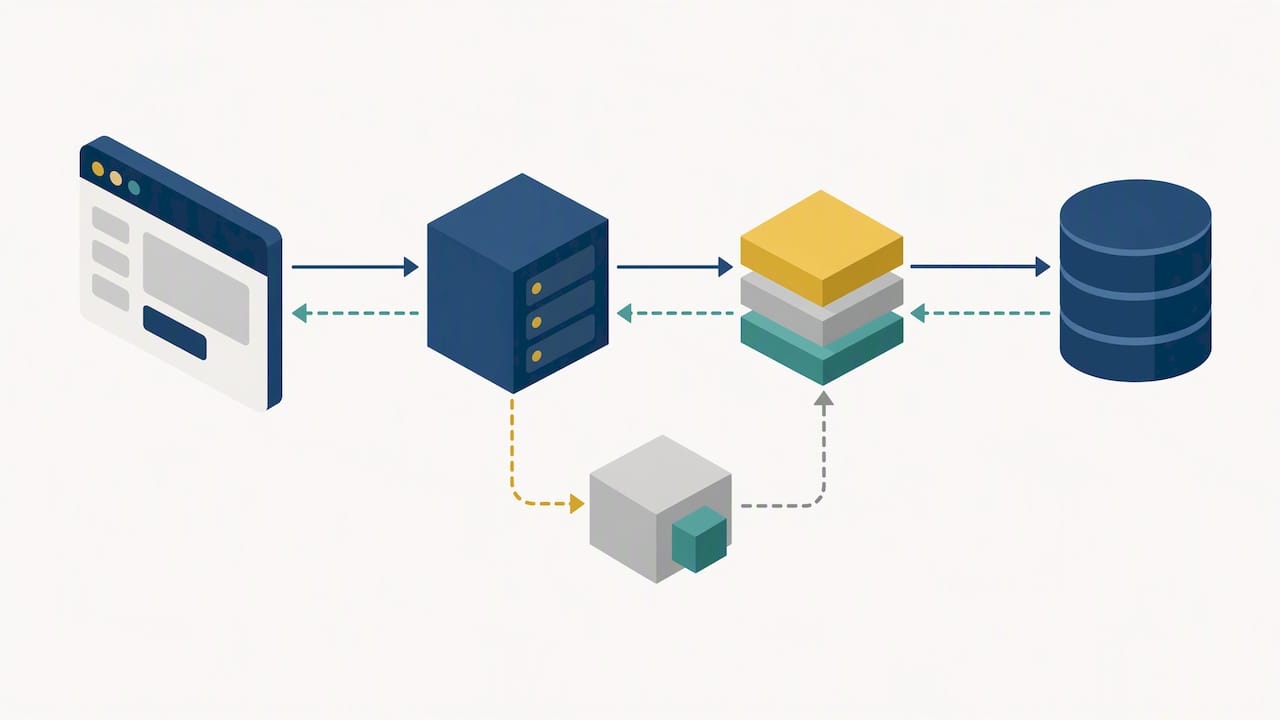
- A system inventory. A list of applications, databases, queues and external services, with the dependencies between them. Microsoft’s modernization guidance recommends starting with a comprehensive inventory of the digital estate and mapping dependencies, and the same exercise serves onboarding. A rough diagram drawn in an hour beats none.
- A list of known hazards. Modules people avoid, jobs that must not run twice, tables that are read by other teams. This is often held only in one person’s head.
- A named mentor with protected time. Not “ask anyone.” One person, with hours blocked in their calendar for the first month.
- A first ticket that is small, real and low risk. Real, so the engineer learns the deployment path. Small, so a mistake is cheap.
A 30-day onboarding plan
Ramp-up works best as a widening spiral: orient broadly, then go deep only where the engineer’s work lands. Adjust the days to your team, but keep the order.
| Window | Goal | What the engineer does | What the team provides |
|---|---|---|---|
| Days 1 to 3 | Orient | Run the app locally, read the system diagram, trace one request end to end | Environment recipe, inventory, mentor walkthrough |
| Days 4 to 10 | Locate | Find the modules a first ticket touches, read tests and logs, ask questions | Hazard list, a small first ticket |
| Days 11 to 20 | Understand intent | Read history, tickets and old pull requests for the code to be changed; write characterization tests | Access to people who remember context |
| Days 21 to 30 | Own a change | Ship a small change through review, release and monitoring | Review within a day, a release partner |
Days 1 to 3: trace one real path
Pick a single user action, such as placing an order or resetting a password, and follow it from the interface to the database and back. This teaches more about structure than reading directories. The mentor should be present for the first trace, since this is where undocumented dependencies surface.
Days 4 to 10: read the tests, then the logs
Where tests exist, they are one of the quickest ways to learn what the code is supposed to do. Where they do not, production logs and error reports show what it actually does. Ask the engineer to keep a running list of questions and review it with the mentor daily. Questions that nobody can answer are valuable: they mark the places where knowledge has been lost.
Days 11 to 20: recover intent and add tests
Before changing a module, read its version history and the tickets linked to it. Then write tests that describe current behavior. The next section covers how.
Days 21 to 30: ship something
A merged, released and monitored change is the real end of onboarding. It proves the environment, the review process, the deployment path and the engineer’s understanding all work.
Characterization tests: make changes safe before making them
If a legacy system has no automated tests, refactoring is a risk, not an improvement. A characterization test does not assert what the code should do. As Sourcegraph’s modernization guide explains, it pins down what the code currently does, quirks included, so any change in observable behavior shows up immediately.
A practical pattern for a new engineer:
- Choose the slice of code the first ticket will change.
- Run it with realistic inputs and capture the outputs.
- Turn those captures into tests that fail when the output changes.
- Make the change, and review every test failure to decide whether it is intended.
This also acts as documentation. A test named after a surprising behavior tells the next engineer more than a paragraph of prose.
Where AI tools help, and where they do not
AI assistants and modern mocking tools can speed up the first pass. Birgitta Böckeler’s article on onboarding to a legacy codebase with AI help explores how they can identify relevant files and explain snippets. The limits matter, though. Treat generated characterization tests as a bridge to proper refactoring, not a replacement for it. If the tools are used to patch over messy architecture indefinitely, the team ends up avoiding the structural fixes it needs. Deep object hierarchies and dependencies across repositories are also where human mentors still explain more than a tool can.
Mentoring is part of the system
Technical documentation transfers facts. A mentor transfers judgment: which module is fragile, which reviewer cares about what, why a strange pattern exists. The Google apprenticeship research mentioned above describes this as new engineers learning through gradual participation in real work alongside experienced colleagues.
In practice, that means:
- A short daily check-in during week one, then twice a week.
- Pairing on the first change, with the newcomer at the keyboard.
- Code review that explains the reasoning, not only the corrections.
- Encouraging questions in public channels so answers become searchable.
For remote or distributed teams, the same principles apply, with more deliberate scheduling. Our guide on managing offshore developers without micromanaging covers the rhythms that work across time zones.
Deciding what to fix, and what to leave
New engineers often arrive with a strong urge to rewrite. Resist it as a default. Martin Fowler describes the Strangler Fig pattern as an incremental alternative: build new functionality as separate components and migrate pieces gradually instead of attempting a large-scale rewrite. Validating each migrated piece requires establishing feature parity, which in turn depends on the automated tests you started building in onboarding.
To decide where to invest, use evidence rather than opinion. A large-scale Google study of over 1,200 projects, on architectural complexity and maintenance burden, found that higher complexity, measured by propagation cost and structural anti-patterns, is associated with more code spent on bug fixing than on features. Its conclusion is that tracking these metrics is a more objective basis for refactoring decisions than team sentiment alone.
There is a productivity argument too. Google’s research on what improves developer productivity found a causal link between code quality and individual productivity. That supports giving the team time to improve the code it works in every week, a little at a time.
Common mistakes to avoid
- Starting with a rewrite. It delays value and discards the behavior the old system encodes.
- Handing over a wiki link and calling it onboarding. Stale documents mislead as often as they help.
- Giving the hardest module first. Build confidence with a contained change.
- Measuring speed by lines or tickets. Measure by changes shipped safely and questions answered.
- Leaving knowledge in one head. If the only person who understands billing is also the mentor, you have a bus-factor problem. Record what the newcomer learns.
When to bring in outside senior engineers
Some legacy systems are too large or too risky for a team that is already at capacity. Signs that outside help is worth considering:
- Your in-house engineers are spending most of their time on maintenance and cannot mentor.
- The people who understood the system have left and no one can reconstruct it quickly.
- You need to add tests, document the system and ship features at the same time.
Senior engineers are the right profile for this work because they can read unfamiliar code, form a map without hand-holding and write the tests that make later changes safe. If you are weighing options, our comparison of staff augmentation and recruitment explains which model fits which situation, and the guide to hiring remote developers covers screening and integration.
Our perspective
We place senior, pre-vetted Eastern European engineers with growth-stage companies, and a large share of those placements land in code the client did not write or no longer fully understands. From that experience, we hold three views.
First, the match matters more than the résumé. An engineer who is patient with unfamiliar code and comfortable asking questions will outperform a faster coder who needs clean structure. That is why our founder is personally involved in matching, so we can understand your codebase, your team and your constraints before proposing anyone.
Second, onboarding is a shared responsibility. We recommend that clients name a mentor and prepare the environment recipe, just as we would expect of any new in-house hire. The companies that do this see engineers contributing sooner.
Third, tests come before ambition. A new engineer’s first useful contribution is often not a feature but the characterization tests that make the next ten features safer.
— Editorial Team
Getting senior help for a legacy codebase
If you need an experienced engineer to work inside an existing system, our staff augmentation service starts from $45 per hour, with engineers integrated into your team and tools. If you would rather hire someone permanently, our tech recruitment service is $7,999 one-off per successful hire. Either way, you talk to our founder first, so the person we propose fits your code and your team.
FAQ
How long does it take a new engineer to become productive in a legacy codebase?
It varies with system size, test coverage and mentor availability, so any fixed number would be a guess. A reasonable target is a small change shipped to production within the first 30 days, as in the plan above. Larger ownership usually follows once the engineer has written tests for the areas they work in.
Should new engineers refactor legacy code right away?
No. First add characterization tests around the code that will change, then refactor in small steps. Incremental approaches such as the Strangler Fig pattern reduce risk compared with a large rewrite.
Can AI tools handle legacy code onboarding on their own?
They help with finding files, explaining snippets and drafting first-pass tests. They are weaker on deep hierarchies and cross-repository dependencies, and generated tests should lead to real refactoring, not replace it. A human mentor remains the best source for intent and context.
What should be documented first?
Start with the local setup steps, a diagram of the main components and their dependencies, and a list of known hazards. These three items remove most early blockers. Add more only when a real question shows a gap.
Sources
- Modern Mocking Tools and Black Magic, Martin Fowler
- Onboarding to a legacy codebase with the help of AI, Martin Fowler
- Strangler Fig, Martin Fowler
- Learning to be a software engineer in a complex organization, Google Research
- Understanding Architectural Complexity, Maintenance Burden, and Developer Sentiment, Google Research
- What Improves Developer Productivity at Google? Code Quality, Google Research
- Make an inventory and collect data, Microsoft Learn
- Legacy Code Modernization: A Practical Guide for Engineering Teams, Sourcegraph
- Onboard Engineers Faster on Any Codebase, Repowise
Recommended
This article may have used AI tools in the writing process. Facts, figures, and recommendations can be wrong or out of date. Do not treat this as professional advice.