
To evaluate a developer well, define the job first, then measure candidates against it with the same exercises, the same questions and the same scoring rubric. Add a realistic work sample, test how they communicate, and keep judging after the hire with several metrics rather than one. This guide covers both stages: choosing the right person, and confirming over the first months that the choice was right.
TL;DR
- Write a scorecard before you meet anyone: 4 to 6 outcomes the role must deliver, each with a clear definition of strong and weak.
- Use a work sample that resembles the real job, and a structured interview where every candidate gets the same questions, scored on the same scale.
- Evaluate communication and judgment as seriously as syntax. Senior engineers are paid for decisions, not typing speed.
- Never judge a developer on one number such as commits or lines of code. Use a balanced set that includes how the developer experiences the work.
- Any test you use is your legal responsibility, even if a vendor sold it to you. Tie every exercise to the duties of the job.
Table of Contents
- Start with a scorecard, not a résumé
- A step-by-step process to evaluate software engineers
- What strong and weak signals look like
- Keep your evaluation fair and legally sound
- Evaluate developers after you hire them
- Our perspective: evaluating for fit, not just skill
- When you would rather not run the process yourself
- FAQ
- Sources
Start with a scorecard, not a résumé
Most weak developer evaluations fail before the first interview. The team has a vague picture (“a strong senior backend person”) and each interviewer silently applies a different definition. The result is a debrief where one person says “great culture fit,” another says “not deep enough,” and nobody can point to evidence.
A scorecard fixes this. For each role, write down:
- Outcomes for the first 6 to 12 months. For example: “Own the billing service migration,” or “Reduce p95 API latency on the checkout path.”
- Technical competencies tied to those outcomes. Name the actual stack and the actual problems, not a generic list of languages.
- Working-style competencies. Written communication, handling ambiguity, giving and receiving code review, working across time zones.
- A 1 to 4 scale with anchors. Describe what a 1 and a 4 look like for each competency, so scores mean the same thing across interviewers.
Keep it short. If the scorecard has fifteen lines, interviewers will skim it. Five or six well-defined lines get used.
If you are hiring for a specific stack, a checklist written for that role helps you set the technical anchors. Our founder’s checklist for hiring a senior React developer is one example of turning a role into concrete criteria.
A step-by-step process to evaluate software engineers
The steps below run from cheapest to most expensive for both sides. Each stage should remove candidates who clearly do not meet the scorecard, so that the expensive stages are spent on a short list.
1. Screen the background for evidence, not keywords
Read the résumé and any public work (repositories, talks, writing, portfolio) looking for evidence of the outcomes on your scorecard. Ask yourself three questions:
- Has this person owned something end to end, or only contributed tickets?
- Is the scope of past work comparable to what you need, in team size, traffic, or system complexity?
- Is there a pattern of staying long enough to see the consequences of their own decisions?
A long list of technologies tells you little. A short description of a system they built, what broke, and what they changed tells you a lot. A brief screening call can confirm this. For a full process at this stage, see our practical guide to technical screening for developers.
2. Use a work sample that looks like the job
The closest predictor of on-the-job behavior is doing a slice of the job. Good work samples share a few traits:
- They are bounded. Aim for 60 to 90 minutes of candidate time. Anything much longer filters for people with free evenings, not for the best engineers, and strong senior candidates with several options will simply decline.
- They resemble real work. Review a pull request with three planted problems, extend a small API, debug a failing test suite, or sketch a migration plan. Avoid puzzle questions that you would never face at work.
- They have a rubric. Decide before the exercise what a strong result includes: correctness, tests, naming, handling of edge cases, and the trade-offs the candidate explains.
- They are the same for everyone. Changing the exercise per candidate makes comparison impossible.
For live formats, published coding interview rubrics commonly score areas such as communication, problem solving, technical competency and testing. These are a useful starting point for your own scorecard, adapted to your stack.
One point that is often overlooked: candidates should know what you are assessing. Microsoft Research on technical interviews found that candidates often misjudge which criteria interviewers actually use, and that companies do better by sharing assessment rubrics and being clear about the skills and design trade-offs they expect to see. A clear brief gives you a truer signal because you are measuring ability, not the ability to guess the format.
3. Run a structured interview
An unstructured conversation rewards confident talkers and people who resemble the interviewer. A structured interview does the opposite: every candidate gets the same predetermined questions in the same order, and answers are scored against consistent standards. The U.S. Office of Personnel Management describes structured interviews as an assessment method for measuring job-related competencies that are hard to assess otherwise, including interpersonal skills and problem-solving behavior. Academic work on the topic, including a narrative and quantitative review of the structured interview literature, examines how structure reduces bias.
For developers, use two kinds of questions:
- Behavioral: “Tell me about a production incident you were responsible for. What did you do in the first hour, and what did you change afterward?”
- Situational: “A product manager asks you to ship in two weeks something you estimate at six. Walk me through what you do.”
Score each answer immediately, on the 1 to 4 scale, before discussing with other interviewers. This prevents the loudest voice in the debrief from setting everyone’s view. If you want a bank of questions and a way to practice scoring, our page on senior developer interview questions with a mock scoring exercise is built for that.
4. Test design judgment and code review
For senior roles, the most revealing hour is often not coding at all. Give the candidate a small system design problem drawn from your own product, or a real (sanitized) pull request, and ask them to talk through it.
Listen for:
- Questions about requirements and constraints before proposing a solution.
- Explicit trade-offs (“this is simpler but won’t scale past X; here is when I’d revisit it”).
- Feedback that is specific and kind, not vague or dismissive.
- Willingness to say “I don’t know, here is how I’d find out.”
These behaviors predict how a senior engineer will influence your team far better than their ability to recall an algorithm. Research on hiring pipelines supports taking the process seriously: a study of what went right and wrong in technical interviews describes how multi-stage pipelines can be “leaky,” losing qualified candidates along the way.
5. Evaluate communication and remote readiness
If the developer will work remotely or across time zones, communication is part of the technical skill. Test it directly:
- Ask for a short written explanation of a technical decision, as an email or a design note. Written clarity is hard to fake and matters daily in distributed teams.
- Check that the candidate can state overlap hours, response expectations and preferred tools without prompting.
- Observe how they handle a vague requirement. Do they clarify, or guess?
Many remote hires that fail do so for process reasons rather than skill reasons. Our write-up on why remote developer hiring fails and how to fix it covers the common patterns.
6. Check references with specific questions
Generic reference calls produce generic praise. Ask specific, scorecard-linked questions: “What was the hardest technical decision this person led? How did they handle disagreement in code review? Would you put them on your most critical project?” Ask about what they would need from a manager to do their best work. The answers feed directly into your onboarding plan.
7. Decide with the scorecard
Gather the independent scores, compare them against the anchors, and discuss only where interviewers differ by two points or more. Hire against the scorecard, not against the feeling in the room. If two finalists tie, pick the one whose gaps are easiest to coach.
What strong and weak signals look like
| Area | Strong signal | Weak signal |
|---|---|---|
| Ownership | Describes systems they ran in production, including failures | Only lists features or tickets completed |
| Problem solving | Clarifies the problem, states trade-offs, tests assumptions | Jumps to code, defends the first idea |
| Code quality | Readable, tested, handles edge cases | Works only on the happy path |
| Code review | Specific, constructive comments | Style nitpicks only, or no comments |
| Communication | Clear written summaries, asks good questions | Vague answers, avoids saying “I don’t know” |
| Judgment | Pushes back on scope with reasons, offers options | Agrees to everything or refuses without alternatives |
Use this as a calibration aid for your scorecard anchors, not as a replacement for them.
Keep your evaluation fair and legally sound
If you hire in the United States, your selection tools carry legal weight. The EEOC’s guidance on employment tests and selection procedures places responsibility for the validity of a selection tool on the employer, including tools purchased from a vendor. If a procedure disproportionately excludes a protected group, the employer must be able to show it is job-related and consistent with business necessity.
In practice:
- Tie each exercise and question to a duty listed in the job description.
- Be careful with automated screening and scoring tools. The same EEOC guidance matters for tools that rely on correlations rather than clear links to job duties, so ask any vendor how the tool was validated and keep that documentation.
- Apply the same process to every candidate, and record the scores and the reasons.
This is general information, not legal advice. If you plan to use automated scoring or a new assessment at scale, have your employment counsel review it before launch.
Evaluate developers after you hire them
Evaluation does not end at the offer. The first months determine whether the hire works, and a structured start gives you real evidence. A practical read on this period is available in this piece on technical leadership in the first 90 days, which is useful when you define what an engineer should show in their first quarter.
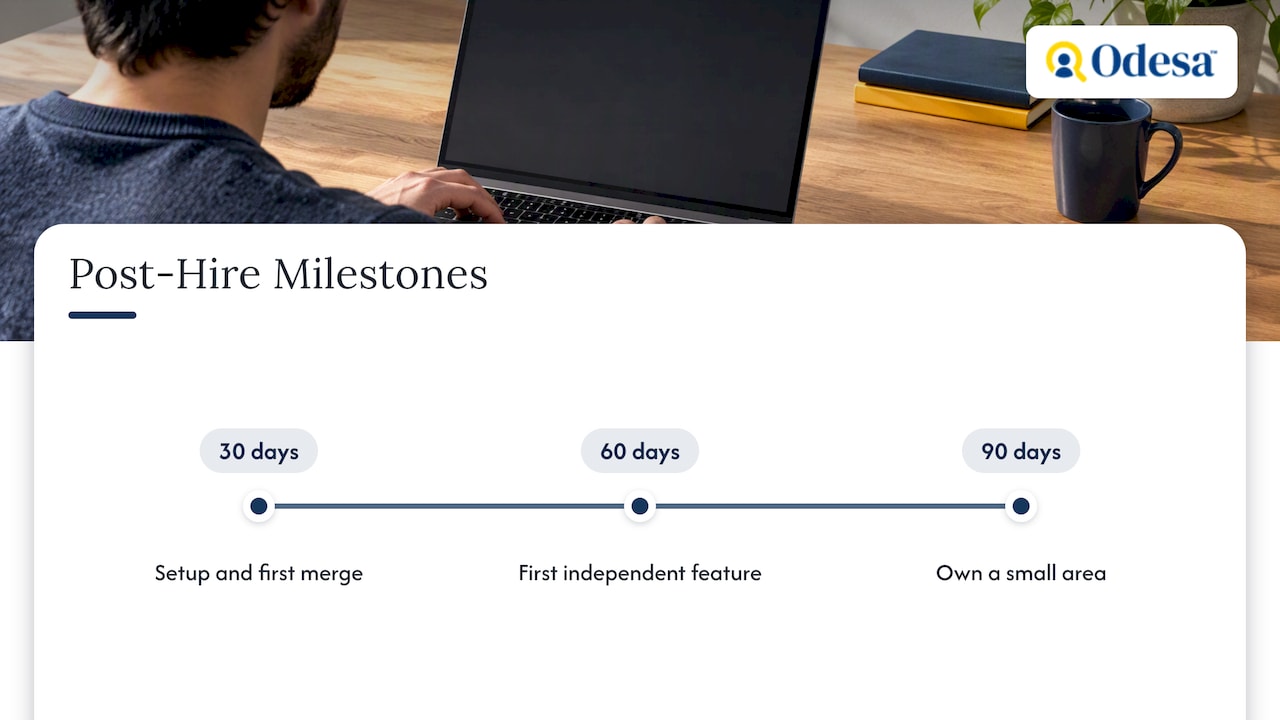
Set 30, 60 and 90 day expectations taken from the scorecard: environment set up and first merged change, first independent feature, then ownership of a small area. Review them in a short, regular one-on-one.
Avoid single-number measurement
Commit counts, pull request counts and lines of code are tempting because they are easy to pull from your tools. They are also easy to game and poorly related to value. The SPACE framework states that developer productivity cannot be captured by a single metric or dimension. It covers satisfaction and well-being, performance, activity, communication and collaboration, and efficiency and flow.
A later paper in the ACM, EngThrive, makes the same point: productivity is multidimensional, and managers should look at several metrics in tension, such as pull request merge time next to survey data on developer experience. Likewise, DORA’s measurement research says that delivery measures such as deployment frequency and change failure rate should be combined with human-centered measures like satisfaction, flow and cognitive load.
For a small team, a workable set is:
- Delivery: cycle time from first commit to production, and change failure rate.
- Quality: escaped defects, and review feedback trends.
- Collaboration: time to first review on others’ pull requests, and quality of written updates.
- Experience: a short quarterly survey on blockers, tooling and focus time.
Track team-level trends first. Use individual numbers only as conversation starters, never as a ranking.
Our perspective: evaluating for fit, not just skill
We place senior engineers from Eastern Europe with growth-stage companies, and we have noticed that most hiring mistakes come from vague criteria rather than from a shortage of talent. A candidate who is technically sound but does not match the team’s pace, communication habits or ownership expectations will struggle, however good the résumé.
This is why matching at Odesa starts with a direct conversation between our founder and the client about what the team needs: the stack, the stage of the product, the working hours and the kind of person who will thrive. Candidates are pre-vetted before they reach you, so your own evaluation can concentrate on fit with your team and your problems rather than on basic screening.
Our advice to any hiring manager, whether or not they work with us: write the scorecard, keep the process consistent, and treat the first 90 days as part of the evaluation. A short, well-run process beats a long, improvised one.
— Editorial Team
When you would rather not run the process yourself
Running a full evaluation takes engineering time that many growth-stage teams do not have. If you need senior engineers quickly, our staff augmentation service starts from $45 per hour and places pre-vetted engineers into your team. If you prefer a permanent hire, our tech recruitment service is $7,999 one-off per successful hire. Not sure which model suits you? Our comparison of staff augmentation vs recruitment walks through the decision.
FAQ
How long should a developer evaluation process take?
For most roles, two to four weeks from first screen to offer is workable, with three to four stages: a screen, a work sample, a structured interview and a final conversation. The candidate time commitment should total a few hours, not days. Strong senior candidates often have several processes running at once, so slow or sprawling pipelines lose them.
Are take-home tests or live coding better?
Neither wins in every case. A short, bounded take-home gives candidates time to think and shows their normal working style, while live sessions show how they reason and communicate. Many teams use a short work sample followed by a live discussion of the candidate’s own solution, which tests both. Whichever you choose, keep it job-related and identical across candidates.
Can I evaluate a developer if I am not technical?
Yes, with preparation. Use a scorecard, a structured interview and a work sample that a technical advisor has reviewed and scored. You can personally judge communication, ownership and reliability, which are a large part of senior performance. For the technical depth, ask a trusted engineer to review the work sample against your rubric.
What metrics should I use for developers already on my team?
Use a balanced set instead of one number. Combine delivery measures such as cycle time and change failure rate with quality, collaboration and a short developer experience survey. Frameworks like SPACE and DORA both recommend including human-centered measures alongside system metrics.
Sources
- Structured Interviews, U.S. Office of Personnel Management
- The Tech-Talk Balance, Microsoft Research
- Employment Tests and Selection Procedures, U.S. EEOC
- The SPACE of Developer Productivity, ACM Queue
- EngThrive, ACM
- DORA measurement frameworks
- The Structured Employment Interview, Personnel Psychology
- Debugging Hiring, NSF Public Access Repository
- How candidates are evaluated in coding interviews, Tech Interview Handbook
Recommended
- Hiring a Senior React Developer: A Founder’s Checklist
- Technical Screening for Developers: A Practical Guide
- How to Hire Remote Developers: A Practical Guide
This article may have used AI tools in the writing process. Facts, figures, and recommendations can be wrong or out of date. Do not treat this as professional advice.