
Choose staff augmentation when you need execution capacity under your own management. Choose consulting when you need an external party to define, own, and deliver an outcome. The trade-off is simple: augmentation costs less per hour but demands more of your internal management time, while consulting costs more but transfers delivery risk to the vendor. The decision framework below walks through both paths in detail.
TL;DR:
- Augmented engineers can become productive within one to three weeks, but only when a manager assigns work and provides access and context.
- Consulting usually begins with discovery, so appoint an empowered sponsor and define measurable acceptance criteria before work starts; unclear scope can undermine fixed price protection.
- Compare total costs, not vendor rates with employee wages: augmentation adds onboarding and management time, while both models can incur rework and handoff costs.
- When scaling a team while redesigning a system, let consultants own architecture decisions and augmented staff execute the backlog, with clear decision rights.
- Before committing long term, require a trial period, a knowledge transfer plan, and written replacement terms for underperforming staff.
Table of Contents
- 1. What do staff augmentation and consulting actually mean?
- 2. Key differences between the two models
- 3. Comparing total cost, not just the hourly rate
- 4. Governance, onboarding, and who manages what day to day
- 5. How to decide between staff augmentation and consulting
- 6. How we approach staff augmentation for tech teams
- 7. Weighing the benefits and drawbacks of each model
- Choosing for long-term capability versus short-term delivery
- How Odesa fits into the augmentation decision
- FAQ
- Sources
1. What do staff augmentation and consulting actually mean?
Staff augmentation places individual specialists inside your existing team, under your direction. You set the priorities, run the sprints, and assign the daily tasks. The engineer, designer, or analyst you bring in works as an extension of your own workforce, usually billed hourly or as a flat monthly rate per person. Odesa offers staff augmentation from $45/hr on month-to-month contracts. According to PMI’s guidance on managing external and internal consultants, this model embeds named specialists in the client’s existing team, with the client directing priorities and daily work.
Consulting works differently. A consulting firm takes a defined problem, often documented in a statement of work, and owns the plan to solve it. The firm supplies its own methodology, project leadership, and deliverable, and typically carries more of the delivery risk and outcome accountability than an augmented team member would. Payment structures reflect that shift: fixed-price, milestone-based, or outcome-based fees are common once scope is clear.
The operational difference shows up fast in practice:
- A staff augmentation engineer joins your daily standup, takes tickets from your backlog, and reports to your engineering manager.
- A consulting team runs its own internal workflow, delivers against milestones in the SOW, and reports progress to a project sponsor rather than taking line-item direction.
Picture two scenarios. A product team needs three backend engineers for six months to clear a feature backlog ahead of a funding round. That is staff augmentation: the team already knows what to build, and the gap is hands, not direction. Now picture a company that needs to redesign its data architecture but has no internal team capable of scoping that work. That is a consulting engagement: the gap is judgment and ownership, not just labor.
2. Key differences between the two models
The two models split along a handful of decision axes, and each one changes how a project manager should structure governance.
- Control versus accountability. With augmentation, you control priorities and are accountable for results. With consulting, the vendor controls the approach and is contractually accountable for the outcome.
- Scope flexibility. Augmented teams can be redirected daily as priorities shift. Consulting scope is fixed once the SOW is signed, so changes typically trigger a change order.
- Team composition. Augmentation adds named individuals who fit into your existing roles. Consulting brings a structured team (often a partner, a lead, and juniors) assembled around the problem, not your org chart.
- Governance cadence. Augmentation runs on your existing rituals: standups, sprint reviews, one-on-ones. Consulting runs on its own cadence of steering committees and milestone reviews, which your stakeholders must still attend.
- Security and IP exposure. Augmented staff typically work inside your systems and under your access controls. Consulting firms may need broader access to diagnose a problem, which raises questions about data handling and IP ownership that should be addressed in the contract before work starts.
The PMI resource on managing external and internal consultants identifies expectation and organizational-context conflicts as a frequent source of friction when consultants sit outside your culture; success depends on stakeholder alignment and explicit authority for the consultant. That single distinction, who controls day-to-day work versus who owns the outcome, is the practical dividing line project managers can use when designing contracts and assigning acceptance criteria.
Pro Tip: Write the control-versus-accountability split into the contract explicitly, not just into your mental model of the relationship.
3. Comparing total cost, not just the hourly rate
Hourly rates make augmentation look cheap and fixed-price consulting look expensive, but that comparison misses the line items that actually determine total cost.
Augmentation billing usually runs per engineer, per hour or per month, sometimes with a ramp period or minimum retainer. Consulting billing runs fixed-price or milestone-based when scope is well understood, or time-and-materials during an initial discovery phase when scope is still being defined. The GAO’s guidance on performance-based service contracting makes a point worth sitting with: a fixed price does not eliminate your risk if scope and acceptance criteria are unclear. GAO recommends specifying measurable outputs and acceptance criteria for outcome-based contracts rather than assuming a flat fee covers everything.
Several costs rarely show up on the initial quote:
- Onboarding time, since even a strong engineer needs days to weeks to learn your codebase and tooling.
- Internal management hours, which augmentation consumes at a higher rate than consulting because you own the planning.
- Rework from unclear requirements on either model.
- Vendor coordination overhead when running augmentation and consulting side by side.
- Transition costs at the end of an engagement, including documentation and handoff.
Vendor bill rates are not the same thing as employee wages, and comparing them directly produces misleading math. BLS occupational wage data report median hourly wages for employees in a given industry, but a vendor’s bill rate also bakes in recruiting, benefits, margin, tooling, and compliance costs that an employee wage figure never captures. Treating a staffing quote as directly comparable to a salary benchmark, without adjusting for those layers, is one of the more common budgeting mistakes project managers make when comparing the true cost of hiring a developer against an external bill rate.
4. Governance, onboarding, and who manages what day to day
Each model shifts a different set of responsibilities onto your side of the table, and underestimating that shift is where many engagements go sideways.
For staff augmentation to work, you need to supply active planning, regular code or work reviews, and some mentoring for anyone new to your stack. Without a manager who can assign real work on day one, an augmented engineer sits idle or improvises, which defeats the purpose of hiring for speed.
Consulting shifts the burden to sponsorship rather than daily management, often supported by consulting and managed IT services that provide strategic technology guidance. You still need a sponsor empowered to make decisions, a stakeholder group that shows up to milestone reviews, and clear agreement on what “done” looks like before the first invoice. PMI’s project management guidance for consultants recommends phasing consulting work through define, design, pilot, and transition stages, each with its own governance checkpoint, specifically to avoid the common failure of starting execution before acceptance criteria are even testable.
Ramp-up times differ too: augmented engineers often become productive within one to three weeks once access and context are in place, while consulting engagements typically spend the first phase entirely on discovery before any delivery work begins.
- Augmentation failure mode: no internal owner, which leaves the engineer directionless.
- Consulting failure mode: no empowered sponsor, which stalls decisions at every milestone.
- Shared failure mode: skipping a trial period or pilot phase before committing to a longer contract.
5. How to decide between staff augmentation and consulting
A short checklist turns this decision from a gut call into something you can defend to a budget owner.
- Is the scope already clear? If your team can write the tickets today, augmentation fits. If you need someone else to define the problem first, lean consulting.
- Do you have internal delivery leadership? Augmentation requires a manager who can direct the work daily. Without one, augmented hires underperform regardless of their skill.
- Do you need outcome ownership transferred? When you need a vendor contractually on the hook for a result, consulting’s structure supports that. Augmentation does not transfer that risk.
- How much risk can you tolerate? Higher-risk, ambiguous problems favor consulting’s structured governance. Lower-risk, well-defined backlogs favor augmentation’s speed and lower cost.
Three quick scenarios: a startup clearing a well-scoped backlog before a demo day should hire augmentation and watch for vendors who push for a long minimum commitment before proving fit. A company replatforming a core system with no internal architecture lead should hire consulting and watch for vague acceptance criteria in the SOW. A company doing both, scaling a team while also redesigning a system, often runs the two in parallel, with consulting owning the architecture decisions and augmentation executing the resulting backlog.
Whichever model you choose, request these items in the contract: acceptance criteria stated as measurable outputs, a defined knowledge-transfer plan, a trial period before long-term commitment, a replacement SLA if a staffed individual does not work out, and performance triggers that let you exit cleanly. Steve Jobs’s 1992 remarks on consultants are worth weighing here: he criticized consultants who recommend without owning implementation, arguing that people who do not implement their own ideas cannot learn from the results. That is a reason to contract specifically for implementation support and documented knowledge transfer whenever durable internal capability matters, through paired work sessions, recorded runbooks, or a transition sprint at the end of the engagement.
Pro Tip: Ask any consulting vendor to name the specific knowledge-transfer artifact they will hand over before the engagement ends, not just the final deliverable.
6. How we approach staff augmentation for tech teams
We built our matching process around one constraint: a mismatched engineer costs a growth-stage team far more than a slow search does. Our founder is directly involved in understanding what a client actually needs before any engineer is proposed, rather than handing that judgment to an account manager working from a list of available resumes. Engineers come from a pre-vetted network of senior talent based in Eastern Europe, and engagement terms stay flexible enough to shift between augmentation, direct recruitment, or custom development as a project’s needs change.
Whichever provider you evaluate, run these checks before signing anything:
- Ask for a trial period with the specific engineer, not a generic “we’ll find someone similar” guarantee.
- Request references from clients with a comparable team size and stack.
- Clarify what happens if a placed engineer leaves or underperforms, and get any retention or replacement commitment in writing.
- Confirm who manages day-to-day direction once the engineer starts, since that responsibility stays with you in an augmentation model.
7. Weighing the benefits and drawbacks of each model
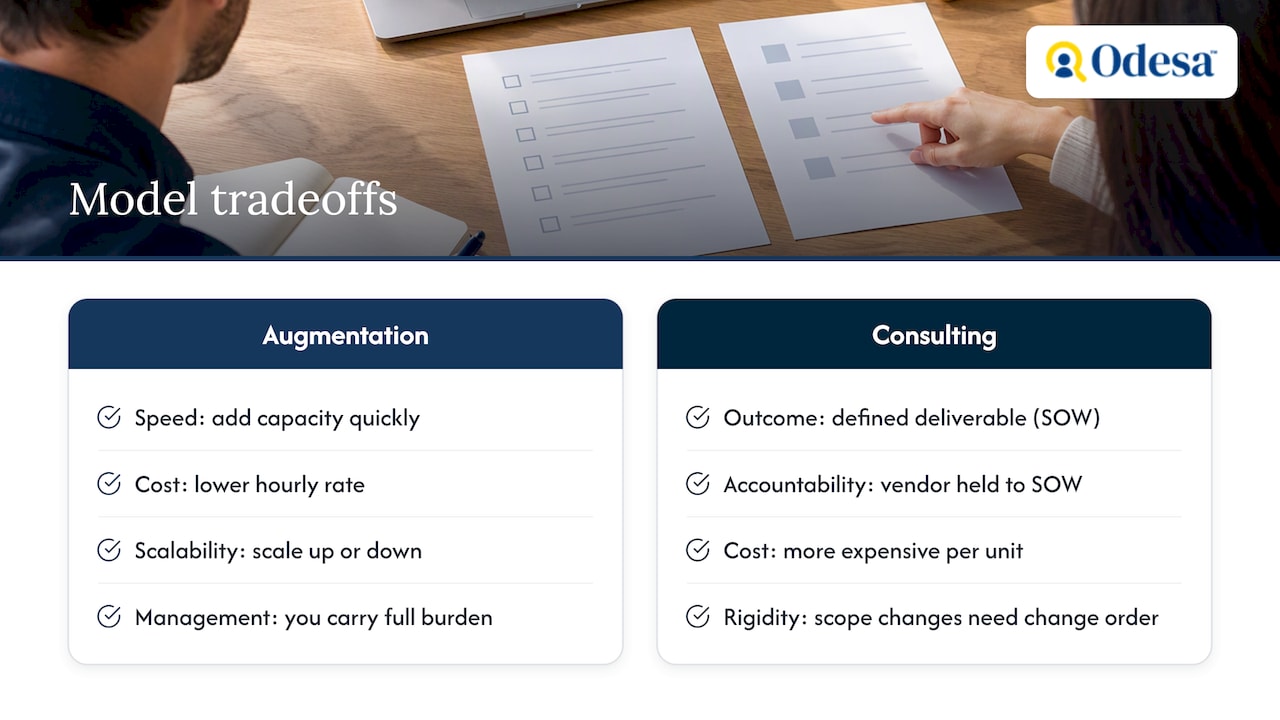
Staff augmentation’s main advantage is speed and cost control: you add capacity quickly at an hourly rate lower than hiring a full-time employee, and you can scale the team up or down as priorities shift. The drawback is that you carry the full management burden, and results depend heavily on how well you direct the work.
Consulting’s main advantage is risk transfer: you are buying a defined outcome, and a well-structured SOW holds the vendor accountable for delivering it. The drawback is cost and rigidity. Consulting is typically more expensive per unit of work, and changing scope mid-engagement usually means a change order and a delay. Neither model is better in the abstract. Each one solves a different problem, and picking the wrong one for your situation is what generates most of the complaints you see about either approach.
Choosing for long-term capability versus short-term delivery
We tend to recommend augmentation for growth-stage teams that already know what they are building and simply need more hands to build it, which describes most of the clients we work with. Consulting earns its higher price when the real gap is judgment, not labor, and when no one internally can own that judgment yet.
The caution worth considering: consulting cannot substitute for internal ownership if you never build a transition plan. A firm that leaves without a documented handoff leaves you right back where you started once the contract ends.
How Odesa fits into the augmentation decision
If the checklist above points you toward staff augmentation, a suitable model involves matching senior, pre-vetted Eastern European engineers to growth-stage teams, with founder involvement in understanding your stack and team dynamics before proposing candidates, and flexible engagement terms to extend into direct recruitment or custom development if your needs shift later.
Review our staff augmentation service details and book an introductory call or request a trial engineer to see the fit before committing to a longer engagement.
FAQ
What did Steve Jobs say about consultants?
Steve Jobs argued that consultants who recommend a course of action without owning its implementation miss the chance to learn from the results, a point he made in a 1992 talk resurfaced by MIT Sloan. His comment is a useful caution for buyers, not a blanket case against consulting: it points toward contracting for implementation support and real knowledge transfer when long-term capability matters.
Is staff augmentation considered outsourcing?
Staff augmentation sits inside the broader category of outsourcing but works differently from most outsourced projects. The augmented worker reports into your management structure and takes direction from your team daily, while typical outsourcing hands an entire scope of work to an outside party to manage independently.
What is the difference between staffing and consulting?
Staffing, or staff augmentation, supplies individuals who work under your direction on tasks you define. Consulting supplies a firm that defines the problem, owns the approach, and delivers a specific outcome under its own management, usually against milestones agreed in a statement of work.
Is it better to work as an employee or a consultant in IT?
The answer depends on what you value: employees typically get more stability and deeper integration into one company’s systems and culture, while consultants often see a wider range of problems and command higher rates in exchange for less job security. Neither path is objectively better; the right choice depends on your risk tolerance and career goals.
Sources
- Challenges – Managing External and Internal Consultants (PMI)
- Contract Management: Guidance Needed for Using Performance-Based Service Contracting (GAO)
- Steve Jobs talks consultants, hiring, and leaving Apple in unearthed 1992 talk (MIT Sloan)
- Occupational Employment and Wage Statistics (BLS)
Recommended
- Direct Hire vs Contract: An Employer Checklist and a Third Path
- Hire Ukrainian Developers: Talent Pool, Time Zones, Rates and Continuity
Reviewed by Val Narodetsky, founder of Odesa.co.