
The team extension model adds external engineers to your existing software team. They work inside your tools, follow your priorities and report to your managers, while a partner company handles sourcing, vetting, employment and payroll. You keep control of the product, the architecture and the code. The partner supplies capacity.
This guide covers what the model includes, what it costs, where it fails, and how to set up an extended development team so it behaves like part of your company. It is written for founders, engineering leads and project managers at US growth-stage companies.
TL;DR
- Team extension means external engineers join your team and work under your management. It is not outsourcing, where a vendor owns delivery.
- It suits companies that already have technical leadership and a delivery process but lack senior capacity or a specific skill.
- Compare the contract rate with the fully loaded cost of a US hire, not with salary alone. Management time on your side is a real cost.
- Access control, code review and offboarding should be written into the contract before the first commit.
- It is the wrong choice if nobody on your side can own the product and make decisions.
Table of Contents
- What the team extension model actually is
- Team extension compared with other engagement models
- When team extension makes sense
- When it is the wrong call
- What team extension costs
- The five-step implementation framework
- Security and access: the part founders defer
- Our perspective
- Choosing the right Odesa engagement
- FAQ
- Sources
What the team extension model actually is
In a team extension, you define the roles, interview or approve the engineers, and direct their daily work. The partner company employs them, handles contracts and payroll in their country, and replaces people when a match does not work. The engineers join your standups, your repository, your ticket board and your chat.
Three features separate it from other arrangements:
- You manage the work. Priorities, architecture decisions and acceptance criteria stay with your team.
- The engineers are individuals, not a black-box team. You know who writes which code and can talk to them directly.
- The commitment is flexible. You add or remove people as the roadmap changes, within the terms of the contract.
Many providers use “staff augmentation” and “team extension” for nearly the same thing. When a distinction is drawn, team extension stresses long-term integration and continuity, while basic staff augmentation can mean filling a short gap. If you want the contracting detail, our guide to IT staff augmentation and how to plan it goes through it step by step.
Team extension compared with other engagement models
The right model depends on who owns delivery and how much management capacity you have in-house.
| Model | Who manages daily work | Who owns delivery | Best fit |
|---|---|---|---|
| Team extension / staff augmentation | Your managers | You | You have tech leadership and need senior capacity |
| Dedicated team | Often a vendor lead, with your input | Shared | You want a self-contained squad with less management load |
| Project outsourcing | The vendor | The vendor | A scoped deliverable with a clear spec |
| Direct hire (recruitment) | You, as employer | You | A permanent role you want on your payroll |
Two of these comparisons come up most often. If you are deciding between renting capacity and hiring permanently, read staff augmentation vs recruitment. If the question is whether to hand over delivery entirely, seven questions on staff augmentation or outsourcing will help you decide. For the squad-style alternative, see when a dedicated development team fits and what it costs.
When team extension makes sense
The model pays off in a few recurring situations:
- You have a roadmap and not enough senior hands. Your architect and product owner exist, and the backlog is growing faster than you can hire.
- You need a skill for a defined period. Examples include a Rust performance engineer, a .NET migration specialist or a React Native developer for a mobile launch.
- Hiring locally is slow. A US search can take months, and a partner with a pre-vetted bench shortens the front end of that process.
- You want to test before committing. Contract capacity lets you validate a team shape before adding permanent headcount.
- QA is a bottleneck. Release testing is easier to extend than to hire for, because the workload is lumpy.
The conditions behind all five are the same: someone on your side knows what “done” means and has time to review the work.
When it is the wrong call
Adding people does not by itself make delivery more predictable. A June 2021 GAO review of major Department of Defense IT programs found officials struggling with hiring, with the move to Agile and with technical environments, and 20 of the 29 programs reported cost or schedule changes since January 2019. Staffing was one problem among several. Requirements and governance were others, and extra headcount fixes only the first.
Skip team extension, or fix the basics first, if:
- Nobody owns the product. If requirements change weekly with no decision-maker, additional engineers amplify the churn.
- You have no review process. Without code review and a definition of done, quality depends entirely on each individual.
- You want to delegate and forget. If you need a vendor to run the project end to end, outsourcing or a managed service is the more honest fit. Our comparison of staff augmentation and managed services lays out the difference.
- The need is a single, fixed deliverable. A scoped project with a fixed price may be cheaper than open-ended hourly capacity.
What team extension costs
The cost question has two sides: the price of the contract and the cost of what you would otherwise do.
The US employment baseline. The US Bureau of Labor Statistics reports that software developers earned a median of $135,980 per year in May 2025, and software quality assurance analysts and testers a median of $104,300. The same data puts the 10th-to-90th percentile range for developers at $82,460 to $214,670. These are employee wages. They exclude benefits, payroll administration, equipment, recruiting time and the management hours each hire consumes, so a fair comparison adds those items. We break them down in our guide to the cost of hiring a US software developer.
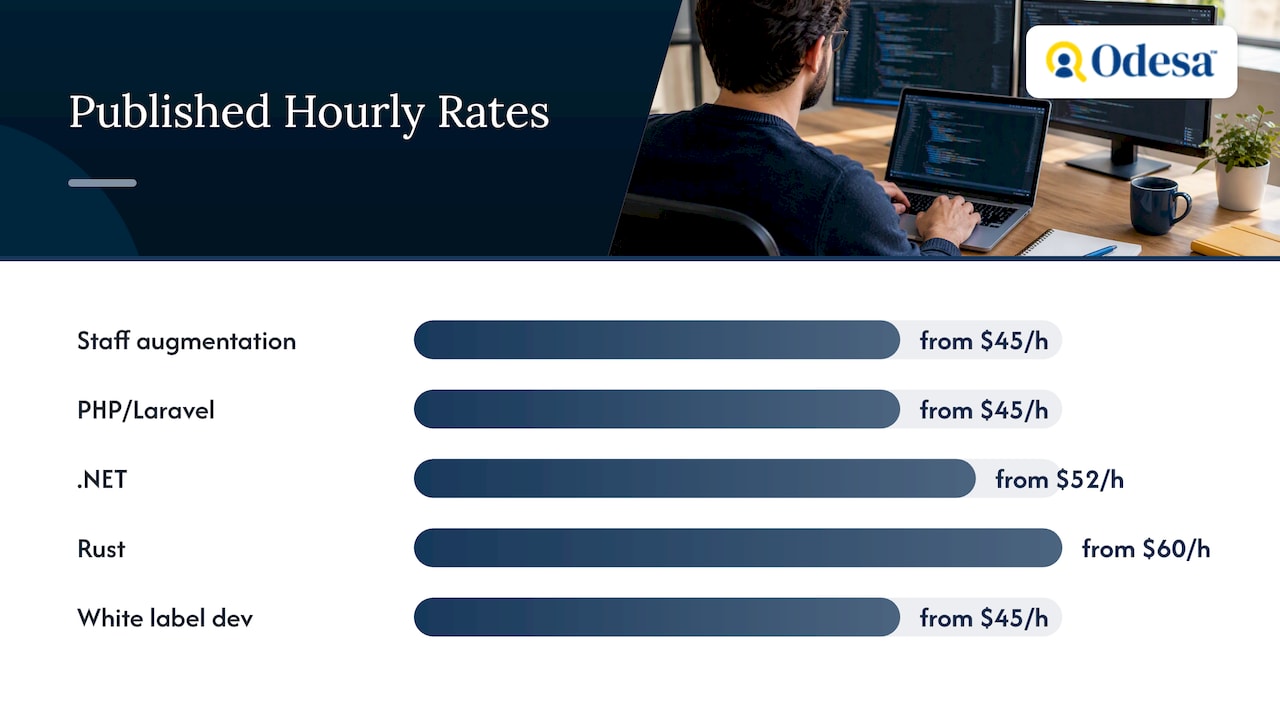
The extension side. Contract prices vary by country, seniority and stack. Ours are published:
| Service | Published price |
|---|---|
| Staff augmentation | from $45 per hour |
| Tech recruitment | $7,999 one-off per successful hire |
| Human Release Check | $1,500 one-off |
| Release Check + Real Users | from $2,500 one-off |
| Ongoing Human QA | from $3,500 per month |
| White Label Development | from $45 per hour |
Specific stacks carry their own starting rates on our pages, for example senior PHP and Laravel developers from $45 per hour, .NET from $52 per hour and Rust from $60 per hour.
A headline rate is only half the picture. When you compare quotes from any provider, ask each one:
- Is the rate per engineer, and what seniority does it assume?
- What is the minimum term and the notice period?
- What happens if a match does not work: replacement time and cost?
- What is the conversion fee if you later want to hire the engineer directly?
- Who pays for tooling, licenses and test devices?
The savings we describe to clients, up to 53% against local hiring costs, depend on role, seniority and your own overhead, so run your numbers rather than trusting any single percentage.
The five-step implementation framework
Most failed extensions fail in the first month, not the sixth. This sequence keeps the early weeks under control.
1. Define the role and the owner
Write a one-page brief: the problem, the stack, the seniority, the expected outcome after 90 days, and the named person who will manage the engineer. The GAO findings point the same way. Appoint an internal product or engineering owner and define decision rights before anyone is onboarded.
2. Match and interview
A good partner shortlists a small number of candidates against your brief. Interview them as you would an employee: a technical conversation, a look at past work and a check on communication. English fluency and time-zone overlap matter as much as raw skill. Eastern European engineers typically overlap with the US East Coast for part of the working day, so agree the overlap window up front.
3. Set up access deliberately
Grant the minimum permissions needed for the first tasks and widen them as trust and need grow. The security section below explains why this deserves its own checklist.
4. Onboard like a hire
Give the engineer a first-week plan, a buddy, a starter ticket and access to the people who explain the product. Remote onboarding works better when communication norms are written down. If your team is distributed, this guide to asynchronous project management for remote teams is a practical reference for documenting handoffs and decisions so an extended engineer is not waiting on a call to unblock.
5. Review at 30, 60 and 90 days
Check delivery against the brief, code review feedback and team fit. Decide whether to continue, expand, swap or convert to a direct hire. Short feedback loops are the main protection against a slow mismatch.
Security and access: the part founders defer
The risk in extended teams is rarely geography. It is uncontrolled access and weak oversight of suppliers. GAO’s work on contractors lists unauthorized access, weak controls, poor patch management, inadequate separation of duties and insufficient oversight as recurring problems, and GAO-14-612 on contractor controls specifically names off-site contractor operations and customized software development as areas needing oversight. The evidence comes from government agencies, but the control principles carry over to a private startup.
GAO’s earlier report on oversight of contractor access to systems and data adds the point that third-party code can contain unauthorized features. Treat external engineers as part of your technology supply chain, an idea GAO sets out in its IT supply chain threats blog. Vendor selection, access design, monitoring and offboarding are operational controls, not paperwork for later.
For a practical baseline, NIST’s Secure Software Development Framework (SP 800-218) groups practices into four areas: preparing the organization, protecting the software, producing well-secured software and responding to vulnerabilities. NIST notes that security practices have to be added to the lifecycle you actually use, so a label is not enough. NIST’s third-party SSDF guidance adds that security requirements for external providers should be defined, included in contracts, backed by evidence where appropriate, and reviewed when exceptions are granted.
Turned into a contract and onboarding checklist:
- Least-privilege access to repositories, cloud accounts and customer data, with production access granted separately.
- Mandatory code review by someone on your team for every merge.
- Logging of access and a named contact for incident notification.
- Written ownership of all deliverables and assignment of intellectual property to your company.
- A same-day offboarding procedure: revoke accounts, rotate shared secrets, collect devices or confirm deletion.
- A list of agreed exceptions, reviewed on a schedule.
We cover this from the vendor side in offshore development risks and secure vendor access.
Our perspective
We place senior Eastern European engineers with US and international growth-stage teams, and the pattern we see is consistent: the model succeeds or fails on integration, not on engineering talent. A strong engineer given no context, no owner and no feedback performs below a mediocre one who is part of the team’s routine.
That is why matching is personal at Odesa. The founder speaks with you directly about your stack, your team’s culture and the problem the engineer will solve, and only then do we propose candidates. We would rather send two well-fitted profiles than ten loosely matched ones. Retention matters for the same reason: an extended engineer who stays for years carries context that no onboarding document can replace.
Our advice is also to be honest about the alternatives. If you want a permanent teammate on your payroll, direct recruitment is the better route. If you want a fixed deliverable, scoped development fits. Extension is right when you have leadership, a roadmap and a gap in capacity.
— Editorial Team
Choosing the right Odesa engagement
If the model fits your situation, three of our services map onto it directly:
- Staff augmentation, from $45 per hour, for senior engineers who join your team under your management.
- Tech recruitment, at $7,999 per successful hire, when you want the engineer on your own payroll.
- Human QA, from a $1,500 one-off Human Release Check, to extend testing capacity before a release.
Agencies that need delivery capacity under their own brand can look at white label development. To discuss a role, start from odesa.co and describe your stack and team.
FAQ
What is the difference between team extension and a dedicated development team?
In team extension, your managers direct the engineers day to day and you own delivery. In a dedicated team, the vendor typically supplies a self-contained group, often with its own lead, and shares more of the delivery responsibility. Extension gives you more control and more management work. A dedicated team gives you more delivery support and less direct oversight.
What does “extended team” mean?
An extended team is the group of external engineers who work as part of your in-house team through a partner company. They use your tools, join your meetings and follow your processes. The partner remains their employer for contracts, payroll and replacement.
Is team extension the same as staff augmentation?
In practice the two overlap heavily, and many providers use them interchangeably. Where a distinction is made, team extension emphasizes long-term integration and continuity, while staff augmentation can include short-term gap filling. Check the contract terms, not the label.
Can I hire an extended engineer permanently later?
Often yes, but the terms vary by provider, so ask about conversion fees and notice periods before you sign. If you already know you want a permanent employee, direct recruitment avoids the question from the start.
Sources
- U.S. Bureau of Labor Statistics: Software Developers, Quality Assurance Analysts, and Testers
- U.S. GAO: Software Development, DOD Faces Risks and Challenges (GAO-21-351)
- U.S. GAO: Agencies Need to Improve Oversight of Contractor Controls (GAO-14-612)
- U.S. GAO: Improving Oversight of Access to Federal Systems and Data by Contractors (GAO-05-362)
- U.S. GAO: Risky Business, Threats in the IT Supply Chain
- NIST SP 800-218, Secure Software Development Framework Version 1.1
- NIST NCCoE DevSecOps, Appendix C SSDF Analysis
Recommended
- Staff Augmentation vs Managed Services: Key Differences
- Staff Augmentation vs Recruitment: How to Choose
- Dedicated Development Team: When It Fits and What It Costs
- 7 Questions to Choose Staff Augmentation or Outsourcing for Engineering
This article may have used AI tools in the writing process. Facts, figures, and recommendations can be wrong or out of date. Do not treat this as professional advice.