
A knowledge transfer plan is a structured document that identifies who holds mission-critical knowledge, what that knowledge covers, how it will move to the next person, when the handover happens, and how success is measured. The first action for a manager facing an upcoming departure or reorganization is to draft a one-page prioritized checklist naming the two or three most critical knowledge areas at risk. Everything else in the plan builds from that list.
TL;DR:
- Knowledge transfer plans should prioritize and document high-criticality knowledge areas using scoring systems to focus efforts effectively.
- Capturing tacit knowledge requires socialization methods like shadowing and paired work, especially for judgment-heavy or safety-critical roles.
- Implementation should follow a structured, multi-stage process spanning identification, capture, sharing, and validation over six to eight weeks.
- Regular validation, documentation review, and structured overlap periods enhance the likelihood of successful handovers, with longer overlaps advised for high-risk roles.
- Leadership must explicitly allocate resources and protected time for knowledge transfer, integrating it into routine workflows rather than treating it as a one-off exercise.
Table of Contents
- Checklist and template fields every KT plan must have
- The four stages of knowledge transfer and what to do in each
- A step-by-step workflow to run a KT plan from kickoff to handover
- Methods to capture and transfer tacit and explicit knowledge
- Tools, templates, and documentation patterns that keep knowledge usable
- How to measure success: KPIs, validation checks, and continuous improvement
- Roles, responsibilities, and a sample timeline for handover
- Practitioner notes: embedding knowledge transfer in the flow of work
- Editorial perspective: what leadership actually has to commit to
- Authoritative reports and templates to read next
- Cover a knowledge gap while your plan is still in motion
- Sources
- FAQ
Checklist and template fields every KT plan must have
A workable knowledge transfer plan fits on one or two pages before it grows into supporting documents. The fields below cover what most plans need, drawn from practices that industry guidance recommends for succession and continuity work.
- Scope: the role, project, or function the plan covers.
- Critical knowledge areas: the specific processes, systems, or relationships at risk.
- SME name and contact: the departing or transferring expert, with backup contact details.
- Recipient(s): who inherits the knowledge, named individually rather than “the team.”
- Transfer method(s): interviews, shadowing, documentation, recorded sessions.
- Timeline and milestones: start date, checkpoints, and final handover date.
- Documentation owner: whoever is responsible for writing things down and keeping them current.
- Validation steps: how the organization confirms the recipient can actually do the work.
- Archive and maintenance date: when the documentation gets reviewed again.
Not every knowledge area deserves equal attention. A simple heatmap that plots criticality against documentation gap helps managers decide where to spend limited time: a process that’s both mission-critical and undocumented sits at the top of the list, while something low-risk and already written down can wait.
- List every knowledge area tied to the departing role.
- Score each one on criticality (business impact if lost) and documentation gap (how little exists in writing).
- Prioritize anything scoring high on both before spending time on lower-risk items.
For roles where overlap isn’t possible, a minimum viable version still works: a continuity book compiled before the person leaves, covering troubleshooting heuristics, key contacts, recurring problems, and recent decisions. Pair that with 30/60/90 day checkpoints after handover to confirm the recipient is retaining and applying what they learned, not just nodding along in meetings.
Pro Tip: Build the checklist template once, store it centrally, and reuse it for every transition instead of rebuilding it each time someone leaves.
The four stages of knowledge transfer and what to do in each
Most knowledge transfer frameworks break the process into four stages: identify, capture, share, and apply. Treating these as sequential checkpoints, rather than a single event, keeps a plan from collapsing into a rushed handover memo written the week before someone’s last day.
- Identify: map who holds knowledge that would hurt the organization if lost, and flag gaps where only one person understands a system or relationship.
- Capture: turn tacit expertise into something reviewable, through interviews, recorded walkthroughs, or structured documentation.
- Share: move that captured knowledge to the recipient through training sessions, paired work, or guided practice, not just a shared folder link.
- Apply: confirm the recipient can perform the task independently, through supervised trials or a defined test assignment.
A leadership transition might spend most of its time in identify and share, since much of an executive’s knowledge lives in relationships and judgment calls rather than written procedures. An engineering handover often weighs heavier on capture, given the volume of code, architecture decisions, and deployment quirks that need recording. Operations roles frequently need more time in apply, since process compliance and safety-critical steps require observed, hands-on verification before sign-off.
A step-by-step workflow to run a KT plan from kickoff to handover
Running a knowledge transfer plan works best as a sequence, not a single meeting. The steps below map to a typical six to eight week window, though the timeline compresses or stretches depending on role complexity.
- Kickoff and scoping: hold a brief stakeholder meeting to confirm scope, assign the plan owner, and build the criticality heatmap described earlier. This is also when you identify risk: what happens if the transfer fails or runs out of time.
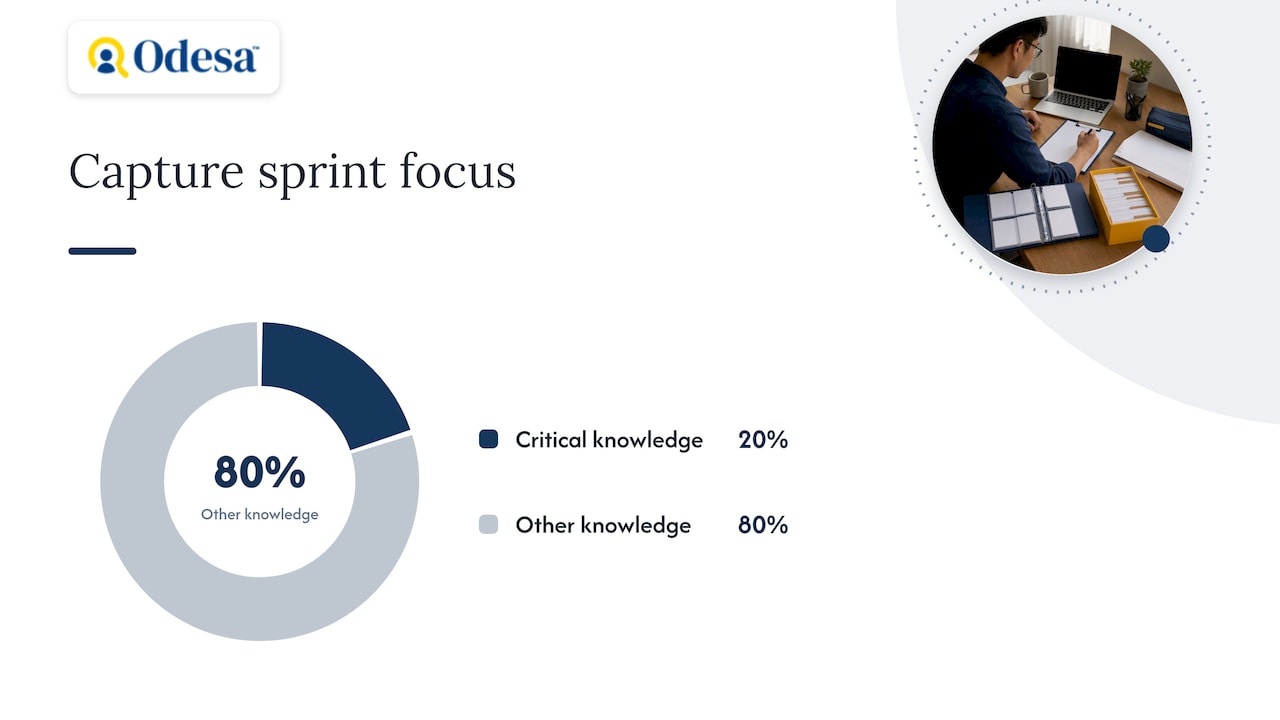
- Time-boxed capture sprints: schedule short, focused sessions, typically one to two hours, aimed at the roughly 20% of knowledge that prevents most operational failures if missing. Rather than trying to document everything a role touches, these sprints prioritize the recurring decisions, escalation paths, and system quirks that cause the most damage when nobody remembers them.
- Validation cycles: have the SME review captured material for accuracy, then have the recipient attempt the task using only the documentation. Gaps that surface here get fixed before the SME leaves, not after.
- Handover and overlap: where possible, build in an overlap period so the recipient shadows real work rather than reading about it. Government guidance on succession planning points to mentoring, rotational assignments, and transition positions as practices that help mission-critical knowledge survive a departure, and an overlap window is the most direct version of that idea.
- Final sign-off and archival: the recipient confirms readiness, the plan owner logs completion, and documentation moves into a searchable archive with a scheduled review date.
Sector-specific guidance built around knowledge loss risk recommends a graded approach: allocate more time and formality to high-risk roles, and less to positions where the knowledge is simple or already well documented. That guidance also emphasizes senior leadership endorsement and standard templates as essential elements of a program that actually gets used rather than filed away.
Pro Tip: Run the capture sprint before announcing a departure publicly when possible. SMEs who know they’re leaving in two weeks document differently than SMEs who still feel some ownership over the outcome.
For technical roles, staff augmentation can buy breathing room during this sequence: bringing in a senior engineer to shadow the outgoing person, rather than compressing the whole handover into their final days, is a pattern worth reading about in how to plan an engineering handover.
Methods to capture and transfer tacit and explicit knowledge
Explicit knowledge, the kind that lives comfortably in a document or a wiki page, is the easy half of the problem. Tacit knowledge, the judgment calls and pattern recognition someone builds over years, resists being written down and usually needs socialization (working alongside someone) or externalization (structured reflection that turns instinct into steps) to transfer at all.
- Interviews: structured Q&A sessions that surface decision-making logic, best for capturing “why” rather than “how.”
- Shadowing: the recipient observes the SME performing real work, effective for judgment-heavy or safety-critical tasks.
- Recorded walkthroughs: screen or video recordings of a process, useful for repeatable technical steps.
- Paired work: SME and recipient perform a task together, with the recipient taking the lead as confidence grows.
- Annotated runbooks: step-by-step documents with context on why each step exists, not just what to click.
- Code walkthroughs: for engineering handovers, a guided tour of architecture decisions and known trade-offs.
Academic work on knowledge transfer frames tacit-to-explicit conversion through socialization and externalization as the primary mechanisms, which is a reasonable explanation for why shadowing tends to reveal gaps that a written questionnaire misses entirely. A questionnaire captures what someone thinks they do; shadowing captures what they actually do, including the shortcuts and workarounds nobody mentions unprompted. For roles where the cost of a missed step is high, favor performance-based capture over self-reported documentation every time.
Tools, templates, and documentation patterns that keep knowledge usable
Capturing knowledge is only half the job. It has to stay findable and trustworthy months later, which means the tools and formatting choices matter as much as the capture sessions themselves.
- Knowledge base or wiki: a searchable home for finished documentation, organized by role or system rather than by department chart.
- Meeting and recording capture: a consistent place to store interview recordings and transcripts tied to the relevant knowledge area.
- Versioned runbooks: living documents with change history, so outdated steps don’t get followed by accident.
- Task-based playbooks: short, action-oriented guides for specific recurring tasks, rather than long reference manuals nobody reads end to end.
- Owner trackers: a simple RACI-style table showing who is responsible, accountable, consulted, and informed for each documented process.
- Review reminders: lightweight automation that flags documents for revalidation on a set schedule.
Every document benefits from the same structure: context for why the process exists, who performs it and when, a worked example, common troubleshooting notes, and a last-validated date. That last field matters more than it seems: a runbook nobody has touched in two years is a liability dressed up as documentation. Deloitte’s guidance on institutional knowledge frames continuous capture in the flow of work, rather than a one-time project, as the difference between documentation that stays current and documentation that quietly rots.
How to measure success: KPIs, validation checks, and continuous improvement
A knowledge transfer plan without measurement is a hope, not a plan. A handful of KPIs turn the exercise into something leadership can track and budget for.
- Time-to-productivity: how long a replacement takes to reach the outgoing person’s performance level.
- Percent of critical topics documented: measured against the prioritized checklist built at kickoff.
- Validation pass rate: the share of recipients who complete the test task successfully on the first attempt.
- Documentation usage frequency: whether people actually open the runbooks after handover, not just during it.
- SME and recipient satisfaction: a short survey capturing whether the process felt rushed or thorough.
A 2021 industry survey found that 57% of respondents were concerned about knowledge transfer risk tied to retirements. That concern tends to translate into action only when KT metrics get tied to something leadership already tracks, such as onboarding budgets or performance objectives for outgoing managers.
A simple audit works without much overhead: pick one knowledge task at random, have the recipient attempt it using only the documentation, and score the outcome against a short scorecard covering accuracy, completeness, and time taken. Running this quarterly for high-risk roles catches decay before it becomes a crisis.
Roles, responsibilities, and a sample timeline for handover
Clear ownership prevents the most common failure mode in knowledge transfer: everyone assuming someone else is writing things down.
- Plan owner: coordinates the overall timeline and keeps the checklist current.
- SME: the person whose knowledge is being captured, responsible for accuracy in reviews.
- Recipient(s): the person or people inheriting the knowledge, responsible for demonstrating competence.
- Reviewer or validator: an independent party who confirms the recipient can perform the task, not just recite it.
- HR or IT support: handles access provisioning, exit logistics, and archival systems.
A recommended overlap period, where feasible, runs somewhere between two and six weeks depending on role complexity, mirroring the transition positions and rotational assignments that succession planning guidance identifies as effective practices for preserving mission-critical knowledge before someone exits.
- Confirm sign-off criteria before the overlap period starts, not after it ends.
- Have the reviewer independently verify the recipient’s readiness rather than relying on the SME’s own assessment.
- Archive final documentation with a maintenance date, and assign someone to own the next review cycle.
Practitioner notes: embedding knowledge transfer in the flow of work
Treating knowledge transfer as a project that happens once, right before someone leaves, guarantees it stays reactive. Teams that handle it well fold capture into routine work instead: a short documentation step added to sprint close-outs, a runbook update logged alongside a deployment, a recorded walkthrough saved the same day a decision gets made.
For engineering teams specifically, paired or shadowed sessions tend to outperform written handoffs alone: a live code walkthrough surfaces the reasoning behind architectural choices that a comment block never captures. Odesa’s own onboarding practice for augmented engineers leans on this same principle, pairing incoming developers with the team’s existing context before independent work starts, a pattern worth reviewing in remote developer onboarding practices.
Editorial perspective: what leadership actually has to commit to
Most knowledge transfer plans fail for the same reason: leadership treats them as a documentation exercise rather than a resourcing decision. A checklist template solves nothing if the SME has no protected time to fill it out, or if nobody ever revisits the archive once the handover is technically complete.
Three commitments separate plans that work from plans that get filed and forgotten: leaders have to prioritize knowledge transfer explicitly in planning cycles, resource it with real hours rather than “whenever there’s time,” and recognize the people who do the capturing well. Add knowledge transfer to management objectives, protect SME time on the calendar, and credit contributors publicly. None of that requires a large budget. It requires deciding that undocumented knowledge is a business risk worth managing before someone walks out the door with it.
Authoritative reports and templates to read next
For a formal, large-scale program, government succession planning guidance and sector-specific knowledge transfer guidance both offer frameworks built around risk assessment, leadership endorsement, and standardized templates. For a faster, team-level plan, Deloitte’s five-step approach to institutional knowledge is easier to adapt without a formal program office behind it. The Clarkston Consulting survey on retirement-driven knowledge loss is useful context for justifying budget to leadership skeptical that the risk is real.
Cover a knowledge gap while your plan is still in motion
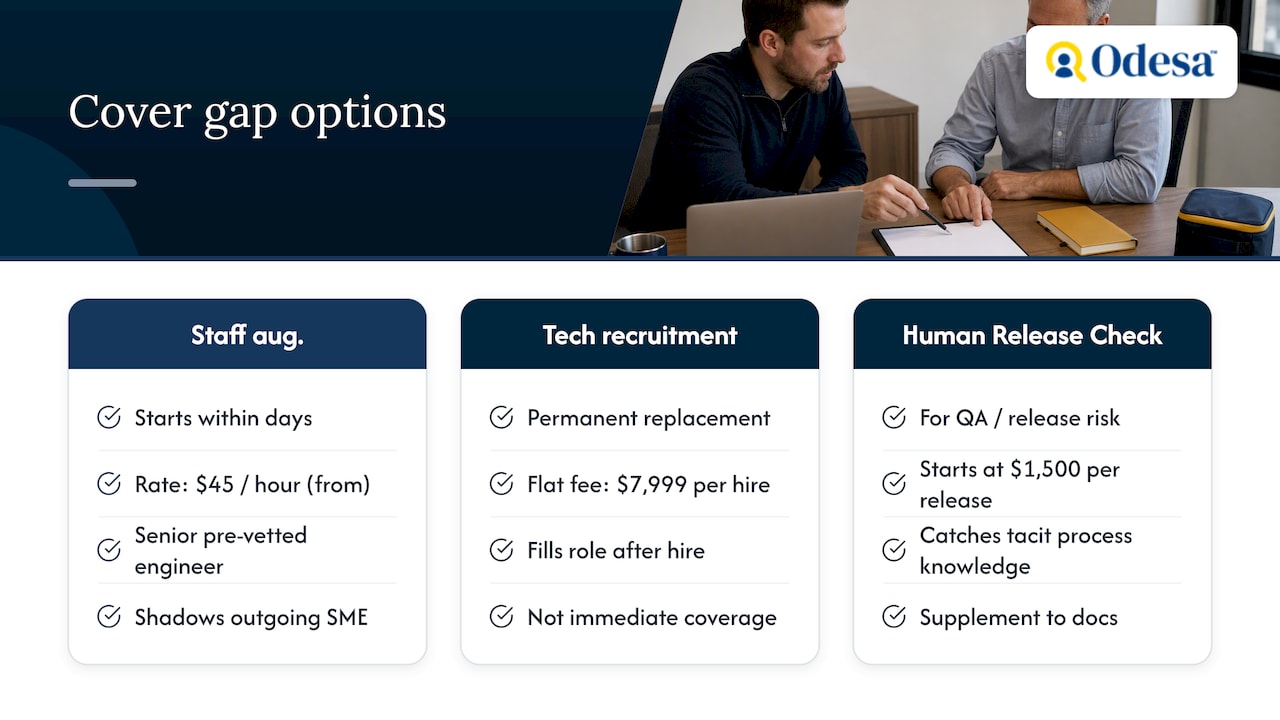
Building a knowledge transfer plan takes weeks, and sometimes a critical engineering role opens up before the documentation catches up. Odesa’s staff augmentation service places a senior, pre-vetted engineer alongside your team within days, at rates starting from $45 per hour, so someone experienced can shadow the outgoing SME and absorb context while the formal capture sprints are still running. If the handover ultimately needs a permanent replacement rather than a temporary bridge, tech recruitment fills that role for a flat $7,999 per successful hire. For teams whose knowledge gap is really a QA or release-quality risk, Human Release Check starts at $1,500 per release and catches the kind of tacit process knowledge that documentation alone tends to miss. The founder is often involved in matching engineers to a client’s specific context, which matters most in exactly this kind of transition, when generic staffing doesn’t have time to work. Check current availability through the staff augmentation page to see how quickly a match can happen for your situation.
Sources
- Knowledge Management Practices in Response to Workforce Retirement Planning
- Capturing institutional knowledge | Deloitte Insights
- GAO: Strategic training and development framework
- Essential elements of knowledge transfer and retention (INPO/industry guidance)
FAQ
What should a knowledge transfer plan include?
A knowledge transfer plan should name the scope, the critical knowledge areas at risk, the SME and recipient, the transfer methods being used, a timeline with milestones, a documentation owner, validation steps, and an archive date for future review. Leaving out validation is the most common gap, since documentation alone doesn’t confirm the recipient can actually perform the work.
What is a knowledge transfer program?
A knowledge transfer program is an ongoing organizational practice, rather than a single plan, that standardizes how critical knowledge gets identified, captured, shared, and validated across multiple roles and transitions. Sector guidance on succession and continuity recommends building this around standardized templates and leadership endorsement so it functions consistently rather than being reinvented for every departure.
What is a KT checklist?
A KT checklist is the practical, fillable version of a knowledge transfer plan: a one or two page document listing scope, critical knowledge areas, SME contacts, recipients, transfer methods, timeline, and validation steps. It’s the working tool a manager fills out and updates, rather than a narrative document meant to be read once and filed.
What are the four stages of knowledge transfer?
The four stages are identify, capture, share, and apply: identify who holds critical knowledge, capture it in a reviewable form, share it with the recipient through training or paired work, and confirm through testing that the recipient can apply it independently. Skipping the apply stage is the most common reason handovers look complete on paper but fail in practice.
How long should a knowledge transfer overlap period last?
Overlap periods commonly run between two and six weeks depending on role complexity, though high-risk or highly specialized roles sometimes need longer. Where overlap isn’t possible at all, a continuity book compiled before departure, covering key contacts, recurring issues, and recent decisions, serves as a practical minimum.
Recommended
Reviewed by Val Narodetsky, founder of Odesa.co.