
Managing an offshore team well comes down to five things: named ownership, a deliberate communication system, outcome-based measures, a real onboarding process and steady trust-building. Most failures come from missing structure, not from the engineers. This guide covers each of the five, with the steps we recommend to US growth-stage companies that add senior engineers abroad.
TL;DR
- Assign accountability before the first sprint. Research from Pangea attributes 40% of unsuccessful outsourced engagements to unclear accountability.
- Reserve live overlap hours for high-value work. Move everything else to written, recorded and documented async communication.
- Measure outcomes (shipped work, quality, cycle time), not hours online or green status lights.
- Treat offshore engineers as team members: same tools, same code review standards, same access to context.
- Choose senior engineers who can work independently. Management load falls sharply when the people are experienced.
Table of Contents
- Why offshore teams get hard to manage
- 1. Define ownership before work starts
- 2. Build a communication system, not a chat habit
- 3. Measure outcomes, not presence
- 4. Onboard offshore engineers the way you would onboard local hires
- 5. Manage without micromanaging
- Our perspective
- Choosing a model that fits how you want to manage
- Where Odesa fits
- Common mistakes to avoid
- FAQ
- Sources
Why offshore teams get hard to manage
The usual complaint from onshore managers is that offshore work feels like babysitting. They check in constantly, rewrite tickets, and still get surprises at demo time. The cause is rarely talent. It is usually one of three gaps.
- Context gaps. The offshore engineer does not know why a feature exists, so they build to the letter of the ticket.
- Ownership gaps. Nobody is sure who decides on scope, who approves a release, or who escalates a problem.
- Feedback gaps. With a time difference, a question asked at 5 p.m. in New York can wait a full day for an answer, and small misunderstandings become lost sprints.
A PMI paper on on-site and offshore teams looks at how different cultures shape the performance of teams split between the customer’s site and a remote one. The practical reading is that differences in working style should be planned for, not discovered mid-project.
Each gap can be closed with process. The sections below take them in order.
1. Define ownership before work starts
Pangea’s guidance on outsourced teams recommends three explicit roles: a technical lead who owns architecture and quality, a lead developer on the delivery side who owns the timeline, and a delivery owner who owns budget, contract and escalations. The names matter less than the principle: every decision type has one person behind it.
For a growth-stage company that adds two or three engineers to an existing team, a lighter version works:
- Technical owner (yours): usually a CTO, VP Engineering or staff engineer. Decides architecture and approves merges.
- Day-to-day lead: the senior offshore engineer who coordinates the others and flags risk early.
- Commercial owner: whoever handles contract, hours and escalations, on your side or the provider’s. If you contract engineers directly, our guide to paying overseas developers covers payment methods and tax forms.
Write these three names in the project’s first document. When something goes wrong, the team should not have to ask who decides.
2. Build a communication system, not a chat habit
Chat and email alone do not carry a distributed team. The approach that holds up is to separate live collaboration from everything else.
Use overlap hours for what needs a conversation
Eastern European engineers overlap with US teams for only part of the day. By one time converter, a 9:00 a.m. to 5:00 p.m. day in New York corresponds to roughly 4:00 p.m. to midnight in Kyiv for most of the year. The practical overlap with the US East Coast is therefore the morning, and it narrows further for the West Coast.
Protect that window. Use it for:
- Sprint planning and backlog refinement
- Design and architecture discussions
- Pairing on a hard problem
- Unblocking a stuck engineer
- Weekly one-on-ones
Do not spend it on status updates. Those can be written.
It helps to keep a shared view of everyone’s local time. A multi-zone world clock setup is one way to keep the team’s hours visible, and even a simple pinned world-clock widget in your chat tool prevents the 6 p.m. meeting invite that lands at 1 a.m. for someone.
Make async the default
Pangea’s guidance on distributed teams describes async-first communication built from recorded videos, thorough documentation and a central source of truth for decisions and architecture. We would translate that into four habits:
- Write tickets with the why. Each ticket states the user problem, acceptance criteria and links to designs or related decisions.
- Record walkthroughs. A five-minute screen recording of a feature or a bug is often clearer than three paragraphs.
- Keep a decision log. One page, dated, listing what was decided, by whom and why. New team members read it on day one.
- End each day with a handover note. Offshore engineers write what was done, what is blocked and what they will do next. Your morning starts with answers, not questions.
Keep a simple rhythm
| Cadence | Format | Purpose |
|---|---|---|
| Daily | Written standup or handover note | Progress and blockers, no meeting needed |
| Twice weekly | 30-minute call in overlap hours | Unblocking, design questions |
| Weekly | One-on-one with the day-to-day lead | Concerns, career, feedback |
| Every sprint | Demo and retrospective | Shared view of progress, process fixes |
Adjust the numbers to your team size. The point is that every meeting has a clear purpose and a written output.
3. Measure outcomes, not presence
If you track whether a developer is online, you will manage the wrong thing. Track what the business needs.
A workable set of measures for an engineering team:
- Delivery: what was committed in the sprint versus what shipped.
- Quality: defects found after release, and how long they took to fix.
- Cycle time: how long a change takes from first commit to production.
- Review health: how fast pull requests receive feedback, in both directions.
- Predictability: how often estimates were close to reality.
Apply the same metrics to onshore and offshore engineers. Separate dashboards for each group quietly create two classes of team member.
For quality, consider an independent check before major releases. Developers testing their own work miss what real users hit. Our Software Release Checklist covers the gates, rollback planning and human checks we recommend, and UAT vs QA explains who should sign off at which stage.
4. Onboard offshore engineers the way you would onboard local hires
Many teams give offshore engineers a repository link and a ticket queue, then wonder why progress is slow. A structured first month changes the result.
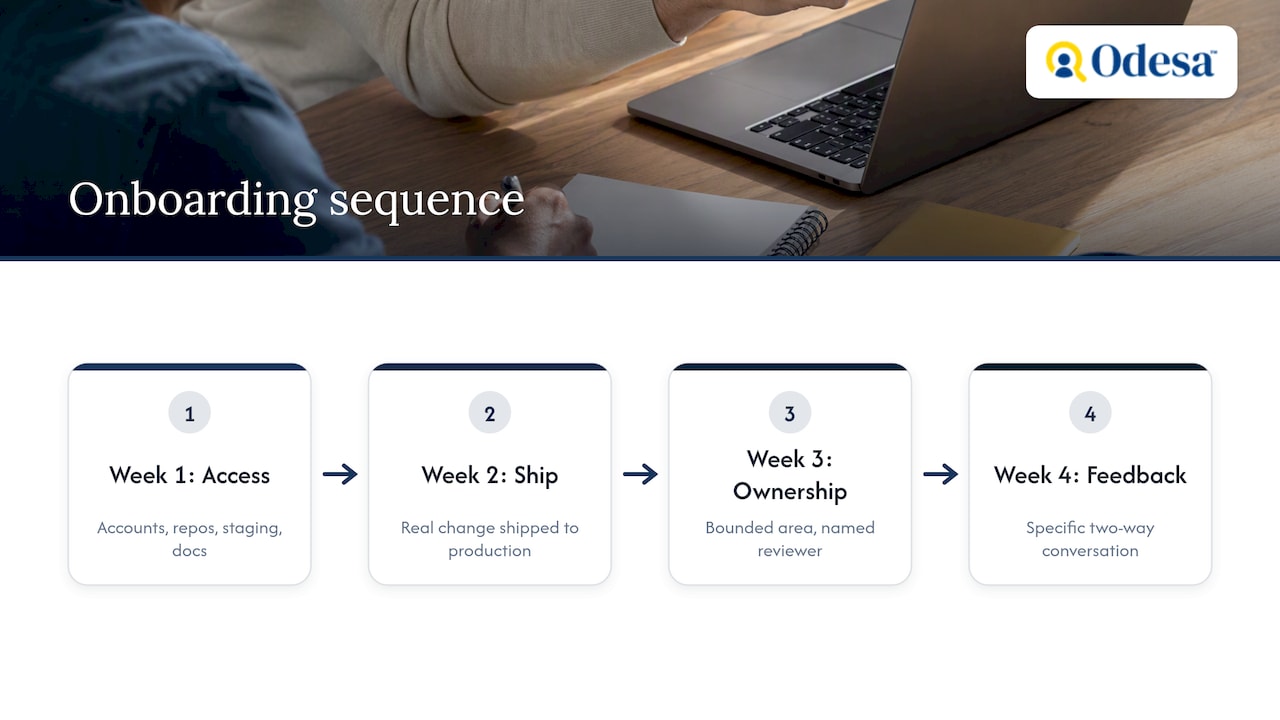
Week 1: access and context. Accounts, repositories, staging environments and documentation on day one. Scope that access with the controls in our offshore development risks checklist. A call with the product owner explaining customers, roadmap and why the current work matters.
Week 2: first real contribution. A small but real change shipped to production, so the engineer experiences your whole pipeline, including review and deploy.
Week 3: ownership of a bounded area. A feature or a service the engineer owns, with a named reviewer on your side.
Week 4: feedback conversation. Two-way and specific: what is working, what is unclear, what tools or documents are missing.
If you are still deciding how to find and add people, our guide on how to hire remote developers covers sourcing and screening, and why remote developer hiring fails lists the mistakes that make management harder later.
5. Manage without micromanaging
Micromanagement is the usual response to uncertainty. The better response is to reduce the uncertainty with structure and then step back.
- Delegate outcomes, not tasks. “Reduce checkout errors by half this quarter” gives an engineer room to think. A list of fifteen tickets does not.
- Review the work, not the person. Code review, demos and test results show quality directly.
- Make it safe to raise problems. Cultural norms differ on whether to disagree with a manager or admit a delay. Ask explicit questions, such as “What is the riskiest part of this?”, and thank people who answer honestly. PMI’s work on multinational, multicultural onshore and offshore teams notes that cultural and business-practice differences can put offshore initiatives at risk, particularly for teams with limited international experience.
- Include the team socially. Invite offshore engineers to company all-hands, share customer feedback with them, and give credit publicly.
- Keep a predictable rhythm with room for focused work. A short daily written update, one weekly planning call and a fixed demo slot replace most ad hoc check-ins. Protect blocks of the day without meetings so engineers can finish hard problems.
- Review the work that carries risk. Spend review time on architecture decisions, security-sensitive changes and anything that touches production data, rather than reading every line of low-risk work.
- Fix friction while it is small. A recurring blocker, an unclear ticket format or a slow approval is cheaper to fix in week two than in month three. Ask in each one-to-one what slowed the engineer down that week.
Our perspective
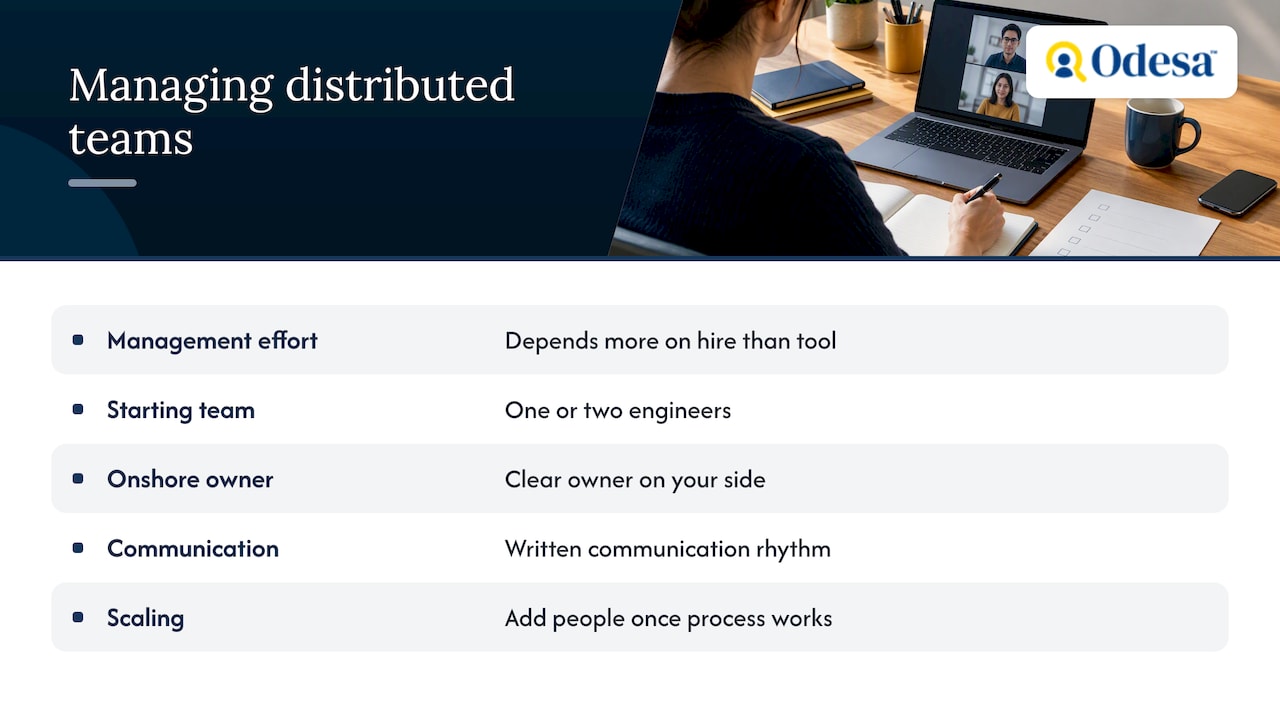
We place senior engineers from Eastern Europe with US and international growth-stage teams, and the pattern is consistent: management effort depends more on who you hire than on which tool you use. A senior engineer asks clarifying questions, pushes back on unclear tickets and flags risk before it becomes a missed date. A junior engineer in the same setup needs close supervision, and that is where the babysitting feeling comes from.
That is why our founder talks directly with each client before matching, to understand the stack, the team’s working style and the kind of autonomy the role needs. A good match on working style removes a surprising amount of management overhead. We would also say that a fair evaluation of any provider should include how it handles retention, because every departure resets the context you built. A written knowledge transfer plan limits how much context a departure takes with it.
Our advice to first-time managers of distributed teams is to start smaller than you think: one or two engineers, a clear owner on your side and a written communication rhythm. Add people once the process works. When you are ready to grow, engineering capacity planning shows how many engineers the roadmap needs.
Choosing a model that fits how you want to manage
How much management you carry depends on the engagement model.
| Model | Who manages day to day | Best when |
|---|---|---|
| Staff augmentation | You | You have engineering leadership and want engineers inside your team |
| Direct recruitment | You, after the hire | You want the person on your own payroll long term |
| Managed or project-based development | The provider | You want a defined outcome and less involvement |
For a closer comparison, see Staff Augmentation vs Managed Services and Staff Augmentation vs Recruitment. If geography is part of your decision, Nearshore vs Offshore Software Development explains the trade-offs on time zones and cost for US companies.
Where Odesa fits
If you want senior engineers who work inside your team with minimal hand-holding, our staff augmentation service starts from $45 per hour per engineer, with matching handled personally by our founder. If you would rather hire the engineer directly, tech recruitment is $7,999 one-off per successful hire. For release quality, our Human QA options start with a Human Release Check at $1,500 one-off. To start, see how to hire offshore developers on US hours and a US contract.
Common mistakes to avoid
- Expecting full-day overlap. Plan for a few hours and design the rest of the process around async work.
- Hiding context. Offshore engineers who only see tickets will build only tickets.
- Splitting standards. Different review rules or metrics for offshore engineers create resentment and uneven quality.
- Skipping the owner. Without a named decision-maker, questions bounce for days.
- Ignoring risk until it appears. Review the main risks of offshore development before you start, and agree on mitigations.
FAQ
How do you effectively manage an offshore team?
Name an owner for technical, delivery and commercial decisions. Use live overlap hours for collaboration and written, async updates for everything else. Measure shipped outcomes and quality, and give the offshore engineers the same context and standards as your local team.
How many hours of overlap does an offshore team need?
There is no universal number, but a few shared hours per day is enough for most software work when async habits are strong. With Eastern Europe, the overlap is mostly your morning in US time zones. Fix those hours for planning, reviews and unblocking, and protect them from routine status meetings.
What is the difference between managing offshore and remote developers?
The core practices are the same: clear goals, written context and outcome-based measures. Offshore adds a time difference, often cultural and language differences, and sometimes a separate employer. That makes explicit ownership and documentation more important than they are for a team in one country.
Should you hire a manager for an offshore team?
Not always. A small team of senior engineers can report to your existing technical lead if that person has the time and a clear process. Once you have more than a handful of offshore engineers, a dedicated day-to-day lead helps keep communication and delivery consistent.
Sources
- How to Manage and Scale Outsourced Development Teams, Pangea
- Project management working with on-site and offshore teams, PMI
- Managing multinational multicultural onshore/offshore teams for effective project delivery, PMI
- East New York to Kyiv Time Converter, Savvytime
Recommended
- Nearshore vs Offshore Software Development: A US Guide
- How to Hire Remote Developers: A Complete Guide for Growing Teams
Reviewed by Val Narodetsky, founder of Odesa.co.