

To pay international contractors from the US, sign a contractor agreement, collect IRS Form W-8BEN (individuals) or W-8BEN-E (companies) before the first payment, screen the payee against OFAC sanctions lists, and then send money by bank wire, a payments platform such as Wise or PayPal, a contractor-management platform such as Deel or Remote, or through a staffing partner that sends you one US invoice. Under IRS guidance, foreign persons who give you a valid Form W-8 are exempt from Form 1099 reporting, so you do not issue a 1099 for work done entirely outside the US.
This guide walks through the order of operations, the tax and compliance points that matter for US businesses, the payment methods and their published costs, and what senior developers cost in the regions US teams hire from most. It is general information, not legal or tax advice; confirm your situation with a CPA or attorney.
TL;DR
- Treat an overseas developer as an independent contractor: collect a W-8BEN or W-8BEN-E first, not a W-9, and do not issue a 1099-NEC for work performed entirely outside the US.
- Screen every payee against the OFAC sanctions lists and keep a record of the check.
- Budget for transfer costs. Global average remittance costs are close to 6.4%, and business payments vary by route, so compare the all-in cost of a test transfer.
- Where the work is physically performed matters more than where the contract is signed or the money is sent.
- A staffing partner that bills you one US invoice in USD moves the payment, paperwork and replacement risk off your desk, at a rate you can compare line by line.
Table of Contents
- Start with the engagement, not the payment rail
- The paperwork before the first payment
- Payment methods compared
- What senior overseas developers cost
- A simple setup checklist
- Our perspective
- When a partner simplifies payment
- FAQ
- Sources
Start with the engagement, not the payment rail
The payment method follows from how you engage the developer. There are three common structures, and each one changes who you pay, in which currency and with what paperwork.
- Direct independent contractor. You contract with the individual and pay them yourself. You control the rate, but you also own the tax forms, sanctions screening, IP assignment and payment logistics.
- Local entity or employer of record. A third party employs the developer in their home country and invoices you. Payroll and local labor law sit with that entity.
- Staff augmentation or recruitment partner. A firm with pre-vetted engineers contracts with them and bills you, usually in USD, by the hour or month. For a permanent hire, a recruiter charges a one-off fee and you then employ or contract the engineer yourself.
If you are still deciding between these, our comparison of staff augmentation and recruitment and the direct hire vs contract checklist cover the trade-offs in detail.
The paperwork before the first payment
Tax forms: W-8BEN, not W-9
Payments to nonresident alien independent contractors for services performed entirely outside the United States are generally not subject to US withholding or reporting on Form 1099-NEC. What you should have on file is a properly completed Form W-8BEN for an individual or W-8BEN-E for an entity, which establishes foreign status and supports any tax treaty claim. IRS Publication 515 describes these rules and states that foreign persons who provide a valid Form W-8 are exempt from backup withholding and Form 1099 reporting. It also covers the cases where Form 1042-S reporting may apply if the income is treated as US-source. Form W-9 is for US persons; see the IRS pages for Form W-8BEN and Form W-9.
Practical steps:
- Ask for the W-8 form before you approve the first invoice.
- Note its expiration and any change in circumstances that would make it invalid, and request a new one when needed.
- Confirm in writing where the developer physically works.
That last step is not a formality. IRS guidance on treaty benefits explains that payments for services performed within the United States may face 30% withholding unless a treaty exemption is claimed. A developer who travels to a US conference and works from a hotel for two weeks can change the analysis for that period. Ask your tax advisor or CPA to review any contractor who spends time in the US.
Work authorization and the I-9
An overseas contractor is not your employee, so you do not complete a Form I-9 for them. USCIS is clear, however, that federal law prohibits contracting with someone you know is not authorized to work, and the burden of ensuring legal status stays with the contracting business, as explained in the USCIS employer handbook. For a developer who lives and works in their own country, this is rarely an issue. It becomes one if they relocate or travel to the US.
Sanctions screening
US businesses must screen payees whether the project is large or small. OFAC publishes enforcement actions that show the cost of skipping basic diligence: in one settlement with an individual, a US person agreed to pay $133,860 over apparent violations of the Iranian Transactions and Sanctions Regulations. The lesson for a small company is simple. Check each contractor and their bank against the Specially Designated Nationals (SDN) list before paying, and save a dated record of the result. Repeat the check when you add a new payee or change the payout account.
IP, confidentiality and data security
A US contract template does not automatically work abroad. The International Trade Administration notes that intellectual property protection varies by country and recommends local counsel to confirm that IP assignment, NDA and non-compete terms hold up locally. Have a lawyer in the developer’s country, or an experienced cross-border attorney, review the template once, then reuse it.
Data is the other exposure. The FTC’s Lesson of BLU shows that a company stays responsible for the security practices of its service providers. If your overseas developer touches customer data, limit access, use your own repositories and cloud accounts, and review their practices on a schedule rather than once at signing. Our guide to offshore development risks covers this in more depth.
Payment methods compared
There is no single best way to pay. The right method depends on payment volume, the contractor’s country and how much admin you want to carry. The table lists what each provider publishes about its own pricing, checked on October 19, 2026; fees change, so confirm on the linked page before you choose.
| Method | How it works | Published pricing | Best for |
|---|---|---|---|
| Bank wire (SWIFT) | You send from your US bank to the contractor’s bank abroad | Your bank’s outgoing wire fee, plus any intermediary or receiving bank fees and the bank’s exchange-rate margin; varies by bank and route | Large, infrequent payments |
| Wise Business pricing | You pay into Wise and it pays out to the contractor’s local bank account in their currency | Sending fee “varies by currency, from 0.23%”; Wise says it does not inflate the mid-market exchange rate | Monthly payments to one or a few contractors |
| PayPal fees | You send to the contractor’s PayPal account | PayPal’s business fee page lists an additional percentage-based fee for international commercial transactions and a currency conversion spread | Contractors who already use PayPal |
| Deel pricing | Contractor management: contracts, invoices, payments in 120+ currencies and tax form collection | From $49 per contractor per month; Contractor of Record from $325 per contractor per month | Several contractors, or when you want the provider to take on classification risk |
| Remote pricing | Contractor management in 190+ countries with localized contracts and invoice approval | From $29 per contractor per month; Contractor Management Plus from $99 per contractor per month | Teams that want contracts and payments in one system |
| Staffing partner (for example, Odesa) | The partner contracts and pays the engineer; you pay one US invoice in USD | Built into the rate; Odesa staff augmentation starts at $45/hr | Teams that want no cross-border payment setup |
Avoid crypto unless your counsel has approved it. It adds compliance questions without removing the need for W-8 forms or sanctions checks.
What transfer costs actually look like
According to a 2026 speech by the Bank of Italy’s governor, global average remittance costs remain near 6.4%, more than double the 3% target set for end-2030, and costs reach 9% in some corridors. Remittances are mostly individual transfers, so a business sending larger amounts may pay less; the point is that fees and exchange-rate margins vary widely by route.
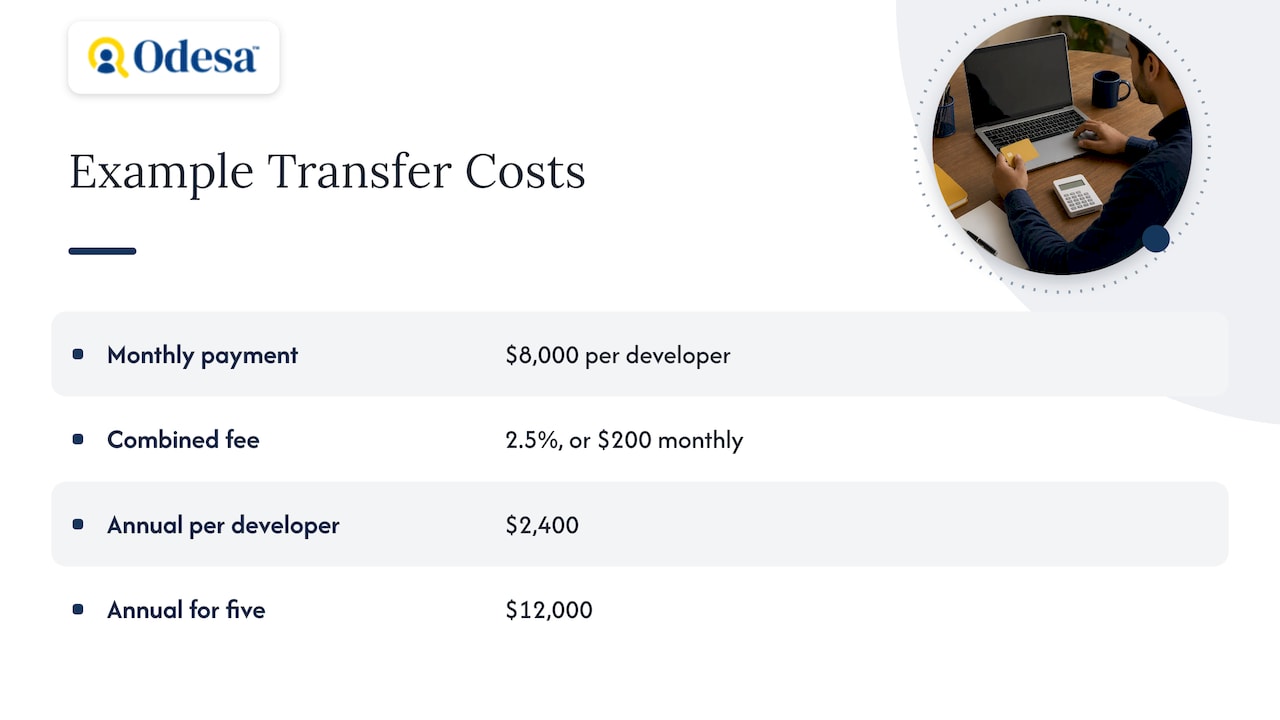
A worked example makes the scale clear. Suppose you pay a senior developer $8,000 a month, which is roughly full-time at $50 an hour. A hypothetical 2.5% combined fee and markup costs $200 a month, or $2,400 a year, per developer. With five contractors, that is $12,000 a year in avoidable friction. Compare the all-in cost on a test transfer, not the headline fee, and ask the platform what exchange rate it applies against the mid-market rate.
Currency: pay in USD or local currency?
Paying in dollars gives you predictable costs, but the developer then carries the conversion cost and may ask for a higher rate to cover it. Paying in local currency shifts FX risk to you but is often welcomed. Whichever you choose, write the currency, the invoice cycle and who covers transfer fees into the contract. Disputes about a payment that arrived short are common and avoidable.
Keep a clean audit trail
Payments across borders are increasingly treated as regulatory touchpoints, with anti-money-laundering and KYC rules adding scrutiny, as the same Bank of Italy speech notes. Keep for each contractor: the signed agreement, W-8 form, sanctions screening record, invoices and proof of payment. If your bank asks about a transfer, you can answer in minutes.
Cash flow when you pay before you bill
Many startups pay contractors monthly while their own customers pay on 30 or 60 day terms. If that gap strains your budget, plan for it in your cash forecast before you delay payments to developers. Late payment is the fastest way to lose a good engineer.
What senior overseas developers cost
Published rate ranges vary widely, which is why “offshore” budgets from a spreadsheet often miss. One vendor comparison, Euvic citing Accelerance’s blended-team rates, lists senior developers at $45 to $80 per hour in Central Europe, $30 to $59 in Eastern Europe and $32 to $65 in Latin America. These are third-party market ranges, not quotes, and the page does not show a publication date. A low rate for a junior does not tell you what a senior engineer who owns architecture decisions will cost.
For context, the Bureau of Labor Statistics reports a national median annual wage of $135,980 for US software developers as of May 2025, before benefits, payroll taxes, recruiting and equipment. Our breakdown of the true cost of hiring a US developer adds those hidden costs.
When you compare quotes, use the same basis:
- Seniority. Years of experience and scope of ownership, not job title.
- Billing model. Hourly, monthly or fixed price, and what counts as billable.
- What is included. Management, replacement, equipment, payment fees, IP terms.
- Working hours. Hours shared with your team, since this affects velocity more than the rate does. Odesa engineers work full US business hours in every region.
- Retention. What happens when the engineer leaves in month five.
For region choice across Latin America, the EU and Eastern Europe, see our comparison of Eastern European and Latin American developers and the guide to nearshore vs offshore.
A simple setup checklist
- Decide the engagement model: direct contractor, entity or partner.
- Confirm the developer’s country of residence and where the work will be done.
- Run sanctions screening and save the record.
- Collect W-8BEN or W-8BEN-E.
- Sign a contract with IP assignment, confidentiality, data handling, currency, invoice cycle and termination terms, reviewed by counsel.
- Test the payment route with a small transfer and check the amount received.
- Set a calendar reminder for W-8 renewal and quarterly access reviews.
- Keep all records in one folder per contractor.
Our perspective
We place senior engineers from Latin America, the EU and Eastern Europe with US growth-stage teams, and the same pattern repeats. Founders rarely struggle with the hourly rate. They struggle with everything around it: forms, screening, contracts, transfers and what happens if the engineer leaves. A rate that looks 50% cheaper on paper loses its edge when someone on your team spends hours a month on payment admin or when a departure restarts the hiring search.
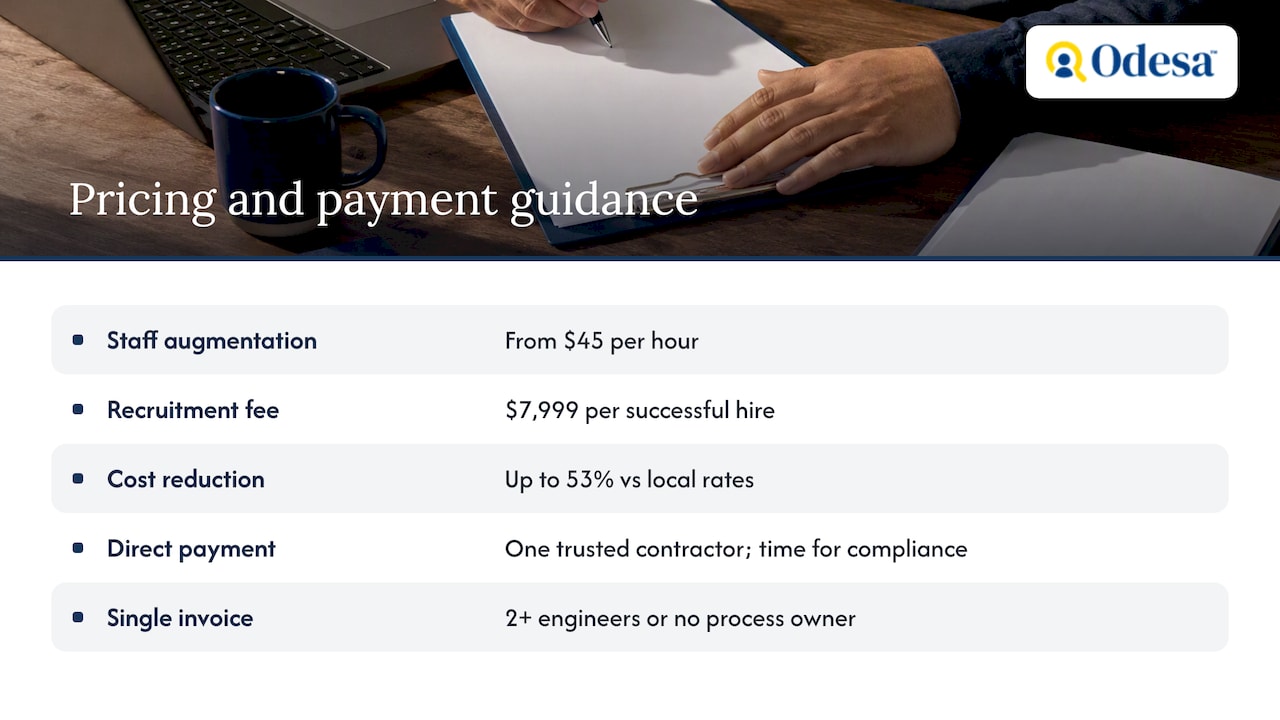
That is why we sell the work in clear commercial terms. Staff augmentation starts from $45 per hour, and our tech recruitment fee is $7,999 one-off per successful hire. Our founder is involved in matching, so the engineer fits your stack before anything is signed, and every engineer works full US business hours. With staff augmentation, Odesa contracts and pays the engineer and you pay one US invoice. We report 94% 12-month engineer retention (company-reported). Your own numbers will differ by role and stack, so compare on the five criteria above.
Our view: pay directly only when you have a single trusted contractor and the time to manage compliance. Once you have two or more engineers, or no one to own the process, a single invoice in dollars is usually cheaper than it looks.
When a partner simplifies payment
If you would rather not manage W-8 forms, sanctions checks and international transfers for each engineer, our staff augmentation service starts from $45 per hour, month to month with a two-week trial. You pay one US invoice, and Odesa handles the engineer’s contract and payment. The process: sign an MSA, hold a kickoff meeting, Odesa sources talent and presents profiles, you interview, and the engineer onboards. If you want to employ the engineer yourself, tech recruitment is $7,999 one-off per successful hire. Either way, you can talk to us about the match before committing. Not sure which fits? Read staff augmentation vs outsourcing first.
FAQ
Do I need to send a 1099 to an overseas developer?
Generally no, when the services are performed entirely outside the United States. You collect a W-8BEN or W-8BEN-E instead; IRS Publication 515 says foreign persons who provide a valid Form W-8 are exempt from Form 1099 reporting. See IRS Publication 515. If any work is performed in the US, or you are unsure of the income’s source, ask a CPA before paying.
What is the cheapest way to pay an international contractor?
The cheapest method is the one with the lowest all-in cost for your amount and country, which you find by testing a transfer. Watch the exchange-rate margin as well as the stated fee. Compare the published fees in the table above against a test transfer from your own bank.
Do you need a W-9 for international contractors?
No. Form W-9 is for US persons. A foreign individual contractor gives you Form W-8BEN, and a foreign company gives you Form W-8BEN-E; see the IRS pages for Form W-8BEN and Form W-9. If a contractor is a US citizen or resident living abroad, they give you a W-9 instead.
Can a US company pay a foreign contractor?
Yes. Sign a contractor agreement, collect a W-8BEN or W-8BEN-E, screen the payee against OFAC sanctions lists, and pay by wire, a payments platform, a contractor-management platform or a staffing partner’s invoice. Keep the agreement, tax form, screening record and proof of payment on file.
What are the steps to pay an overseas contractor?
Choose the engagement model, confirm where the work is performed, run sanctions screening, collect the W-8 form, sign a contract with IP, currency and invoice terms, test the payment route with a small transfer, and keep records for each contractor. The setup checklist above lists each step.
Can I pay an overseas developer as an employee?
Not directly without a local presence. Employing someone abroad usually requires a local entity or an employer of record, and local labor law applies. Most US startups use contractor agreements or a staffing partner instead.
Do I have to screen overseas contractors for sanctions?
Yes, US businesses are expected to screen payees, and OFAC enforcement actions show penalties for failing basic diligence. Check the SDN list before the first payment, document the result and repeat when payment details change.
Sources
- IRS Publication 515
- IRS: Claiming tax treaty benefits
- USCIS Handbook for Employers, Form I-9 questions
- OFAC settlement with an individual, $133,860
- International Trade Administration: negotiating with a foreign representative
- FTC: Lesson of BLU
- Bank of Italy: Interconnect to stabilize, cross-border payments
- Euvic: hourly rates by country (citing Accelerance)
- Bureau of Labor Statistics: Software Developers, Quality Assurance Analysts, and Testers
- IRS: About Form W-8BEN
- IRS: About Form W-9
- Wise Business pricing
- PayPal business fees
- Deel pricing
- Remote pricing
Recommended
- Offshore Development Risks: 5 Risk Areas and the Controls That Reduce Them
- Eastern European vs Latin American Developers: A Data-Driven Comparison for US Companies
- How to Manage Offshore Teams: A Practical Guide for US Companies
- How to Hire Remote Developers: A Complete Guide for Growing Teams
Reviewed by Val Narodetsky, founder of Odesa.co.