
Choose direct hire when a role needs long-term ownership, culture fit, and retention. Choose contract when speed, flexibility, or a defined project window matters more than permanence. Contract-to-hire splits the difference: it lets you test fit before committing to payroll, benefits, and the higher upfront cost that direct hire carries.
TL;DR:
- For needs under six months, contract staffing fits; compare agency markups of 50% to 85% with fully loaded employee costs, not salary alone.
- The DOL and IRS apply separate classification tests, so document deliverables, limit control over contractors’ methods, and seek counsel when status is unclear.
- A contract to hire arrangement typically lasts 60 to 180 days; check conversion fees, exclusivity windows, and early termination notice periods before signing.
- Direct hire recruiting fees are paid once, while contract markups recur each billing cycle; executive searches cost roughly six times more than nonexecutive hires.
Table of Contents
- Definitions: Direct Hire, Contract Work, and Contract-to-Hire
- Advantages and Disadvantages for Employers and Workers
- Cost Comparison: Agency Fees, Markups, and Cost-Per-Hire Benchmarks
- Classification and Compliance: How the DOL and IRS Evaluate Worker Status
- How to Choose: A Decision Checklist Before You Hire
- Contract-to-Hire: Mechanics, Timelines, and When It Reduces Risk
- How Direct Hire vs Contract Shapes Team Dynamics and Continuity
- How Hiring Models Affect Retention and Long-Term Talent Strategy
- Legal and Compliance Considerations for Eastern European Talent Sourcing
- Case Studies in Direct Hire vs Contract Decisions
- Staff Augmentation vs Recruitment (Direct Hire)
- Our Approach: Staff Augmentation and Recruitment as a Practical Middle Path
- Get Senior Engineering Talent Without the Direct Hire Timeline
- FAQ
- Sources
Definitions: Direct Hire, Contract Work, and Contract-to-Hire
Before comparing costs or risks, it helps to pin down what each term actually means, because the labels get used loosely in job postings and recruiting conversations.
- Direct hire: a permanent placement on the employer’s own payroll, with benefits, a set schedule the employer controls, and an ongoing employment relationship with no defined end date.
- Contract: a fixed-term engagement, usually billed through a staffing agency or paid as a 1099 independent contractor, that pays a higher hourly rate but comes with no employer-sponsored benefits and a defined end point.
- Contract-to-hire: a trial period structured as a contract, with an option (not an obligation) to convert the worker to direct-hire status once both sides confirm the fit.
These definitions describe intent, not legal status. A worker labeled “contractor” in a contract is not automatically a contractor under the law. The Department of Labor’s economic reality test looks past the paperwork and asks whether the worker is economically dependent on the employer or genuinely in business for themselves, and no single factor settles that question on its own. We treat that distinction as the starting point for every hiring decision, because the title on the contract means less than how the relationship actually functions day to day.
Advantages and Disadvantages for Employers and Workers
Every hiring model trades one advantage for another, and the trade-offs land differently depending on whether you’re the one writing the check or the one cashing it.
For employers, direct hire tends to pay off in retention. A permanent employee has a reason to invest in your product roadmap, your codebase, and your team’s working norms, which cuts down on the churn that comes from constantly onboarding new contractors. The cost is upfront: direct hire usually takes longer to fill and carries a larger initial outlay in recruiting fees, benefits setup, and onboarding time.
Contract work flips that calculus. Employers get speed: a staffing agency can often place a qualified engineer within days, not months, and in some arrangements the labor sits off the core payroll, simplifying headcount reporting. The downside shows up over time. Hourly rates on contract labor run higher than an equivalent salaried rate once you annualize it, and a revolving door of contractors makes it harder to build the kind of institutional memory a long-running project needs.
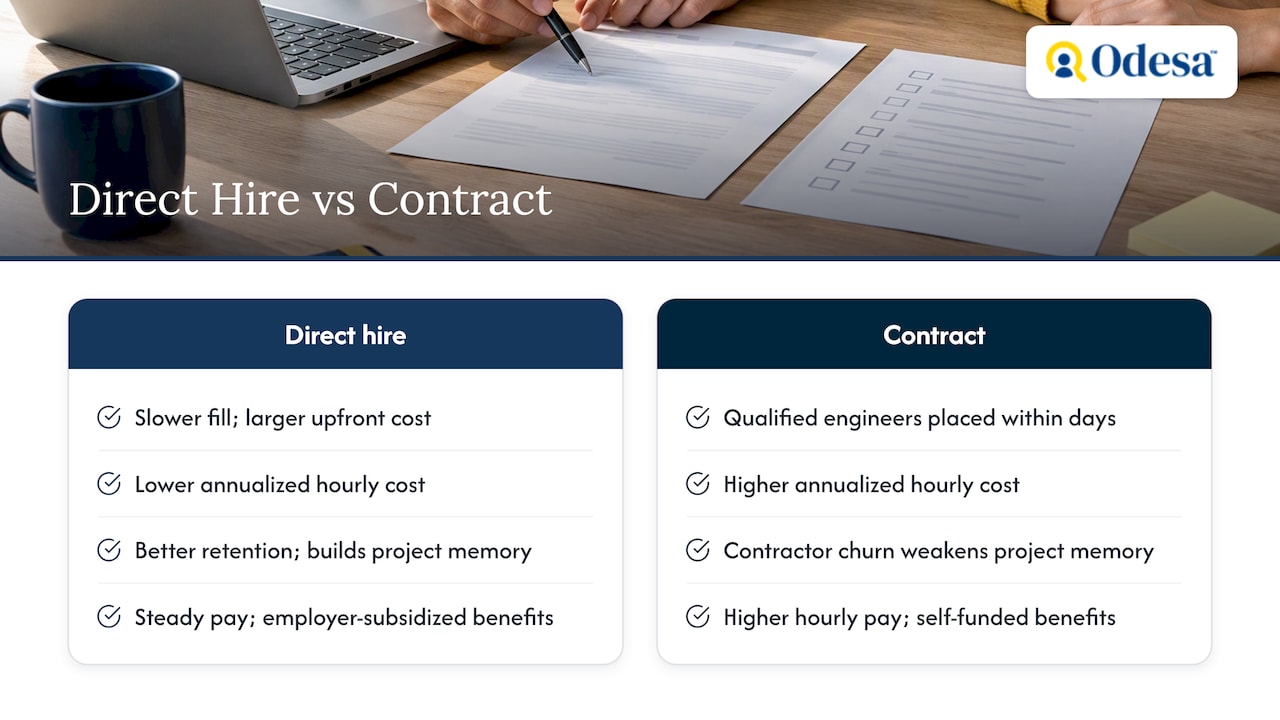
From the worker’s side, the calculation mirrors the employer’s. Contractors typically negotiate higher hourly rates specifically because they’re covering their own health insurance, retirement contributions, and the gaps between assignments. Direct employees trade some of that top-line pay for predictability: a steady paycheck, employer-subsidized benefits, and protections that come with W-2 status.
Two quick examples show how this plays out in practice. A team that needs a senior engineer for a six-month feature build, with a clear scope and end date, is a textbook contract situation: the work has a defined boundary, and paying a premium hourly rate for six months is cheaper than running a full recruiting cycle for a role that ends anyway. A team hiring a product lead who will own architecture decisions for years is a different story. That role benefits from someone who has a stake in the outcome past the next release, which argues for direct hire even though it costs more and takes longer to fill.
Pro Tip: When negotiating a contract rate, ask the agency for a breakdown of what the markup covers (payroll taxes, insurance, overhead) before accepting the headline number; it gives you real leverage to negotiate down.
Cost Comparison: Agency Fees, Markups, and Cost-Per-Hire Benchmarks
Numbers make this decision concrete, so it helps to anchor both models against published benchmarks rather than guesswork.
Some vendors quote a low headline percentage and then add back-charged pass-throughs for background checks, skills assessments, or onboarding tools, which can materially raise the real total. We’d insist on all-inclusive pricing before signing, so the number you’re quoted is the number you pay, a practice HR Dive’s benchmarking coverage flags as a common gap in vendor agreements.
Contract staffing works differently: the agency applies a markup on top of the worker’s base pay to cover payroll taxes, workers’ compensation insurance, and its own administrative overhead. That markup commonly falls in a wide range, often 50% to 85% over base pay, and tends to run higher on shorter assignments because the agency has less time to spread its fixed costs across billable hours, according to BLS staffing industry data.
SHRM’s 2025 benchmarking research gives a useful anchor for direct-hire costs specifically:
BLS compensation-cost data for June 2026 puts average total compensation for private industry workers at $46.89 per hour, a figure worth keeping in mind when you’re comparing a contractor’s quoted hourly rate against the fully loaded cost of a salaried employee with benefits.
A few practical takeaways follow from these numbers:
- Direct-hire fees are a one-time cost; contract markups repeat every billing cycle, so a long contract assignment can eventually cost more than a direct hire would have.
- Executive-level direct hires cost roughly six times more to recruit than nonexecutive roles, which argues for getting senior hires right the first time.
- A low-percentage recruiting fee quote is worth scrutinizing for pass-through charges before you compare it against a competing bid.
For a deeper breakdown of what a US-based developer actually costs once benefits and overhead are factored in, our analysis of the true cost of hiring a US developer walks through the full math.
Classification and Compliance: How the DOL and IRS Evaluate Worker Status
Getting the hiring model right on paper matters less than getting the classification right in practice, and the two agencies that matter most apply different but related tests.
The DOL’s economic reality test asks one central question: is the worker economically dependent on your business, or are they genuinely operating an independent business of their own? Factors like the worker’s opportunity for profit or loss, the permanence of the relationship, and the degree of control you exercise over their work all feed into that answer, but DOL guidance is clear that no single factor controls the outcome.
The IRS applies its own common-law framework, organized around three categories: behavioral control (do you direct how the work gets done), financial control (who bears the investment and profit risk), and the type of relationship (is there a written contract, benefits, or an expectation the work continues indefinitely). A worker can pass one agency’s test and fail the other’s, which is part of why misclassification remains a live risk even for employers acting in good faith.
One in five organizations tracks quality of hire as a metric, according to SHRM’s 2025 benchmarking data, which means most hiring decisions, including the choice between contract and direct hire, get made without a clear read on whether the model actually delivered better outcomes.
Misclassification exposure is not abstract. The GAO’s review of nonstandard work arrangements found that companies commonly rely on contractor labor and that misclassification shows up repeatedly as a disclosed risk factor in corporate filings, tied to potential back taxes, unpaid benefit contributions, and penalties.
Three practical steps lower that exposure:
- Document the scope of work in writing, with clear deliverables and a defined end date, rather than an open-ended description that looks like an ongoing job.
- Limit direct behavioral control over contractors: set the outcome, not the hours or the method, and let them use their own tools where feasible.
- Structure payment around deliverables or milestones rather than a schedule that mirrors employee payroll, and route payment through the contractor’s own business entity when possible.
None of this substitutes for legal advice specific to your situation; a worker’s actual status depends on facts that counsel is better positioned to evaluate than a general guide.
How to Choose: A Decision Checklist Before You Hire
Turning the comparison into a decision comes down to six questions, asked roughly in this order.
- How critical is this role to your core product or roadmap? A role central to long-term strategy favors direct hire; a role supporting a defined initiative favors contract.
- What’s the expected duration of the need? Under six months points to contract; an open-ended, ongoing need points to direct hire or contract-to-hire.
- What’s your budget structure? If you need to avoid a large upfront recruiting fee and prefer ongoing operating expense, contract staffing fits better than a one-time direct-hire fee.
- How fast do you need someone productive? Contract placements typically move faster; direct hire involves a longer interview and onboarding cycle.
- How sensitive is the role to compliance risk? Roles with heavy IP exposure or regulatory oversight often warrant direct-hire structure to avoid classification ambiguity.
- Do you want a path to convert later? If you’re unsure whether the need is temporary or permanent, contract-to-hire preserves the option without committing either way.
For contract negotiations, push for billing transparency (ask what the markup covers), confirm the agency carries adequate insurance, and nail down IP assignment language before work starts, not after. For direct hire, negotiate probation terms clearly and consider a retention bonus structure tied to a milestone like a one-year anniversary, which gives both sides a reason to confirm the fit is working.
Pro Tip: If you’re genuinely unsure which model fits, default to contract-to-hire; it costs a little more in flexibility but removes the risk of a costly direct-hire mistake.
Contract-to-Hire: Mechanics, Timelines, and When It Reduces Risk
Contract-to-hire arrangements typically run 60 to 180 days before a conversion decision, with the exact window set in the original contract. Many agencies build in a conversion fee if you hire the contractor permanently before the window ends, though some structure that fee as a declining credit the longer the contract runs.
This model earns its keep in two situations: when you genuinely don’t know whether the need is temporary or ongoing, and when the role is skilled enough that a bad direct hire would be expensive to unwind. Testing fit for a few months before committing to payroll and benefits removes much of that downside.
A few terms are worth reading closely before signing:
- Exclusivity windows that prevent you from hiring the same worker through another channel during the contract period.
- Notice periods required before either side can end the arrangement early.
- Fee caps that limit how much the conversion fee can grow, even on longer contract terms.
How Direct Hire vs Contract Shapes Team Dynamics and Continuity
The hiring model you choose shapes how a team actually works together, not just what it costs. Direct hires tend to invest in shared tooling, documentation, and mentoring junior teammates, because they expect to be around when those investments pay off. That investment compounds: a team with stable core members tends to ship with fewer handoff errors and less repeated context-setting.
Contract labor, by contrast, works best when the task is well-scoped and doesn’t depend on deep institutional context. A contractor brought in for a defined feature build can move fast precisely because they’re not expected to absorb the team’s full history. The risk shows up when contract roles stack up around a project’s critical path: frequent turnover in those spots creates repeated onboarding costs and knowledge gaps every time a contract ends. Teams that mix long-term direct hires for core ownership with contract support for defined, bounded work tend to get the continuity benefits of permanence without paying for it everywhere.
How Hiring Models Affect Retention and Long-Term Talent Strategy
Retention is where the direct-hire versus contract decision shows its long-term cost, not just its upfront one. A permanent employee who sees a career path, not just a project, has a reason to stay past the first tough sprint. Contract arrangements don’t offer that same pull, by design: the relationship is scoped to end, and a contractor optimizing for their own business has little reason to turn down the next opportunity that pays better or starts sooner.
That doesn’t make contract labor a weaker talent strategy on its own; it makes it a different tool. Organizations building a long-term talent strategy tend to reserve direct hire for roles tied to competitive advantage, retention, and institutional knowledge, while using contract or contract-to-hire arrangements for work that’s genuinely episodic. The mistake is applying one model everywhere: treating every hire as permanent inflates fixed costs, and treating every hire as disposable contract labor erodes the continuity a growing product needs.
Legal and Compliance Considerations for Eastern European Talent Sourcing
Sourcing engineering talent from Eastern Europe adds a layer of compliance beyond the standard direct-hire versus contract decision, because the worker’s location changes which rules apply. A US employer hiring a contractor based in another country isn’t typically subject to that country’s labor code the way a local employer would be, but the structure of the engagement still matters: how payment flows, who issues the contract, and whether the arrangement resembles employment under either country’s tests all affect risk.
For staff augmentation arrangements, where an Eastern European engineer works as part of a US team through an intermediary rather than as a direct 1099 contractor, the intermediary typically handles local tax and employment compliance in the engineer’s home country, which removes a layer of exposure for the US-based company. That structure is different from an EOR arrangement, where a local employer of record runs statutory payroll and filings in the worker’s country, a model more common in markets like South Africa, where providers like this South Africa tech recruiting and EOR guide walk through BCEA-compliant contracts and local payroll filings. Whichever structure you use, confirming who bears compliance responsibility in the worker’s home country, and getting that in writing, is worth doing before the first invoice.
Case Studies in Direct Hire vs Contract Decisions
Concrete examples make the trade-offs easier to apply than general rules. A growth-stage startup building a new mobile feature with a hard six-month deadline typically gets more value from a contract engineer than a direct hire: the work has a defined scope, the deadline creates natural urgency, and the team doesn’t need the engineer’s long-term institutional buy-in once the feature ships.
Compare that to a company hiring its first dedicated backend architect to own a system that will grow for years. Here, the slower, more expensive direct-hire process pays for itself: the architect’s decisions compound over time, and a revolving door of contractors in that seat would mean re-explaining architectural context every few months. A third pattern shows up often in practice: a company unsure whether a QA function needs to be permanent uses a contract-to-hire QA engineer for 90 days, confirms the workload is steady, and converts the role once the need proves durable rather than guessing upfront.
Staff augmentation vs recruitment (direct hire)
Choose staff augmentation when you need engineering capacity inside your existing team and want to keep the option to scale down. Choose recruitment when the role is a long-term part of your team and you want to employ the person directly. Both start with the same search; they differ in who holds the ongoing relationship.
| Decision | Staff augmentation | Recruitment (direct hire) |
|---|---|---|
| Best fit | Extra capacity in a team that already has a technical lead | A continuing role you want to own directly |
| Day-to-day direction | Your team sets priorities, tools and delivery standards | Your company manages the person as its own hire |
| Who employs the engineer | Odesa, under a US contract with you | Your company, after the candidate accepts |
| Odesa pricing | From $45/hr; the rate depends on role and experience | $7,999 flat per hire, due when the candidate accepts; salary is separate |
| Odesa terms | Month to month, two-week trial | 90-day replacement guarantee |
| Typical use | Feature push, specialist gap, team growth you may reverse | Core team building, leadership or long-tenure roles |
Compare the two over the same period. 160 hours at $45/hr is $7,200 in service fees for one month, while the $7,999 recruitment fee is paid once, with the engineer’s salary and employment costs on top. Neither figure alone tells you which costs less over six or twelve months; model both with your own hours, salary range and expected tenure. If you have no one to lead delivery, adding an engineer may not help, and a scoped custom development project can fit better. See staff augmentation, tech recruitment and pricing.
Our Approach: Staff Augmentation and Recruitment as a Practical Middle Path
Most hiring decisions aren’t purely binary once you look past the framework. We built our model around that reality: rather than forcing growth-stage companies to choose between the slow, expensive direct-hire path and the thinner continuity of ad hoc contracting, we offer both staff augmentation and direct recruitment, matched to what the role actually needs.
When a team needs senior engineering capacity for a defined stretch, a feature build, a scaling push, a QA cycle, staff augmentation gives access to pre-vetted Eastern European engineers who integrate into an existing team without the multi-month recruiting cycle direct hire usually requires. When the need is clearly permanent, our recruitment service runs a flat-fee search focused on finding a long-term fit rather than filling a seat quickly.
What ties both together is how the matching happens: our founder is personally involved in understanding what a specific team actually needs before proposing engineers, rather than running candidates through a generic filter. That personal involvement is also why we can speak to retention: clients working with us report engineers who stay integrated well past the initial engagement, which is the outcome direct hire is supposed to guarantee and contract staffing often doesn’t. For teams weighing the two models side by side, the staff augmentation vs recruitment comparison above shows which situations favor each path.
Get Senior Engineering Talent Without the Direct Hire Timeline
Whichever model this comparison points you toward, we can usually deliver it faster than a from-scratch search. If the need is a defined project or a capacity gap, our staff augmentation service starts at $45 per hour and places a pre-vetted senior engineer into your team without a lengthy recruiting cycle. If the role is permanent, our tech recruitment service runs a flat $7,999 one-off fee per successful hire, with no percentage-of-salary math to untangle later.
Clients working with us often benefit from hiring cost savings compared with hiring at local rates, because our engineers are sourced from a pre-vetted Eastern European network and matched directly by our founder rather than passed through a generic filter.
- Need short-to-medium-term senior engineering capacity: start with staff augmentation.
- Need a permanent engineering hire: start with tech recruitment.
- Need release testing support alongside either model: our Human QA services cover everything from a single release check to ongoing QA.
Reach out through our site to talk through your specific hiring need and get matched with the right engagement model.
FAQ
Who pays the fee for direct hire?
The hiring employer pays the direct-hire recruiting fee, typically structured as a one-time percentage of the placed employee’s first-year salary, commonly in the 20% to 30% range. The worker being placed never pays this fee themselves.
What are the risks of direct hire?
The main risks are a longer time-to-fill and a larger upfront cost, since you’re paying a recruiting fee and absorbing onboarding and benefits costs before the employee generates full value. A bad direct-hire decision is also more expensive to unwind than ending a contract, since it typically involves severance or a longer offboarding process.
What does it mean when a job says direct hire?
A job posted as direct hire means the employer is offering permanent, W-2 employment on its own payroll, with benefits and no defined end date, rather than a temporary placement through a staffing agency. It signals the role is meant to be long-term from the outset.
Is it better to hire an employee or contractor?
It depends on the work: a defined, time-bound project with a clear end date usually fits a contractor better, while ongoing work tied to long-term strategy usually justifies a direct employee despite the higher upfront cost. Classification should follow the actual nature of the work, evaluated under the DOL’s economic reality test, not just the label on the offer.
Sources
- DOL: Questions and Answers on NPRM: Employee or Independent Contractor Status
- SHRM releases 2025 benchmarking reports
- GAO report on nonstandard work arrangements and related risks
- IRS: Independent Contractor (Self-employed) or Employee?
Recommended
- How to Choose a Staffing or Recruiting Company
- The Cost of Hiring a US Developer: A Complete Budget
- Hire Ukrainian Developers: Talent Pool, Time Zones, Rates and Continuity
Reviewed by Val Narodetsky, founder of Odesa.co.