
An NDA for subcontractors is a written promise that anyone doing part of your work will keep your non-public information private and use it only for the job. Sign it before the subcontractor sees code, customer data, or product plans. It must define what is confidential, limit use to the project, bind the subcontractor’s own people, and say what happens to your information when the work ends. This guide walks through each of those pieces, with a clause checklist you can take to your attorney.
TL;DR
- Have the NDA signed before any access is granted, not once a project becomes urgent.
- Define confidential information narrowly and specifically. An overbroad definition is a weakness, not extra protection.
- Limit use to performing the services, bind the subcontractor’s personnel in writing, and require prompt notice of any suspected breach.
- State the term, whether duties survive termination, and a deadline for returning or destroying information.
- Notarization is not required. Have counsel review the final document, and pair the NDA with technical access controls.
Table of Contents
- What a subcontractor NDA protects
- When to put an NDA in place
- Do NDAs have to be notarized?
- What a subcontractor NDA should include
- Term, survival, and what happens when the work ends
- Legal limits on what an NDA can restrict
- A simple process for using it
- Our perspective
- Working with an engineering partner
- Template checklist to bring to your attorney
- FAQ
- Sources
What a subcontractor NDA protects
A subcontractor NDA protects proprietary or confidential information from being disclosed to unauthorized people, and it sets expectations about that at the outset. SixFifty’s overview of subcontractor NDAs frames it the same way: the document limits disclosure and makes clear what the subcontractor may and may not do with what they learn.
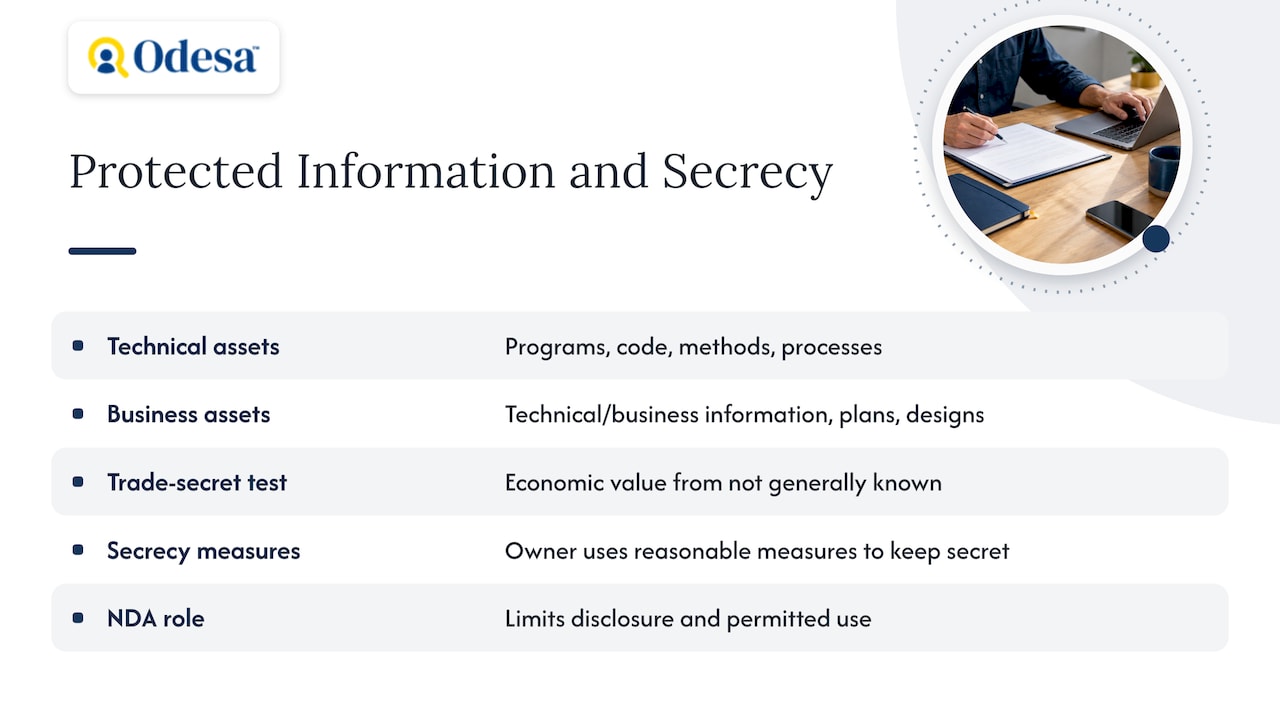
For a software company, the information at stake is usually more than source code. Federal law defines a trade secret broadly. Under 18 U.S.C. § 1839(3), it can include programs, code, methods, processes, technical and business information, plans, and designs, provided the information derives independent economic value from not being generally known and the owner takes reasonable measures to keep it secret.
That last condition is where an NDA earns its place. In a Third Circuit decision on a trade secret claim, the court discussed how the plaintiff said it used NDAs with scientists, vendors, suppliers, and business partners, together with password protection and access controls, as its reasonable secrecy measures. An NDA is one visible piece of showing you took the secrecy of your information seriously.
What an NDA cannot do
An NDA is not a security system. Commentators on software contracting, including Chaindoc, describe it as a fallback for when technical controls such as repository permissions and credential offboarding fail. Treat it as one layer. An NDA can contractually protect information that is not a statutory trade secret, but it cannot create trade secret status where none would otherwise exist, as this analysis of a Southern District of New York decision explains.
If you work with offshore or remote engineers, the same layered thinking applies to access. Our guide on secure vendor access for engineering leads covers the technical side that the contract cannot.
When to put an NDA in place
The short answer is before anything confidential changes hands. The Public Relations Society of America’s guidance on hiring subcontractors recommends having the NDA clause in place from the start, rather than scrambling once a project is urgent. Three situations come up most often:
- Before scoping calls. If a prospective subcontractor will see architecture diagrams, customer lists, or roadmap details while you evaluate them, sign first. Inceptiv Law advises considering an NDA when sensitive discussions occur before the main agreement is formalized.
- When the master agreement is silent on confidentiality. The same source points to contractor agreements that lack confidentiality provisions. Either add a confidentiality article or sign a standalone NDA.
- When your vendor uses its own subcontractors. If you hire an agency that brings in other people, the contract should include a pass-through clause requiring the agency to bind its subcontractors to equivalent confidentiality obligations, a point Chaindoc also makes.
The third case matters more than most founders expect. Your direct counterparty may be trustworthy while the person who actually opens your repository is two contracts removed from you.
Do NDAs have to be notarized?
No. An NDA is a contract, and it generally becomes binding when the parties sign it voluntarily with clear terms and something of value exchanged. A notary verifies who signed, not whether the terms are enforceable, as this explainer on notarizing NDAs puts it. Clear drafting and a proper signature do the work. Notarization can still be a choice if you expect a dispute over whether a particular person signed, but it is not a legal requirement for validity.
What a subcontractor NDA should include
A workable template covers the following elements. SixFifty lists the core items as: the parties, a legitimate business purpose, a definition of confidential information with its exceptions, state-specific obligations, a notice under the Defend Trade Secrets Act, and the consequences of breach.
1. The parties and the purpose
Name the legal entity on each side, not just a brand or a person’s first name. State the purpose in one or two sentences, for example evaluating or performing specific software development services. A defined purpose supports a legitimate business reason for the restriction and gives you a clear boundary for permitted use.
2. A definition of confidential information
This is the clause most worth your time. The American Bar Association’s guidance on NDAs recommends defining confidential information clearly and tailoring it to the circumstances. An overbroad definition may sweep in public or already-known information, while an inadequate one may leave important proprietary material unprotected.
The ABA describes several approaches you can choose among or combine:
- Marking or designation. Only material labeled confidential is covered. This is precise but risks gaps when people forget to label things in chat or on calls.
- Nature-based. Information is covered if a reasonable person would understand it to be confidential.
- Subject-matter or purpose-based. Information relating to a named project, product, or system is covered.
For software work, a combined approach tends to fit: list categories such as source code, system architecture, credentials, customer data, product roadmaps, and pricing, then add a catch-all for information a reasonable person would treat as confidential.
3. Exclusions
Standard exclusions keep the definition honest. According to a Faegre Drinker guide to confidentiality agreements, typical carve-outs cover information that:
- is or becomes public without a breach by the recipient;
- the recipient already possessed;
- the recipient lawfully received from a third party free of restrictions; or
- the recipient independently developed without using the confidential information.
Some subcontractors will not sign without these, and reasonable ones should not have to argue for them.
4. Permitted use and the subcontractor’s responsibilities
A supplier or subcontractor NDA should limit access and use to what is necessary to perform the services, according to a published supplier NDA template from Cleary Gottlieb. The same template requires reasonable protection of the information, restricts disclosure to authorized personnel who are bound in writing, makes the subcontractor responsible for those personnel, and requires prompt notice of actual or suspected breaches.
In practice, add these software-specific points:
- No copying of code or data to personal devices or personal cloud accounts.
- No use of your information to train, benchmark, or improve tools or products for other clients.
- A named list of people who may access the information, updated by written notice.
- A duty to report a lost laptop, leaked credential, or accidental disclosure within a short, stated window.
5. Permitted disclosures to representatives
Subcontractors often need to consult their own staff, accountants, or lawyers. The Faegre Drinker guide notes that permitted disclosures may extend to representatives for the purpose of the agreement, with downstream confidentiality obligations. Write that in explicitly so the subcontractor knows who is inside the circle, and so you know whom you are relying on.
6. Notice under the Defend Trade Secrets Act
For agreements with individuals, include the federal whistleblower immunity notice. SixFifty’s guidance says a confidentiality agreement with an individual should include the DTSA immunity notice. Leaving it out can limit the remedies available to you under that statute, so ask counsel to confirm the current wording.
7. Remedies
State what happens on breach. Cornell’s Legal Information Institute notes that a breach of an NDA can lead to substantial damages and that a party seeking enforcement may be able to obtain a preliminary injunction. Many NDAs include an acknowledgment that money damages alone may be inadequate, which supports a request for injunctive relief. Your attorney can advise on wording that suits your state.
Term, survival, and what happens when the work ends
Three questions belong in every NDA, and they are the ones most often left vague.
How long does the NDA last? There are two separate clocks: how long the agreement is in force, and how long the confidentiality duty continues afterward. One published project-specific subcontractor form, Clayco’s May 2023 template, runs the confidentiality restriction through the second anniversary of termination. Under that form the agreement itself ends after one year or when a definitive agreement is signed, whichever comes first. That is an example of the structure, not a universal standard. Choose periods that match how long your information stays sensitive.
Do duties survive termination? The ABA advises stating this expressly. Confidentiality duties can survive termination, but may not if the agreement does not provide for survival. It also notes that information designated as trade secrets may receive perpetual confidentiality where applicable law permits. A common structure is a fixed term for general business information and an open-ended duty for source code and designated trade secrets.
What happens to the data? The Clayco form requires prompt return or destruction, certification on request, and allows retention only as the project documents permit. Set a deadline, such as a fixed number of days after the work ends or you ask, and require written confirmation that copies, including backups and local clones, are gone.
Legal limits on what an NDA can restrict
An NDA cannot be used to gag legally protected speech, and a clause that tries may be unenforceable or create exposure for you.
- State laws. SixFifty notes that state laws often limit NDAs that prevent disclosure of facts related to labor-law violations, including discrimination, harassment, and retaliation. Those limits vary by state, so check the rules where you and the subcontractor are located.
- The Speak Out Act. According to Cornell’s LII, the Speak Out Act of 2022 prevents enforcement of NDAs concerning sexual harassment unless the agreement was signed after a dispute arose.
- Employee-status risk. A subcontractor who is really treated like an employee may bring labor-law protections with them. The NLRB’s McLaren Macomb decision held that offering a severance agreement with terms reasonably tending to interfere with employees’ Section 7 rights can be an unfair labor practice, as discussed by the American Bar Association. If any of your contractors could be classified as employees, ask an employment attorney to review confidentiality language before you use it.
A practical drafting habit follows from this. Add a short carve-out stating that nothing in the NDA prohibits reporting possible violations of law to a government agency or making disclosures protected by law.
A simple process for using it
A good clause set still fails if nobody follows a routine. This sequence works for small engineering teams:
- Decide what is confidential. List the repositories, environments, and documents the subcontractor will actually need.
- Choose the template and customize it. Start from a reviewed form, then adjust definitions, term, and survival to your situation.
- Have counsel review it. The ABA’s view is that an NDA is a negotiated risk-allocation document, not a routine form, and that counsel should review scope, permitted use, survival, and practical compliance before signing. See the ABA’s best-practices article.
- Sign before access. No repository invites, no credentials, no staging URLs until both parties have signed.
- Grant least-privilege access. Give the minimum permissions for the minimum time.
- Offboard in writing. Revoke credentials, collect the destruction certificate, and file the NDA with the project record.
For the access and onboarding half of this routine, our practical onboarding checklist for external contractors lays out the steps in order.
Our perspective
We see the NDA as the first page of a working relationship, not a barrier placed in front of it. The strongest engagements we have seen start with a clear agreement about what is confidential, who may see it, and when access ends. That clarity lets a senior engineer start contributing quickly, because nobody has to guess where the boundaries are.
Our model is built on pre-vetted senior engineers from Eastern Europe who join U.S. and international growth-stage teams, with the founder personally involved in matching and onboarding. We think that personal involvement matters for confidentiality too: when someone on our side knows the engineer and the client, questions about access, permitted tools, and handoff get asked early rather than after a problem.
For clients we recommend three habits. Put the NDA and the services agreement in place before the first repository invite. Name the people who will touch your code. And treat offboarding as part of the contract, with a date for revoking credentials and confirming deletion. An NDA works best alongside technical controls, and the two should be planned together.
Editorial Team
Working with an engineering partner
If you are bringing in outside engineers, the confidentiality terms should sit alongside the commercial ones. Our staff augmentation service places senior, pre-vetted engineers into your team from $45 per hour, and confidentiality terms are something to settle in the contract before work begins. If you would rather hire an engineer directly, tech recruitment is a flat $7,999 per successful hire.
Agencies that resell development under their own brand have a related need: the pass-through clause described above. Our white label development arrangements start at $45 per hour, and an agency should ask any partner how its engineers are bound to the agency’s client confidentiality terms. To discuss your situation, start at odesa.co.
If you are comparing models before you sign anything, our guides on nearshore versus offshore development and the risks of offshore development explain where confidentiality fits in the wider decision.
Template checklist to bring to your attorney
Use this as a review list when you assess any subcontractor NDA template, whether you wrote it or downloaded it.
| Clause | What to check |
|---|---|
| Parties | Full legal names of both entities and the individuals who will sign |
| Purpose | A specific, legitimate business purpose tied to the project |
| Definition | Tailored to your information, not a blanket claim over everything |
| Exclusions | Public, previously known, lawfully received, independently developed |
| Permitted use | Limited to performing the services |
| Personnel | Written obligations for everyone with access; subcontractor is responsible for them |
| Pass-through | Any further subcontractors bound to equivalent terms |
| Breach notice | Prompt notice of actual or suspected breaches |
| Term and survival | Stated clearly, with a longer or perpetual duty for trade secrets where the law permits |
| Return or destruction | A deadline, a certification, and limited retention rights |
| Legal carve-outs | DTSA notice and protected-disclosure language; state-law check |
| Remedies | Injunctive relief language and governing law |
One caution on free templates: a generic form rarely covers state-specific rules or your actual systems. Treat any template as a starting draft and have a licensed attorney in your state finalize it.
FAQ
Can I use the same NDA for every subcontractor?
You can reuse a reviewed base form, but adjust the purpose, definition of confidential information, access list, and term for each engagement. A one-person design contractor and a team with production database access carry very different risks. Keep the core structure consistent and customize the project-specific parts.
Can I make a simple NDA for free?
Yes, nothing in the law requires you to pay for a form, and published templates exist. The risk is fit: a free form may omit state-specific provisions, the DTSA notice, or a workable definition for your software. Use a template as a draft, then have an attorney review it before you rely on it.
Does an NDA cover illegal activity?
No. An NDA cannot lawfully be used to stop someone from reporting illegal conduct, and several federal and state rules limit confidentiality terms, including the Speak Out Act for sexual harassment disputes. Include a protected-disclosure carve-out and an immunity notice, and check your state’s rules with counsel.
Should the subcontractor’s own staff sign too?
They should be bound in writing, either by signing directly or through their employer’s agreement with them. The subcontractor should be responsible for their compliance. Ask for the list of people who will have access and updates when it changes.
Is an NDA enough to protect my code?
No. An NDA gives you a contractual remedy after a breach, while permissions, logging, and offboarding reduce the chance of a breach in the first place. Use both, and review who has access on a schedule.
Sources
- Understanding Subcontractor Non-Disclosure Agreements, SixFifty
- 18 U.S.C. § 1839(3) definition of trade secret, Cornell LII
- Third Circuit opinion on trade secret reasonable measures
- Contractor NDA for Software Companies, Chaindoc
- NYLJ, Not All Secrets Are Trade Secrets
- 3 Ways to Reduce Your Risk When Hiring a Subcontractor, PRSA
- Non-Disclosure Agreements & Confidentiality, Inceptiv Law
- Does an NDA Need to Be Notarized?
- Best Practices for Negotiating and Entering into Nondisclosure Agreements, American Bar Association
- Confidentiality and Nondisclosure, Faegre Drinker
- Supplier non-disclosure agreement template, Cleary Gottlieb
- Non-disclosure agreement (NDA), Cornell LII Wex
- Project-Specific Subcontractor Non-Disclosure Agreement, Clayco
- McLaren Macomb Gives Employers a Reason to Review Standard Agreements, ABA
Recommended
- Onboarding External Contractors: A Practical US Checklist
- Direct Hire vs Contract: An Employer Checklist and a Third Path
This article may have used AI tools in the writing process. Facts, figures, and recommendations can be wrong or out of date. Do not treat this as professional advice.