

Onboarding external contractors means completing four things before the first deliverable: signed paperwork, a defensible worker classification, scoped system access, and a clear orientation to the project. Done in that order, it protects the company legally and gets the contractor productive in days rather than weeks. This guide walks through each step as a numbered checklist for US companies, with extra detail for engineering teams that bring in senior developers or QA specialists on a contract basis.
TL;DR
- Collect the contractor agreement, statement of work, Form W-9 and any required insurance or NDA before work starts.
- Classification depends on the actual working relationship, not on the label in the contract, so document how the contractor really works.
- Grant least-privilege access with an expiration date tied to the contract end, and revoke it promptly when the engagement closes.
- Orient the contractor on goals, communication and escalation paths, then review progress against milestones on a fixed schedule.
- Treat onboarding as an auditable record: if it is not written down, it is hard to prove later.
Table of Contents
- What “external contractor” means and why onboarding matters
- The contractor onboarding checklist
- Common mistakes that make onboarding fail
- Our perspective: onboarding is where engagements are won or lost
- Onboarding engineering contractors with Odesa
- FAQ
- Sources
What “external contractor” means and why onboarding matters
The IRS describes an independent contractor as someone whose services are controlled by the person receiving them only as to the result, not the method. That definition explains the whole onboarding challenge. You can tell a contractor what must be delivered and by when. You cannot, without risk, direct every detail of how the work gets done.
That is why contractor onboarding differs from employee onboarding. An employee gets a handbook, benefits enrollment and a manager who sets daily priorities. A contractor needs a narrower package: the scope, the access required for the deliverables, the people to contact, and the paperwork that proves the relationship is what you say it is.
Skipping the process has predictable costs. Without structure, companies face misclassification, data-security problems, wasted time and lower productivity. A consistent process also creates the paper trail that compliance reviews depend on. The rest of this article turns that into steps.
The contractor onboarding checklist
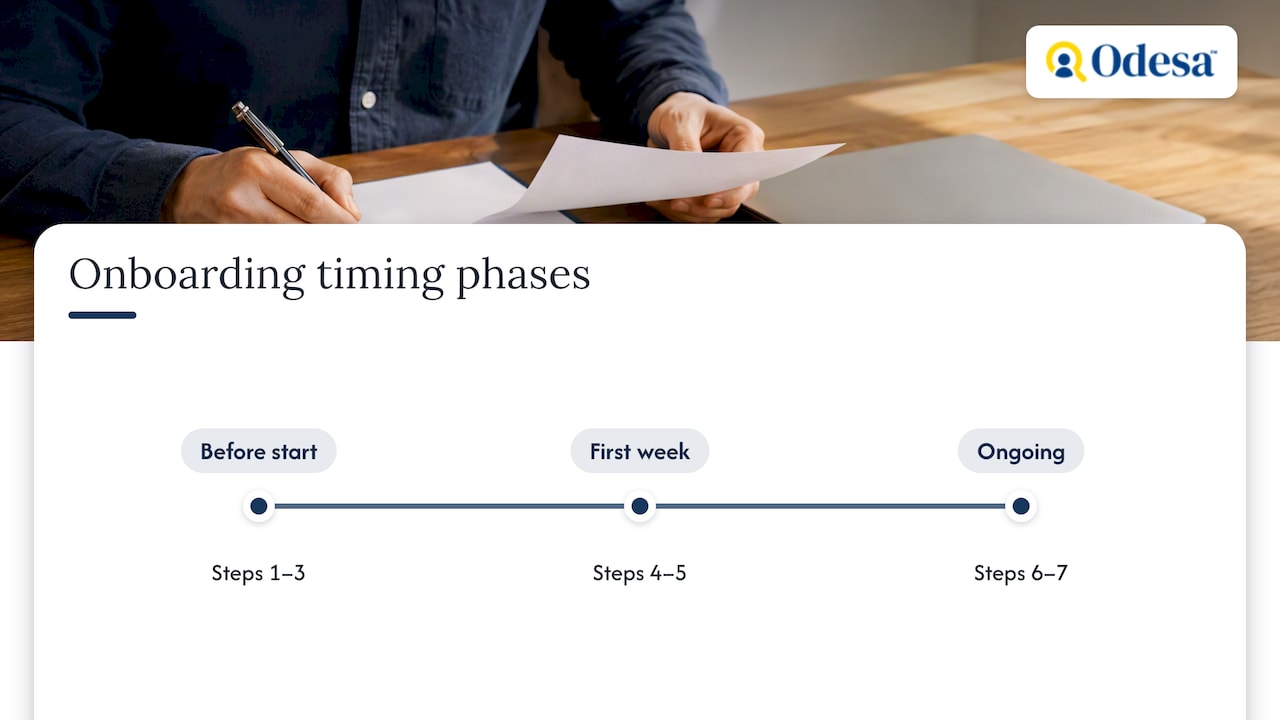
Use the list below in order. Steps 1 to 3 happen before the contractor starts, steps 4 and 5 in the first week, and steps 6 and 7 for the life of the engagement.
1. Define the scope before you sign anything
Write a project brief or statement of work (SOW) that names the deliverables, the timeline and the milestones. A contractor checklist should include a signed agreement, a project brief or SOW, timeline and milestones, and insurance or licenses where required.
A workable SOW answers five questions:
- What does “done” look like for each deliverable?
- Who accepts the work, and how long do they have to review it?
- What are the milestones, and are payments tied to them?
- Which systems, repositories or data will the contractor touch?
- How does either side end the engagement, and with how much notice?
The pricing model shapes this document. If you are choosing between hourly and fixed-fee work, our comparison of time-and-materials versus fixed price covers how each affects scope control and cost risk.
2. Collect the paperwork
Before work starts, a US company should have on file:
- A signed contractor agreement covering scope, payment terms, confidentiality and intellectual property ownership.
- A completed Form W-9. The IRS says the first step with an independent contractor is to have them complete Form W-9 so you have their correct name and taxpayer identification number.
- A certificate of insurance, if the work or your client contracts require it.
- An NDA, if confidentiality is not already in the agreement.
- A classification worksheet that records why you treat this person as a contractor.
That list follows the pre-start checklist many contractor management programs use. Collect the W-9 now rather than at the first invoice. Payers must report nonemployee service payments made in the course of business on Form 1099-NEC, and for payments made after December 31, 2025, the reporting threshold is $2,000 or more in a calendar year. Missing tax details are far easier to fix on day one than in January.
If the contractor lives outside the US, the tax forms and payment rails differ. Our guide to paying overseas developers covers methods, taxes and costs for US teams.
3. Check classification, then document it
Classification is the step most often treated as a one-time formality, and it is the one that causes the largest problems later. Under the Fair Labor Standards Act, worker status turns on the economic realities of the relationship; labels and written agreements do not decide it.
The Department of Labor’s 2026 proposed rule keeps that framing. Its analysis asks whether a worker is economically dependent on a potential employer, focusing on control and the opportunity for profit or loss, with skill, permanence and integration also relevant. It also says the parties’ actual practices matter more than what a contract might theoretically allow. Because this is a proposal, check the DOL page for its current status before you rely on any specific test.
In practice, that means asking three questions at onboarding and again at every renewal:
- Does the contractor set their own schedule and methods, or do we?
- Can they work for other clients, and do they?
- Are they doing a defined project, or filling a permanent seat in our org chart?
If your honest answers drift toward “we direct everything” and “it never ends,” talk to an employment attorney or your payroll advisor before the engagement starts. Our checklist on direct hire versus contract helps when the role looks more permanent than temporary.
4. Provision access with the least privilege
Access is where onboarding meets security. Give contractors access only to the systems and data their deliverables need, document each credential, and set automatic expiration dates aligned with the contract end date. The same source recommends revoking access within 24 hours after the engagement ends.
For engineering contractors, make this concrete:
- Create named accounts. Never share an employee’s login or a team-wide password.
- Scope repository access to the projects in the SOW, not the whole organization.
- Keep production credentials out of reach unless the deliverable requires them, and log every use.
- Use multi-factor authentication on every account.
- Record each credential, its owner and its expiry date in one place.
Identity controls like these are the foundation of most vendor security programs. A primer on identity and access management explains how roles, authentication and access reviews fit together if you need to formalize your approach. Contractors working from outside your network raise the stakes, and our piece on offshore development risks and secure vendor access covers the additional controls.
Physical and regulated environments add requirements. Some large industrial companies, for example, require subcontractors to complete site-specific safety training before job-site work. If your contractor will be on a client site or in a regulated facility, ask what training and credentials the site requires before the start date, not on arrival.
5. Orient the contractor to the project, not the company
Contractors do not need your culture deck. They need context that lets them deliver without constant questions. A good first-week orientation covers:
- The goal behind the work. One paragraph on why the project exists and who uses the result.
- The people. A named day-to-day contact, a named approver and a backup.
- Communication rules. Which channel for quick questions, which for blockers, how often to expect a status update.
- Working agreements. Time zone overlap, response expectations, code review and release process, and how to log time if billing is hourly.
- Escalation and incident reporting. Who hears about a problem first. Some enterprise safety specifications require subcontractors to report workplace incidents to the project contact within one hour for severe events and the same day for others. A software equivalent is a security incident or a production outage, so state the expected timeframe.
For remote technical contractors, add a short written setup guide: repository layout, local environment, branching rules, test commands and the definition of done. Writing it once saves hours on every future engagement. Our guide to managing offshore developers without micromanaging explains how to give direction on outcomes while leaving methods to the contractor, which also supports the classification points above.
6. Set check-ins and review milestones
Onboarding does not end on day five. The support that keeps an engagement healthy includes documented feedback aligned to project milestones, compliance reviews covering duration, scope, access, tax and insurance, clear invoicing processes, and quarterly access reviews.
A simple cadence works for most teams:
| When | What to review | Owner |
|---|---|---|
| End of week 1 | Access works, setup complete, first deliverable agreed | Project lead |
| Every milestone | Deliverable against SOW, feedback documented | Approver |
| Monthly | Invoices match scope and time, budget on track | Finance and project lead |
| Quarterly | Access review, duration and scope check, insurance still valid | Security and HR or operations |
Oversight during an engagement works best with explicit evaluation criteria. A scorecard approach to evaluating vendors can be adapted to score a contractor’s delivery, communication and reliability at each milestone, so renewal decisions rest on notes rather than memory.
7. Plan the offboarding on day one
Every engagement ends. Offboarding is critical for security and must include collecting company assets, revoking all system access, and finalizing and approving the last invoice. Put those three items in the onboarding record so no one has to reconstruct them later. Add a knowledge-transfer step for technical work: documentation, handover of code and credentials, and a final walkthrough with the person who will maintain the result.
Common mistakes that make onboarding fail
A contractor cannot literally fail onboarding the way a candidate fails a test, but the process can fail the contractor and the company. These are the patterns we see most often:
- Starting work before the paperwork is signed. Scope disputes and intellectual property gaps start here.
- Treating classification as settled. Roles change, hours creep up, and a contractor who began on a project can end up working like staff. Review it at renewal.
- Granting broad access “just in case.” It is faster on day one and expensive after a credential leak.
- Vague deliverables. If nobody can say what done means, every review becomes a negotiation.
- No named contact. Contractors who cannot find an answer either stall or guess.
- Forgetting the exit. Accounts that outlive the contract are a quiet security risk.
The broader point is that a structured onboarding process works as a risk-management function that produces a consistent, auditable record, not as an administrative chore.
Our perspective: onboarding is where engagements are won or lost
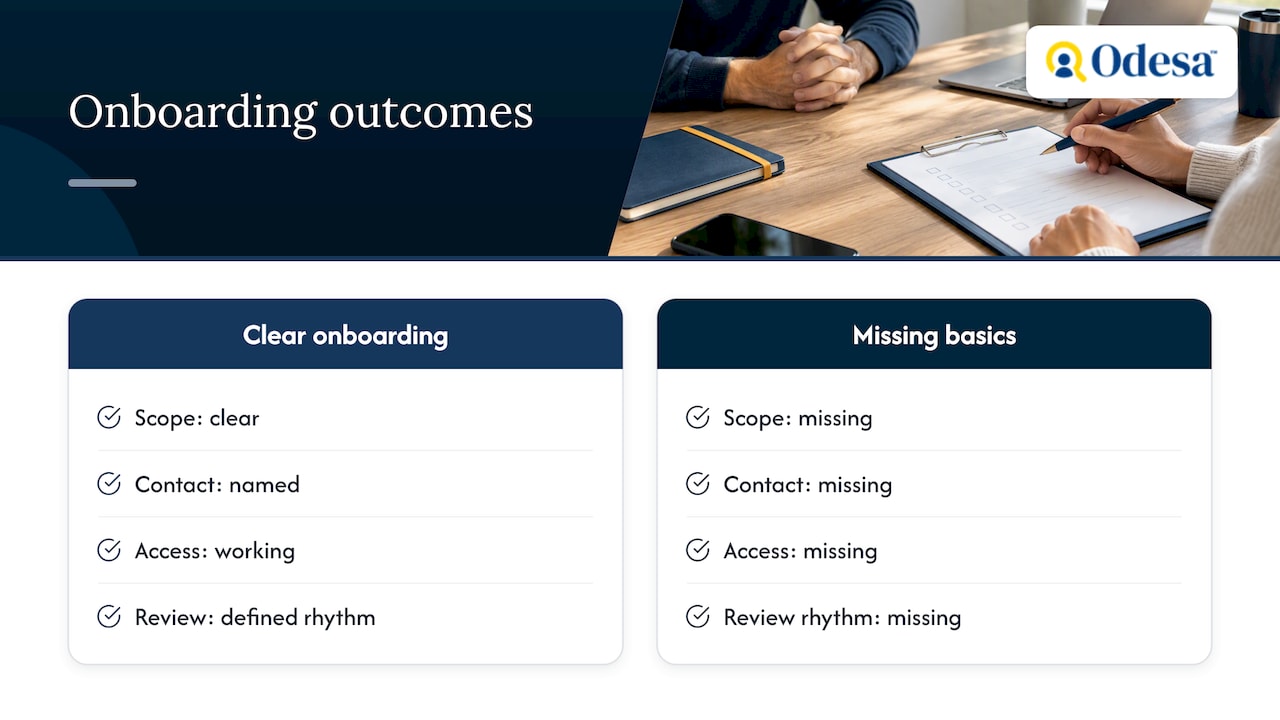
We place senior engineers from Eastern Europe with US-based and international growth-stage teams, and we see the same pattern in nearly every engagement. The technical skill of the engineer is rarely the deciding factor. The first two weeks are. When a client has a clear scope, a named contact, working access and a defined review rhythm, a senior engineer is productive almost immediately. When those are missing, even an excellent engineer spends the first month waiting.
That is why our founder takes part in matching and onboarding personally. The matching conversation covers the stack, the team’s working style and the communication the client expects, so that the orientation described above starts from a shared understanding rather than a blank page. We also encourage clients to decide access, reporting lines and review dates before the engineer’s first day, and to write down how the engagement will close.
We would add one caution. Companies often treat contractor onboarding as lighter than employee onboarding and therefore put less effort into it. For technical roles the opposite is true: a contractor typically has fewer hours to get up to speed, and the company has fewer legal protections if records are thin.
— Editorial Team
Onboarding engineering contractors with Odesa
If your contractors are developers or QA specialists, we can take much of this off your plate. Our staff augmentation service starts from $45 per hour and places pre-vetted senior engineers who work as part of your team, with our founder involved in matching and onboarding. If you want to hire the engineer directly, tech recruitment is a flat $7,999 per successful hire. For release quality, our Human QA offerings include a Human Release Check at $1,500 one-off. To see how the models differ, read our guide on choosing between staff augmentation and recruitment.
FAQ
What is included in a contractor onboarding process?
A complete process includes a signed agreement and SOW, Form W-9, insurance or NDA where required, a classification record, scoped and expiring system access, a project orientation, and a schedule of check-ins. It also includes an offboarding plan covering asset return, access revocation and the final invoice.
What should you not tell a contractor?
Do not dictate daily methods, hours or tools beyond what the deliverable requires, since control over how the work is done points toward an employment relationship. Do not share confidential information outside the scope of the NDA or the project. Never hand out credentials broader than the deliverables need.
What does external contractor mean?
It means a person or firm outside your payroll who delivers a defined result for you. The IRS test centers on whether you control only the result or also the method, and the DOL looks at the economic reality of the relationship rather than the contract label.
How long should contractor onboarding take?
Paperwork and access should be complete before the first day. Orientation usually takes the first week, with a review at the end of it. Complex environments with regulated data or site training take longer, so ask about requirements before you set a start date.
Sources
- Independent contractor defined | Internal Revenue Service
- Forms and associated taxes for independent contractors | IRS
- Form 1099-NEC and independent contractors | IRS
- Fact Sheet 13: Employment Relationship Under the FLSA | US Department of Labor
- Notice of Proposed Rule: Employee or Independent Contractor | US Department of Labor
- Building a Contractor Management Program | Treegarden
- Contractor Onboarding Checklist | Worksuite
- 8-Step Process for Contractor Onboarding Success | Venn
- EHS Safety Specifications, August 2024 revision | Johnson Controls
- Identity and Access Management (IAM) | NullVector
- Use a Scorecard to Evaluate Software Vendors | Bitrupt
Recommended
- Direct Hire vs Contract: An Employer Checklist and a Third Path
- Paying Overseas Developers: Methods, Taxes and Costs for US Teams
- How to Manage Offshore Teams: A Practical Guide for US Companies
- 7 Questions to Choose Staff Augmentation or Outsourcing for Engineering
This article may have used AI tools in the writing process. Facts, figures, and recommendations can be wrong or out of date. Do not treat this as professional advice.