
A full-stack developer builds both the user-facing side of an application and the server side behind it. A specialist goes deep on one layer, such as frontend, backend, data, or infrastructure. Neither is better in the abstract. Full-stack engineers usually suit early products, small teams and work that crosses layers. Specialists suit mature systems and problems that need real depth. This guide explains the difference, shows where each fits, and gives you a decision framework you can apply to your next hire.
TL;DR
- A full-stack developer covers frontend, backend and the database layer. A specialist concentrates on one area and goes deeper in it.
- Full-stack hires tend to fit startups and small teams, where role boundaries overlap and one person has to move across the product.
- Specialists tend to fit complex or unique components: performance-critical APIs, intricate interfaces, data pipelines, and cloud infrastructure.
- Most growing teams end up with a mix. Decide by looking at scope, technical complexity and team structure, not by job title.
- Be precise in the job description. Using “full-stack” to mean “does everything” is a common cause of mismatch and turnover.
Table of Contents
- What each role actually means
- Full-stack vs. backend vs. frontend: the practical differences
- Where full-stack developers fit best
- Where specialists earn their place
- Five questions to decide between them
- Hiring mistakes to avoid
- Our perspective on mixing both
- Find the right profile with Odesa
- FAQ
- Sources
What each role actually means
Amazon Web Services defines full-stack development as building both the frontend and the backend of an application. The frontend is the interface and interactions users see. The backend holds application logic, data integrations, communication with other applications, and data processing.
A specialist takes one of those halves, or a slice of one, as their craft. AWS describes the split in its comparison of frontend and backend work: frontend developers focus on user experience, accessibility, responsive design and frontend performance. Backend developers focus on reliable server-side architecture, correct and efficient application functions, security and cost.
Two points are worth keeping in mind before you write a job description.
- Full-stack does not mean expert in everything. Indeed’s U.S. career guidance notes that full-stack developers are not expected to know everything. They need a broad understanding across databases, server configuration and user interfaces.
- The definition is loose. An engineer writing for Stack Overflow argued that the role is subjective and has no agreed definition. Two companies can use the same title for very different expectations, so define the scope in your own words.
Specialization also exists inside each half. InformationWeek reports that frontend work is itself splitting into sub-specialties, such as the “front of front-end” (UI and layouts) and the “back of front-end” (APIs and routing). “Specialist” can mean a long list of profiles.
Full-stack vs. backend vs. frontend: the practical differences
If you are comparing a full-stack developer with a backend developer, the main difference is scope. A backend developer owns server-side operations: application logic, APIs, databases, data access, integrations, performance and security. A full-stack developer includes much of that scope and also builds and maintains the frontend, the user interactions, and the connection between the two sides, as Indeed’s guide to frontend, backend and full-stack roles lays out.
If you are comparing full-stack with frontend, the question is whether you need someone who also designs the data model and server logic, or someone who concentrates on the interface experience.
| Factor | Full-stack developer | Frontend specialist | Backend specialist |
|---|---|---|---|
| Main scope | Interface, server logic, database, and the link between them | Interface, interactions, accessibility, responsive behavior | APIs, data, integrations, security, infrastructure |
| Strongest at | Moving a feature from idea to working product | Polished, fast, accessible user experience | Reliable, scalable, secure systems |
| Handoffs | Few, since one person covers several layers | Depends on a backend counterpart | Depends on a frontend counterpart |
| Typical fit | Early products, small teams, internal tools | Consumer-facing products with demanding UX | Data-heavy, high-traffic or integration-heavy platforms |
| Depth in one layer | Broad, with depth varying by person | Deep | Deep |
The table shows tendencies, not rules. A senior full-stack engineer with ten years in a Java ecosystem may be deeper on the backend than many people with a backend title. What matters is what the person has shipped and at what level of complexity.
One consequence of the difference is communication. Because one person controls several components, integration overhead drops, since that person only has to coordinate with themselves. OnJob’s hiring guidance lists the same kind of benefits: faster development cycles and better integration between frontend and backend layers.
Where full-stack developers fit best
Full-stack engineers are most valuable when work crosses layers and the team is small.
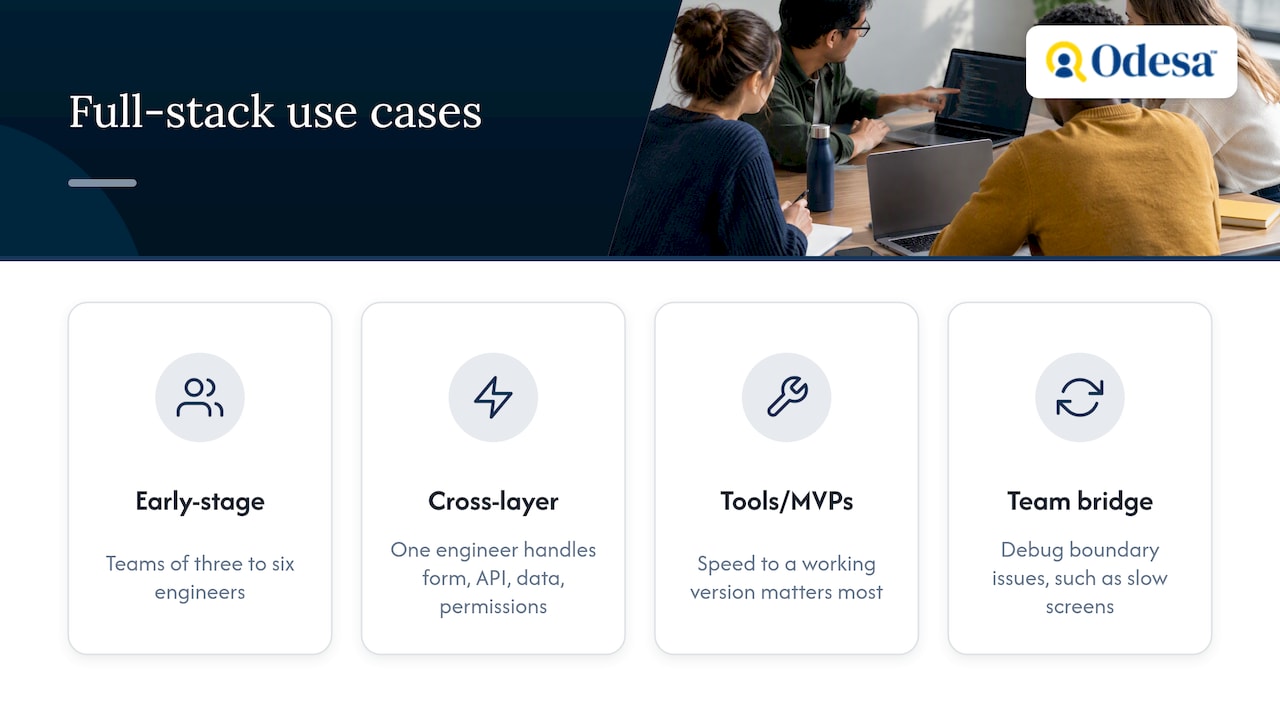
Early-stage products. Indeed’s U.S. guidance points out that breadth is especially useful in startups and small businesses, where role boundaries overlap and one developer may need to contribute across several parts of the product. If you have a team of three to six engineers and need a feature from database table to button, a full-stack hire removes a handoff.
Features that touch everything. A new onboarding flow, a billing screen, or an admin dashboard involves a form, an API endpoint, a data model and permission logic. One engineer who understands all four can ship it coherently.
Internal tools and MVPs. When speed to a working version matters more than squeezing the last bit of performance from one layer, broad coverage is the efficient choice.
Bridging a specialist team. Even mature teams benefit from a few engineers who understand both sides, because they can debug issues that appear at the boundary, such as a slow screen caused by an inefficient query.
If this describes your situation, our page on hiring senior full-stack developers outlines the profiles we place and the rates, which start at $45 per hour.
Where specialists earn their place
InformationWeek’s experts put the distinction clearly: full-stack developers cover the development process and system integration, while specialists focus on complex or unique parts that need deep expertise. The same article quotes the view that it is increasingly hard for one person to master every area of the modern stack because technology advances so quickly.
A specialist usually makes sense in these situations:
- Performance-critical backend work. High-concurrency services, low-latency APIs and systems with heavy data processing benefit from engineers who live in one language and runtime. Depending on your stack, that might be a Go developer, a Java developer, a .NET developer or a Rust developer.
- Framework-heavy frontends. Large applications with complex state, routing and rendering strategies gain from people who know a framework deeply, such as Angular or Next.js.
- Data and pipelines. Analytics, warehousing and streaming are a separate discipline. Data engineers design the systems that other developers depend on.
- Cloud infrastructure. When cost, reliability and security at scale become the main risk, AWS engineers own the platform so product developers do not have to.
- Quality assurance. Release confidence is its own skill set, covered by QA and test automation engineers.
The broader argument for specialists comes from a 2022 InfoWorld piece. Its author contends that for many problems, collaborating front-end and back-end engineers are far more effective than a full-stack soloist, because each can focus entirely on their domain and work together on the overlap. That view holds up as products grow: once the codebase and the user base are large, depth pays off in ways breadth cannot.
Five questions to decide between them
InformationWeek’s guidance boils the decision down to assessing whether the work needs broad frontend-to-backend coverage and integration, or deep expertise for complex or unique components. Turn that into five practical checks.
- How many engineers will you have in six months? With fewer than five, each person usually needs to cross layers. With ten or more, specialization becomes practical because there are enough people to cover each area.
- Where is the real technical risk? If the risk is shipping features quickly, favor breadth. If it is scale, security, data integrity or a hard UX problem, put a specialist on that risk.
- How often does work cross the frontend/backend boundary? Frequent crossings mean handoff costs. A full-stack engineer removes them. Rare crossings mean specialists can work in parallel without friction.
- Who will own the system after launch? Long-lived systems need people who understand the whole picture and people who can go deep when something breaks. Plan for both, even if you hire them in sequence.
- What can your management bandwidth handle? Specialists need clear interfaces and someone to coordinate them. Full-stack engineers need less coordination but more trust and a clear definition of what “done” means.
A useful pattern for growth-stage companies is to start with one or two senior full-stack engineers, add a specialist when a particular layer becomes the bottleneck, and keep at least one person who understands the whole system. The labor market supports planning for this kind of growth: the U.S. Bureau of Labor Statistics projects software-developer employment rising from 1.718 million jobs in 2025 to 1.893 million in 2035, a 10.2% increase. Competition for experienced engineers is part of the picture, so it helps to know early which profile you need.
Hiring mistakes to avoid
Treating “full-stack” as “does everything.” HackerRank identifies this as a common hiring mistake: using the term as a euphemism for expecting one developer to do everything, which leads to misalignment and attrition. Write down the layers, languages and responsibilities you actually expect, and rank them. A full-stack role that is 70% backend and 30% frontend is a different job from the reverse.
Hiring junior breadth when you need senior judgment. Breadth without seniority produces working features that are hard to maintain. Architecture decisions, data modeling and security choices are where experience matters most, and they are hard to fix later. Our technical vetting process explains how senior engineers can be assessed on exactly these decisions.
Hiring a specialist too early. A single-layer expert without a counterpart can leave your team waiting on the other half of every feature. Check that you have, or will hire, the complementary role.
Ignoring the engagement model. The right person is only half the decision. Whether you hire directly, add contractors, or bring in a team changes cost and speed. Our comparison of staff augmentation and recruitment walks through that choice.
Our perspective on mixing both
We work with growth-stage companies that rarely face a pure either/or choice. A founder who says “we need a full-stack developer” often has a product with a clear backend need and a smaller frontend need. A founder who asks for a Java specialist sometimes needs someone who can also ship the admin screens around it. The title matters less than the shape of the work.
Our approach is to start from that work. The founder talks directly with the client to understand the product, the stage of the team, and the problem that is slowing it down. Then we match from a network of pre-vetted senior engineers in Eastern Europe, whether the right profile is a broad full-stack engineer or a specialist in a particular language or framework.
We also treat the first engineer as the start of a team, not a one-off. Staff augmentation lets you add a specialist later without restarting your search, and our model is built around keeping engineers on the engagement long term, so context stays in the team as it grows.
Our advice: hire senior, define the scope in plain terms, and add depth where your system shows you need it.
Editorial Team
Find the right profile with Odesa
If you already know whether you need breadth or depth, we can move quickly. Our staff augmentation service starts from $45 per hour and places senior, pre-vetted engineers into your team, full-stack or specialized. If you would rather hire someone directly, our tech recruitment service is $7,999 one-off per successful hire.

Not sure which profile fits? Describe your product and team on odesa.co and we will help you shape the role before you commit.
FAQ
What is the difference between a backend developer and a full-stack developer?
A backend developer focuses on server-side work: logic, APIs, databases, integrations, performance and security. A full-stack developer covers that scope to a working level and also builds the frontend and the connection between the two. The practical question is whether you need depth on the server or coverage across the whole feature.
Is a full-stack developer better than a frontend developer?
Neither is better in general. A full-stack developer suits work that spans interface, API and data. A frontend developer suits products where interface quality, accessibility and responsiveness are the main differentiator. Many teams pair a frontend specialist with full-stack or backend engineers.
Should a startup hire full-stack developers or specialists first?
Most early-stage teams hire full-stack engineers first, because small teams need people who can contribute across the product, as Indeed’s U.S. guidance describes. Add specialists when a specific layer, such as data, infrastructure or a complex frontend, becomes the constraint.
Can full-stack and specialized developers work on the same team?
Yes, and it is a common arrangement. Full-stack engineers handle integration and end-to-end features, while specialists take on the parts that need deep expertise. InformationWeek’s experts say the two approaches complement each other rather than compete.
How should I write a full-stack job description?
List the layers, languages and frameworks the person will actually use, and say which carry the most weight. Avoid asking for expertise in everything. A clear, ranked scope attracts better candidates and reduces the mismatch that HackerRank links to attrition.
Sources
- What is Full Stack Development? (AWS)
- Front End vs Back End: Difference Between Application Layers (AWS)
- Full Stack Developer: Definition, Skills and Examples (Indeed)
- A Guide to Front-End vs. Back-End vs. Full-Stack Development (Indeed)
- IMHO: The Mythical Fullstack Engineer (Stack Overflow)
- Should Today’s Developers Be More or Less Specialized? (InformationWeek)
- Full-stack engineering is one-third as good (InfoWorld)
- How to Hire a Full Stack Developer (OnJob)
- How to Hire Software Developers (HackerRank)
- Computers and Information Technology (U.S. Bureau of Labor Statistics)
Recommended
- Hire Senior Full-Stack Developers
- Hire Senior Next.js Developers
- Hire Senior Go (Golang) Developers
- Hire Senior .NET Developers
This article may have used AI tools in the writing process. Facts, figures, and recommendations can be wrong or out of date. Do not treat this as professional advice.