
A technical vetting process is the structured sequence of checks you use to confirm that an engineer can do the job before you commit to them. For senior hires, a sound process has five parts: a resume and recruiter screen, a technical screen, a work-based assessment, a structured interview loop scored against a rubric, and reference and eligibility checks. Each stage should test something the previous one could not, and every candidate for the same role should go through the same steps.
This guide walks through the order of those stages, what each one reveals, how to score the results consistently, which legal limits apply in the United States, and what usually causes a candidate to fail.
TL;DR
- Run vetting in stages, from cheap filters to expensive ones: recruiter screen, technical screen, work sample, interview loop, then references and checks.
- For senior engineers, test real decisions (debugging a production failure, weighing architecture trade-offs), not only coding puzzles.
- Score every candidate against a written rubric tied to the role. Structured interviews are among the strongest predictors of job performance.
- In the U.S., selection tools that screen out protected groups must be job-related and consistent with business necessity.
- If you do not have the time to run this yourself, a partner with pre-vetted engineers can shorten the cycle, as long as you can see how they vet.
Table of Contents
- What technical vetting means for a senior engineer
- The stages of a technical vetting process, in order
- Which assessments to use, and what each one shows
- How long should an assessment take?
- Score candidates the same way every time
- Legal guardrails in the United States
- What causes a candidate to fail vetting
- Questions to ask a staffing partner about vetting
- Our perspective
- Working with Odesa when you need senior engineers faster
- A simple vetting plan you can adopt this week
- FAQ
- Sources
What technical vetting means for a senior engineer
Vetting a junior developer is mostly about fundamentals. Vetting a senior engineer is about judgment. You want to know whether the person can diagnose a failing system, choose between imperfect designs, explain the choice to colleagues, and ship without constant supervision.
That changes what the process measures. A resume lists technologies, but it does not show how the candidate decided to use them. A good vetting process therefore asks the candidate to explain real work in their own words and tests that explanation against concrete problems. Guidance on senior evaluation recommends examining real-world decisions such as diagnosing production failures and evaluating architectural trade-offs, rather than relying on resumes and coding exercises alone.
In practice, technical vetting answers four questions:
- Depth: Does the candidate understand the systems they claim to have built?
- Judgment: Do they make sound trade-offs under constraints?
- Communication: Can they explain technical choices to engineers and to non-engineers?
- Authenticity: Is the experience on the resume theirs, and can they discuss it in detail?
If a stage in your process does not help answer one of these, it is probably adding time without adding information.
The stages of a technical vetting process, in order
The order matters because each stage costs more of your team’s time than the one before. A sample interview loop described in the Holloway guide to technical hiring includes a recruiter screen, a technical phone screen, an optional take-home evaluation, onsite interviews, interviewer feedback and possible follow-ups. The version below adapts that sequence for senior roles.
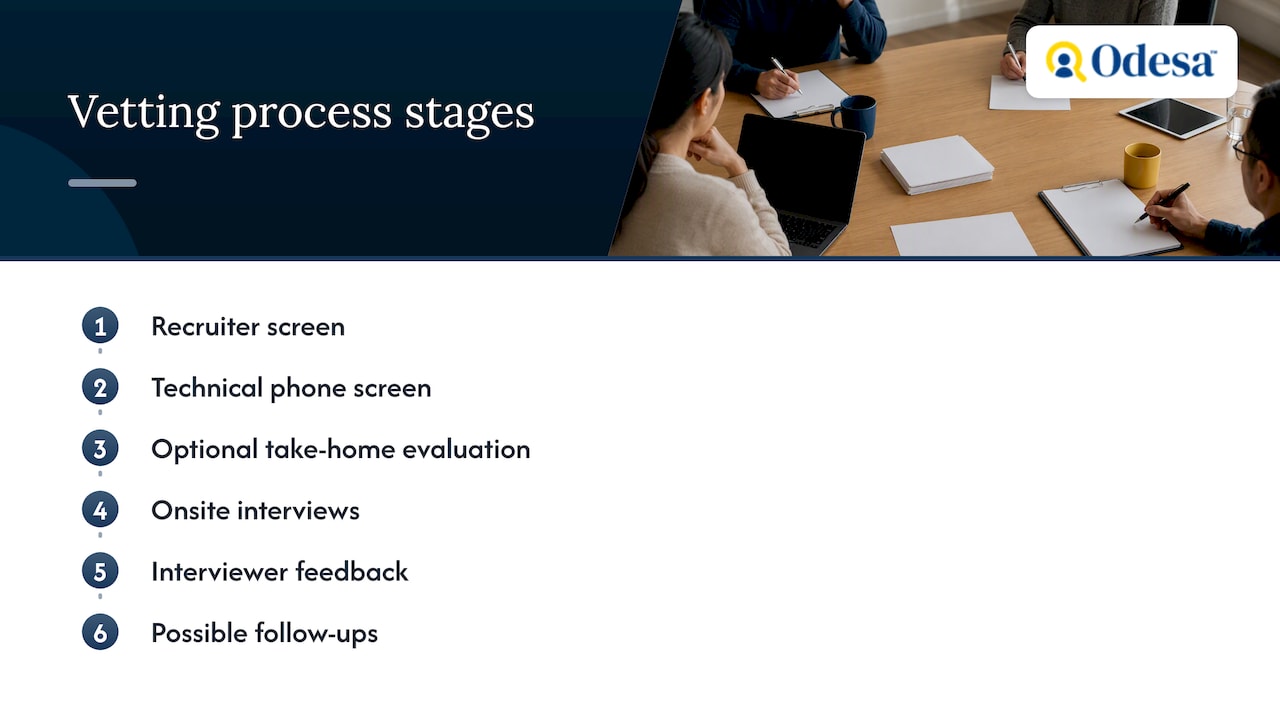
1. Resume and recruiter screen
The first filter covers the basics: relevant experience, seniority level, compensation expectations, location and time zone overlap, work authorization, and motivation for the role. This stage is not technical, but it protects every later stage from wasted effort. Write down the must-haves before you start so the screen is consistent.
2. Technical screen
A 30 to 45 minute call with an engineer should confirm depth in the core stack. Ask the candidate to walk through a system they built: what it did, what was hard, what they would change. Follow-up questions reveal quickly whether the experience is first-hand. Our own technical screening guide for developers covers how to structure this call.
3. Work-based assessment
This is where the candidate shows how they work. Options include a short coding exercise, a code review of a realistic pull request, a production-debugging scenario, or an architecture discussion. Each reveals something different, covered in the next section.
4. Interview loop
The loop is a set of interviews, each with a defined focus: system design, a project deep dive, collaboration and communication, and, where relevant, a conversation with the hiring manager about expectations. Interviewers submit written feedback before they compare notes, so one strong voice does not set the outcome.
5. References and final checks
Reference conversations with former managers or peers confirm what the interviews suggested. Employment eligibility and any background checks your company requires come last, since they are the most formal and should follow the same rules for every finalist.
Which assessments to use, and what each one shows
There is no single best format. The research on senior evaluation lists coding exercises, code reviews or work samples, production-debugging scenarios, architecture discussions and project deep dives as the options employers can combine. Choose based on what the role demands.
| Format | What it reveals | Best used for |
|---|---|---|
| Coding exercise | Fluency, problem decomposition, testing habits | Confirming baseline skill in the core language |
| Code review of a sample pull request | Standards, attention to risk, how feedback is phrased | Roles that review others’ code or lead a team |
| Production-debugging scenario | Diagnostic method, calm under ambiguity | On-call, backend and infrastructure roles |
| Architecture discussion | Trade-off reasoning, scalability and cost awareness | Senior and staff-level hires |
| Project deep dive | Ownership, authenticity, communication | Every senior hire |
Two practical notes. First, ask for the reasoning, not only the answer: a candidate who chooses a message queue and explains what they gave up is showing more than one who names the “right” tool. Second, use the same exercise for every candidate for the role, so you can compare outcomes.
If you want a bank of questions to start from, you can browse real-world interview question examples grounded in how production systems fail, then adapt them to your stack. We also publish senior developer interview questions with a way to score practice answers.
How long should an assessment take?
Keep assessments proportionate. A short, well-defined exercise tests a specific competency, while a long take-home tends to lose strong candidates who already have jobs and other offers. As a working rule, aim for roughly an hour of candidate time for a screen-level exercise, and make any larger take-home optional, paid or replaceable with a live session. If the exercise takes your own engineers more than a short sitting to complete, it is too long for a candidate.
Relevance matters as much as length. Build the task from a real problem your team has faced, and remove anything that depends on trivia. That keeps the assessment fair and also makes it more predictive, because it resembles the actual work.
Score candidates the same way every time
Unstructured conversations feel natural but produce inconsistent decisions. Structured interviews fix this by setting rules for how responses are elicited, observed and evaluated. The U.S. Office of Personnel Management notes that structured interviews limit interviewer discretion and increase agreement between raters, with higher-structure interviews showing higher validity and reliability. A review published by the Society for Industrial and Organizational Psychology found that structured interviews were the strongest predictors of job performance, with a mean operational validity of .42.
To put that into practice:
- Define the role first. List the responsibilities and the skills each one requires. The rubric comes from this list, not from the interviewer’s taste.
- Write the rubric before the first interview. For each dimension (technical depth, design judgment, communication, collaboration), describe what a weak, adequate and strong answer looks like.
- Assign one dimension per interviewer. This avoids five people asking the same question and leaves no dimension untested.
- Score independently, then discuss. Written feedback submitted before the debrief protects against anchoring on the first opinion voiced. The Holloway guide describes interviewers providing written feedback and/or discussing it after standardized loops.
- Record the decision and the reasons. If you later need to explain why a candidate was or was not hired, a short written record is your evidence.
For a fuller model, see our framework on how to evaluate developers, which breaks scoring into criteria hiring managers can reuse.
Legal guardrails in the United States
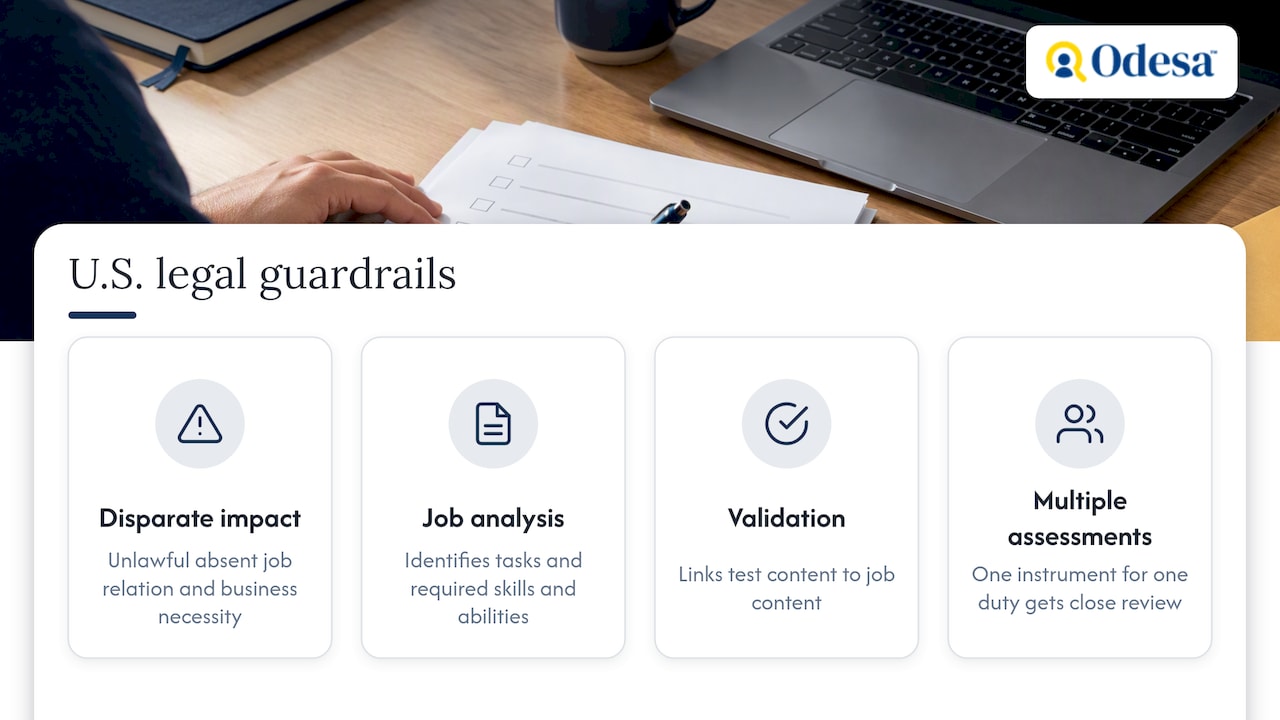
Vetting is a selection procedure, and U.S. employment law applies to it. Under Title VII and the ADA, a practice that has a disparate impact on a protected group is unlawful unless the employer shows it is job-related for the position and consistent with business necessity, according to testimony before the Equal Employment Opportunity Commission (EEOC). The same logic applies whether the test is a human interview, a coding platform or an automated screening tool.
The practical way to meet that standard is a job analysis. As an industrial-organizational psychologist explained to the EEOC, a job analysis identifies the tasks of a job and the knowledge, skills and abilities needed to perform them, and a validation study can then link test content to job content. For most growth-stage companies, a full validation study is not realistic, but a written job analysis that your rubric follows is a sensible baseline. The Uniform Guidelines on Employee Selection Procedures also state that sole reliance on a single selection instrument tied to only one job duty will be closely reviewed, which is another reason to use several assessment types.
Companies that hire through a staffing partner should ask how that partner documents its criteria. Employment counsel can confirm what applies to your situation, particularly if you use automated tools, accommodations for candidates with disabilities, or hiring across states.
What causes a candidate to fail vetting
Candidates rarely fail on a single wrong answer. The pattern is usually one of these:
- Cannot explain their own work. They describe a system at a high level but cannot say why a design decision was made or what went wrong.
- No trade-off reasoning. Every answer is a favorite tool, with no discussion of cost, risk or alternatives.
- Weak diagnostic method. Faced with a production failure, they guess rather than form hypotheses and test them.
- Communication gaps. They cannot explain a concept to a product manager, or they dismiss questions.
- Inconsistency. Details differ between the resume, the screen and the deep dive.
- Mismatch with the role. Strong skills, but in a stack, scale or working style the role does not need.
From the employer side, the common failures are just as instructive: no rubric, interviewers who ask different questions of different candidates, long take-homes, and no written feedback. Fix those and your pass and fail decisions become easier to defend.
Questions to ask a staffing partner about vetting
Many companies outsource the first half of vetting to a recruiting or staff augmentation partner. That can save weeks, but only if the partner’s process is visible. Ask:
- Which stages does every engineer go through before I see a profile?
- Do engineers explain real projects live, or is the evaluation mostly resume-based?
- How do you test seniority specifically: design, debugging, communication?
- Who matches the engineer to my team, and what do they know about my stack and culture?
- What happens if the fit is wrong after the start date?
Our guide on how to choose a staffing or recruiting company goes deeper on the comparison, and staff augmentation versus recruitment explains which model suits which situation.
Our perspective
We see the same mistake at growth-stage companies again and again: the vetting process is designed for the interviewer’s convenience rather than for the signal it produces. A founder or engineering manager with a full calendar runs a loose conversation, likes the candidate, and discovers three months later that the person cannot work independently.
Our model works the other way around. We supply pre-vetted senior engineers from Eastern Europe, and the founder is directly involved in matching, because a technically strong engineer can still be the wrong fit for a particular team, stack or pace. Matching is part of vetting, not a step that comes after it.
We would also tell any hiring manager the same thing we tell ourselves: write down what the role needs, test those things with real problems, and score everyone against the same criteria. Whether you run the process in-house or work with us through staff augmentation or direct recruitment, that discipline is what produces retention.
Editorial Team
Working with Odesa when you need senior engineers faster
Running a full vetting loop takes engineering time that growth-stage teams often lack. We provide senior, pre-vetted engineers through staff augmentation, from $45 per hour, or through tech recruitment at $7,999 one-off per successful hire. The founder works directly with you to understand the role before anyone is proposed.
If you are still deciding on the engagement model, our overview of IT staff augmentation explains when it works and how to plan it. You can also start at odesa.co and tell us about the role.
A simple vetting plan you can adopt this week
If you have no process today, do not try to build everything at once. Start with this:
- Write a one-page role description listing five to eight responsibilities.
- Turn each responsibility into a skill you can test, and draft a three-level rubric for it.
- Pick one work-based assessment that mirrors a real task, capped at about an hour.
- Assign each interviewer one dimension and require written scores before the debrief.
- Review the first three hires: which signals predicted performance, and which did not? Adjust the rubric accordingly.
That last step is what turns vetting from a ritual into a system. Over a few hiring rounds, you will learn which questions separate strong senior engineers from convincing talkers in your specific environment.
FAQ
What does technical vetting mean?
Technical vetting is the structured evaluation of a candidate’s technical skills, judgment and communication before an offer. It usually combines a technical screen, a work-based assessment and a scored interview loop. The goal is to confirm that the experience on the resume is real and relevant to the role.
What happens during a technical interview process?
A typical sequence is a recruiter screen, a technical phone screen, an optional take-home or live exercise, a set of interviews and a debrief where feedback is compared. For senior roles, expect system design and a deep dive into past projects. Many processes end with reference checks.
What would fail a technical vetting?
The most common causes are being unable to explain past work in detail, weak trade-off reasoning, poor debugging method, unclear communication and inconsistencies between the resume and interviews. A mismatch with the specific role can also end the process even when the candidate is strong.
How many interview rounds are enough for a senior engineer?
There is no fixed number, but each round should test something new. Three to five touchpoints, including the screen, a work-based assessment and a structured loop, are usually enough to compare candidates fairly. More rounds without new information mainly raise the chance of losing the candidate.
Can a staffing partner handle technical vetting for me?
Yes, and it can shorten hiring considerably, provided you understand its stages and who makes the matching decision. Ask how engineers are tested for seniority and what happens if the fit is wrong. You should still run a final interview focused on your own team and stack.
Sources
- The Interview Loop, The Holloway Guide to Technical Recruiting and Hiring
- How to Evaluate Senior Engineers Beyond Resumes and Coding Tests
- Structured Interviews, U.S. Office of Personnel Management
- Is Cognitive Ability the Best Predictor of Job Performance?, SIOP
- Testimony of Matthew Scherer, U.S. Equal Employment Opportunity Commission
- Statement of Kathleen K. Lundquist, Ph.D., U.S. Equal Employment Opportunity Commission
- Uniform Guidelines on Employee Selection Procedures
Recommended
- Hire Senior AI/ML Engineers
- Hiring a Senior React Developer: A Founder’s Checklist
- How to Evaluate Developers: A Framework for Hiring Managers
- Hire Data Engineers
This article may have used AI tools in the writing process. Facts, figures, and recommendations can be wrong or out of date. Do not treat this as professional advice.