

Staff augmentation fits when you need senior engineering capacity quickly, for a defined scope or an uncertain horizon. Full-time hiring fits when the role is core to your product and you expect to need it for years. Most growth-stage companies end up using both, and the useful question is which model should cover which part of the roadmap right now.
This guide compares the two on cost, speed, control, retention and risk. It then gives a decision framework and a way to combine them as your needs change.
TL;DR
- Staff augmentation adds vetted engineers to your team on a contract basis. You direct the work, and the provider handles sourcing, vetting and contract administration.
- Full-time hiring builds long-term ownership and culture, but it takes longer and carries costs well beyond salary.
- Choose augmentation for urgent backlogs, specialist skills, variable scope or a trial before a permanent commitment. Choose hiring for roles that hold core product knowledge.
- Compare total cost, not salary against hourly rate. Benefits, recruiting, onboarding and time to productivity all belong in the calculation.
- A hybrid works well: a small permanent core, with augmented engineers covering peaks and specialist work.
Table of Contents
- What the two models actually are
- Side-by-side comparison
- Cost: compare the full picture
- Speed: weeks versus months
- Control, culture and knowledge
- Flexibility and risk
- When to choose staff augmentation
- When full-time hiring is the better choice
- Seven questions to settle the decision
- Combining both as your needs change
- Our perspective
- How Odesa can help
- FAQ
- Sources
What the two models actually are
The terms get blurred, so start with clear definitions.
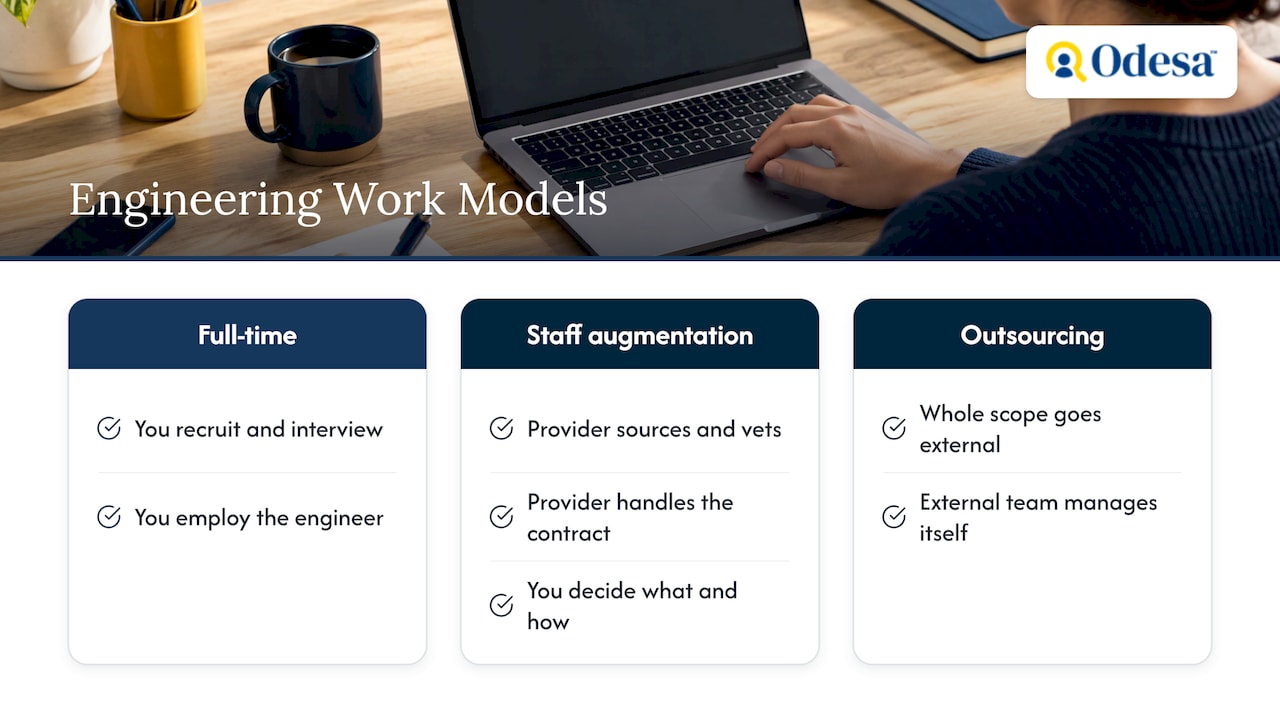
Full-time hiring means you recruit an engineer as your own employee. You run the search, interview, make an offer, run payroll, provide benefits and carry the long-term employment relationship. The engineer takes on your culture, roadmap and institutional knowledge over time.
Staff augmentation means you add external engineers to your existing team for a period. They work inside your processes: your standups, your repositories, your project management tools. You decide what they build and how. The provider sources and vets the engineers and handles the contract and, depending on the arrangement, the payroll and compliance on their side.
Two neighbors are often confused with augmentation. Outsourcing hands a whole scope of work to an external team that manages itself; see our guide on staff augmentation vs outsourcing for engineering. Managed services hand over ongoing operation of a function; we cover that in staff augmentation vs managed services. Augmentation differs from both because you keep direction of the work.
There is also a third route that sits between the two: direct recruitment, where a partner finds and vets a candidate and you hire them as your own employee for a one-time fee. We compare it with augmentation in staff augmentation vs recruitment.
Side-by-side comparison
| Factor | Staff augmentation | Full-time hiring |
|---|---|---|
| Time to start | Often days to a few weeks once a match is agreed | Typically weeks to months, from posting to start date |
| Cost structure | Hourly or monthly rate, no benefits or payroll taxes on your side | Salary plus benefits, payroll taxes, recruiting and onboarding |
| Commitment | Flexible, scalable up or down | Long-term, with notice and severance considerations |
| Control of work | You direct tasks and priorities | You direct tasks, priorities and career path |
| Institutional knowledge | Builds during the engagement, can leave with the engineer unless retention is managed | Accumulates inside your company |
| Best for | Backlogs, specialist skills, variable scope, trials | Core product ownership, leadership, long-term roadmap |
| Main risk | Knowledge walking out at contract end, weak integration | Slow, costly mis-hires, fixed cost in a downturn |
Cost: compare the full picture
The most common mistake in this comparison is setting a salary next to an hourly rate. They measure different things.
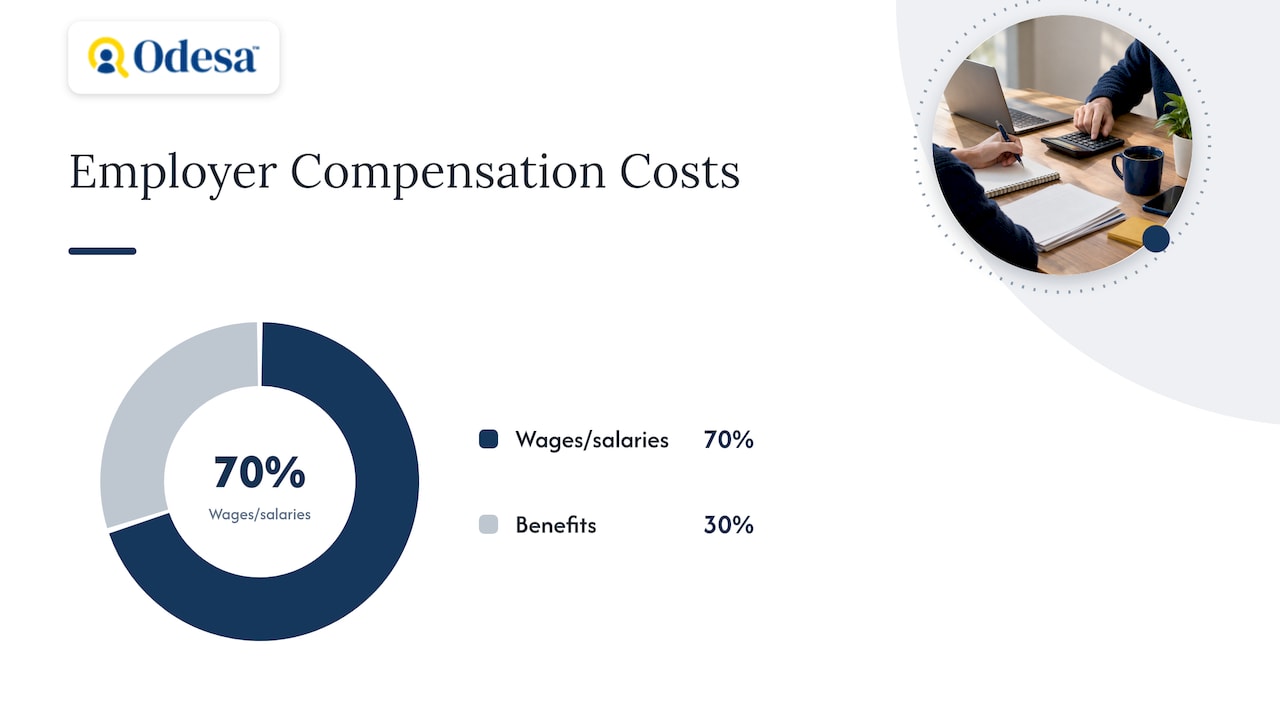
An employee’s salary is only part of what you pay. The U.S. Bureau of Labor Statistics reports that for private industry workers, benefits made up 30.0 percent of employer compensation costs in June 2026, with wages and salaries making up the other 70.0 percent. For full-time private industry workers, benefits were 31.5 percent. In other words, a salary understates what an employee costs by roughly a third before you count anything else.
Then add the costs that never appear in a compensation survey:
- Recruiting. Job ads, recruiter fees or internal recruiter time, screening and interview hours from your senior engineers.
- Onboarding. Equipment, software licenses, and the weeks of reduced output while the new hire learns the codebase.
- Manager time. Coaching, code review and context-sharing that pull your existing engineers away from their own work.
- Mis-hire risk. A hire that does not work out means repeating the whole cycle.
We go through these line by line, with US salary ranges, in our breakdown of the cost of hiring a US software developer.
Augmentation replaces most of these with a single rate. Our staff augmentation starts from $45 per hour for senior engineers, and our model is built so that clients can save up to 53% compared with local hiring rates. That saving comes mainly from drawing on senior engineers in Eastern Europe rather than competing in the most expensive US metro markets. Your actual figure depends on the role, seniority and hours, so run it against your own numbers.
A fair comparison has three steps:
- Calculate the fully loaded annual cost of the employee: salary, the benefits share, recruiting and onboarding.
- Calculate the annual cost of the augmented engineer: hourly rate multiplied by the hours you actually need.
- Divide each by the productive output you expect, and compare cost per productive month, including the ramp-up period.
Augmentation tends to win where hours are uneven or the need is temporary, because you pay only for the capacity you use. A permanent hire tends to win where the work is steady and continuous for several years, because you avoid paying a provider’s margin on top of the engineer’s pay.
Speed: weeks versus months
Hiring is slow because it is sequential. You write the role, source candidates, screen, run technical interviews, extend an offer, wait through negotiation and notice periods, and only then begin onboarding. For senior engineers, who are often employed and fielding other offers, the process stretches further.
Augmentation compresses most of this. The provider already holds a pool of vetted engineers, so the work shifts to matching. At Odesa, the founder engages directly with each client to understand the stack, the team and the working style before proposing engineers. That is slower than picking a name from a list, and deliberately so: a quick wrong match costs more than a few extra days of a good one.
Speed also has a second half: time to real productivity. Any new person, employee or contractor, needs time to learn your code and conventions. Senior engineers shorten this, which is one reason we place only senior, pre-vetted people. For a view on how long hiring cycles run for technology talent across the market, see this piece on why hiring feels harder in 2026.
Control, culture and knowledge
The common objection to augmentation is that contractors will never feel like part of the team. In practice, integration depends on how you set it up more than on the contract type.
Augmented engineers integrate well when they:
- Join your tools and channels on day one, not a separate workspace.
- Attend the same standups, planning sessions and retrospectives.
- Have a named point of contact who owns their onboarding.
- Work in overlapping hours with your team. Engineers in Eastern Europe typically have several hours of overlap with US time zones, particularly the East Coast.
- Are told the “why” behind the work, not just the ticket.
Full-time employees still have clear advantages in some areas. They can grow into technical leadership, mentor others over many years and carry product context that no outside engineer fully absorbs. If a role requires the person to think like a product owner and commit long term, hire.
The knowledge risk with augmentation is real and manageable: documentation, code review and pairing keep knowledge in your repository rather than in one person’s head. It is also where retention matters. We back our placements with a long-term retention commitment, so the engineer who learns your system is likely to stay on it.
Flexibility and risk
Flexibility is the strongest argument for augmentation. You can add two engineers for a launch, scale to five during a migration and drop back to one afterward without a layoff process. For a startup with uncertain funding or a roadmap that changes each quarter, this matters.
Full-time hiring puts risk on your side: a fixed cost that continues if revenue slows, a long search to replace anyone who leaves, and the cost of a mis-hire. Employment also brings legal responsibilities that vary by state. For questions about classification, severance or benefits obligations, talk to your employment attorney or HR advisor rather than relying on a general guide.
Augmentation has its own risks that you manage through the arrangement:
- Dependency. If one engineer holds all knowledge of a system, their departure hurts. Spread knowledge through documentation and review.
- Integration friction. Poor onboarding produces poor results regardless of talent. Plan the first two weeks.
- Provider quality. Vetting standards differ widely. Look at how a provider screens engineers; our technical vetting process shows what a rigorous one covers.
When to choose staff augmentation
Augmentation is usually the better fit in these situations:
- You have a backlog and a deadline. A launch, a funding milestone or a customer commitment needs more capacity now, not after a three-month search.
- You need a specialist for a defined period. A migration, an integration, a security hardening or a performance project does not justify a permanent role.
- Your scope is uncertain. Early-stage roadmaps change. Capacity you can scale is safer than headcount you cannot.
- You want to test before committing. Working with an engineer for a few months shows you fit better than interviews do. If it goes well, a conversion to a direct hire can follow.
- Your local market is too expensive or too thin. For some stacks, senior talent in your city is scarce and costly. Our comparison of Eastern European and Latin American developers looks at the regions US companies most often use.
- You lack hiring bandwidth. If your CTO is also your recruiter, every hour spent interviewing is an hour not spent building.
Our guide on when IT staff augmentation works and how to plan it goes deeper on setup.
When full-time hiring is the better choice
Choose to hire when:
- The role is core to your product. Your first engineering lead, an architect, or the owner of your central system should be an employee with a stake in the outcome.
- The work is steady and long term. If you will need the same capacity for several years, a direct hire spreads recruiting cost over a long period.
- You are building a management structure. People managers and tech leads shape culture and need to be inside it.
- Compliance or customer contracts require employees. Some regulated or government-adjacent work restricts who can access systems or data. Confirm this with counsel and your contracts.
If you are leaning toward hiring but the search itself is the obstacle, direct recruitment can shorten it. Our tech recruitment service is a flat $7,999 per successful hire, and the engineer becomes your employee.
Seven questions to settle the decision
Before choosing, answer these as a team:
- How long will you need this capacity: under six months, six to eighteen months, or indefinitely?
- Is the scope defined, or will it shift as you learn?
- How much of your senior engineers’ time can go to interviewing and onboarding?
- Does the role hold knowledge or decisions that must stay inside the company?
- What is the cost of the work arriving three months late?
- Can you document and review work well enough to protect knowledge?
- If the role disappeared next year, what would that cost you under each model?
If most answers point to short horizon, shifting scope and urgency, augment. If they point to permanence, ownership and stable demand, hire. A mix of answers points to a hybrid.
Combining both as your needs change
The two models are stages in the same plan more often than they are rivals. A common pattern for growth-stage companies:
- Stage one: augment to move. Bring in two or three senior engineers to ship the next release while you hire.
- Stage two: hire the core. Recruit permanent leads for the systems that define your product, and let augmented engineers work under their direction.
- Stage three: flex around the core. Use augmentation for peaks, migrations and specialist projects, and convert strong contractors to employees where it makes sense.
A mixed team works when the permanent engineers own architecture and standards, and the augmented engineers follow the same practices. Treat them as one team in meetings and reviews. Developing permanent staff also helps retention; this piece on growth opportunities for your employees offers ideas that apply to the permanent half of a hybrid team.
For teams that want a stable, long-term augmented group rather than ad hoc contractors, a dedicated development team is a related option.
Our perspective
We built Odesa around a simple observation: most growth-stage companies do not face a choice between augmentation and hiring. They face a timing problem. The roadmap needs senior engineers this quarter, and the hiring process delivers them next half-year.
Our answer is to make the first step fast and the match personal. The founder speaks directly with each client about the stack, the team and the working style before any engineer is proposed. That conversation is what makes a placement feel like an addition to your team rather than a contractor at the edge of it.
We also stand behind long-term retention. The value of a senior engineer grows with time spent in your codebase, so we design the engagement to keep the same person on your work. And when a client wants that engineer as a permanent hire, or wants a different person recruited directly, we offer that route too.
Our view is that augmentation is the lower-risk way to start for most startups. You get senior capacity, a lower cost than local rates, and the freedom to decide later what should become permanent.
Editorial Team
How Odesa can help
We offer both sides of this decision. Staff augmentation places senior, pre-vetted Eastern European engineers into your team from $45 per hour. Tech recruitment finds a permanent hire for $7,999 per successful hire. If you are unsure which fits, describe your stack and timeline and we will recommend one.
Start on the Odesa homepage to talk with the founder about your team.
FAQ
Is staff augmentation cheaper than hiring full-time?
Usually it is cheaper per productive month when your need is temporary or your local market is expensive, because you avoid recruiting, benefits and payroll costs. Benefits alone were 30.0 percent of private industry employer compensation costs in June 2026. For steady, multi-year work, the gap narrows, so compare total cost over your real time horizon.
How fast can staff augmentation start?
Once the scope and stack are clear and a match is agreed, engineers can often begin within days to a few weeks. The match step takes the most care. Full-time hiring commonly takes months from posting to a start date.
Can an augmented engineer become a full-time employee?
Often, yes, and many companies use augmentation as a working trial. The terms depend on the contract, so agree conversion conditions at the start. Talk to your attorney about the details of the employment relationship in your state.
Does staff augmentation work for small teams?
Yes. Small teams often benefit most, since a single senior engineer can unblock a roadmap and a founder has little time to run a search. The key is a clear onboarding plan and a named contact on your side.
What is the difference between staff augmentation and outsourcing?
With augmentation, you direct the engineers as part of your team. With outsourcing, an external team takes responsibility for delivering a defined scope and manages its own people. Our outsourcing comparison lays out seven questions to decide between them.
Sources
Recommended
- Staff Augmentation vs Recruitment: How to Choose
- 7 Questions to Choose Staff Augmentation or Outsourcing for Engineering
- Direct Hire vs Contract: An Employer Checklist and a Third Path
- Cost of Hiring a US Software Developer
This article may have used AI tools in the writing process. Facts, figures, and recommendations can be wrong or out of date. Do not treat this as professional advice.