

Most US companies should plan for roughly six to ten weeks to hire a software developer, and senior engineers sit at the long end. Published figures vary because they measure different things: the median for technical roles from Ashby’s 2026 data is 75 days to first fill, while the interview process alone usually takes a few weeks. This guide explains which number to use, where the days go, and what you can change.
TL;DR
- Expect about 42 days from first contact to offer for a US software engineer, and about 71 days to fill a senior or staff role from the day it opens.
- Time to hire and time to fill are different clocks. Compare your numbers only against the benchmark that starts and stops at the same points.
- The longest delays are usually at the top of the funnel (intake, sourcing) and at the end (slow offers), not in the interviews themselves.
- A written scorecard, fast debriefs, referrals and a short offer step are the cheapest ways to save weeks.
- If the role cannot wait, staff augmentation or a fixed-fee direct hire changes who does the sourcing, not the standard you hire to.
Table of Contents
- Time to hire vs. time to fill
- What the benchmarks say
- Why senior roles take longer
- Where the days go: a stage-by-stage view
- How to shorten the timeline without lowering the bar
- Estimating your own timeline
- When the role cannot wait
- How Odesa can help
- FAQ
- Sources
Time to hire vs. time to fill
The two terms are often used as if they were the same, and that is why benchmarks seem to contradict each other.
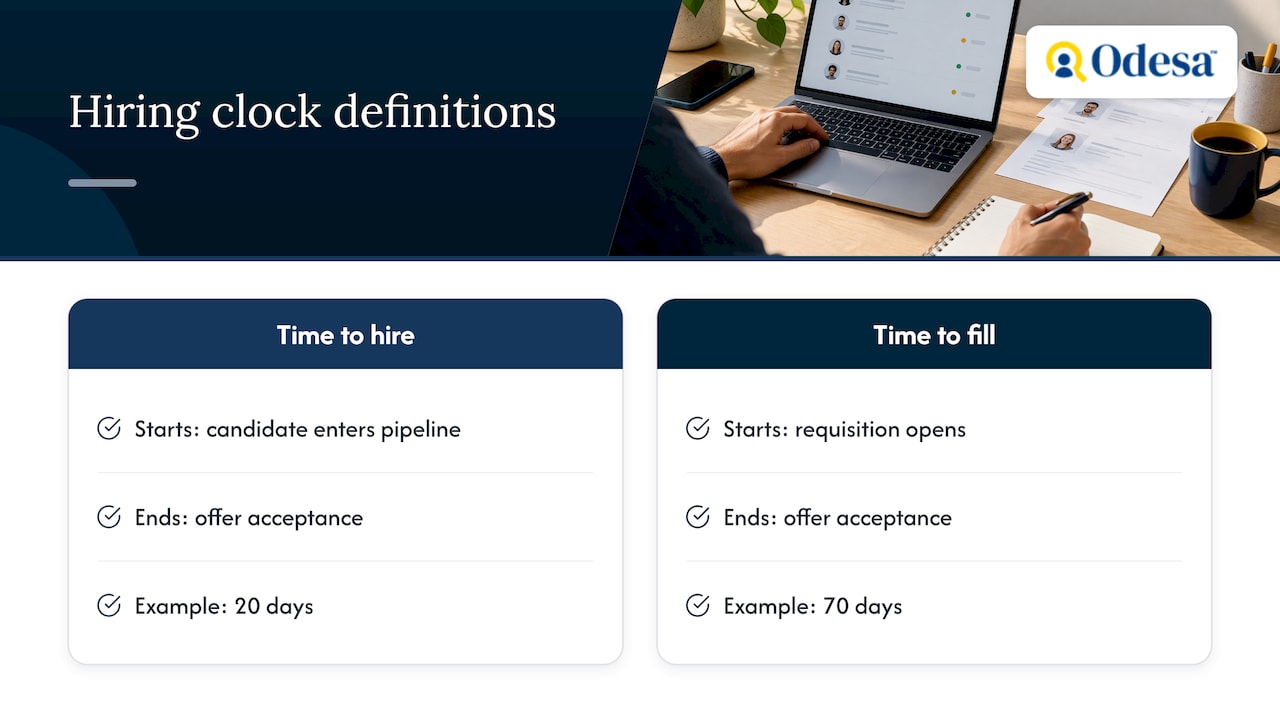
Time to fill starts when the job requisition is opened and ends when a candidate accepts the offer. SHRM defines it this way, as BusFactor’s explainer notes. It includes intake, approvals, sourcing and every interview.
Time to hire starts when the candidate who is eventually hired enters the pipeline and ends at offer acceptance. Greenhouse describes time to fill as a forecast of how long roles take to fill, and time to hire as a measure of how efficient the process is once a candidate is in it.
A company can have a 20-day time to hire and a 70-day time to fill without any contradiction. According to LatestRemote’s August 2026 article, that shape is the most common one: an efficient interview loop behind a slow top of the funnel. If you are the hiring manager, the second number is the one your product roadmap feels.
What the benchmarks say
No single figure fits every company. These are the most useful ones, each with what it measures.
| Benchmark | Figure | What it measures |
|---|---|---|
| SHRM 2025, all US roles | 44 days | Average time to fill, up from 33 days in 2021 |
| SHRM 2026, nonexecutive roles | 39 days | Median time to fill, down from 44 days the year before |
| Criteria 2024–2025, US software engineers | 42 days | Median time to hire, first contact to offer letter |
| Workable, IT and engineering, US and Canada | 56 days / 33 days | Time to fill / time to hire |
| Ashby 2026, technical roles | 75 days | Median time to first fill (business roles: 60 days) |
Read the table as a range rather than a contradiction. Companywide figures sit in the high 30s to mid 40s. Engineering-specific time to hire lands in the 30s to low 40s. Time to fill for technical roles runs from 56 to 75 days depending on the data set and the period. The slowest 10% of US software engineer hires, per the Criteria report cited above, cross 82 days from first contact to offer.
By that measure, a 60-day search for a developer is normal, not a sign that your process is broken. A 120-day search is a sign that something specific is stalling.
Why senior roles take longer
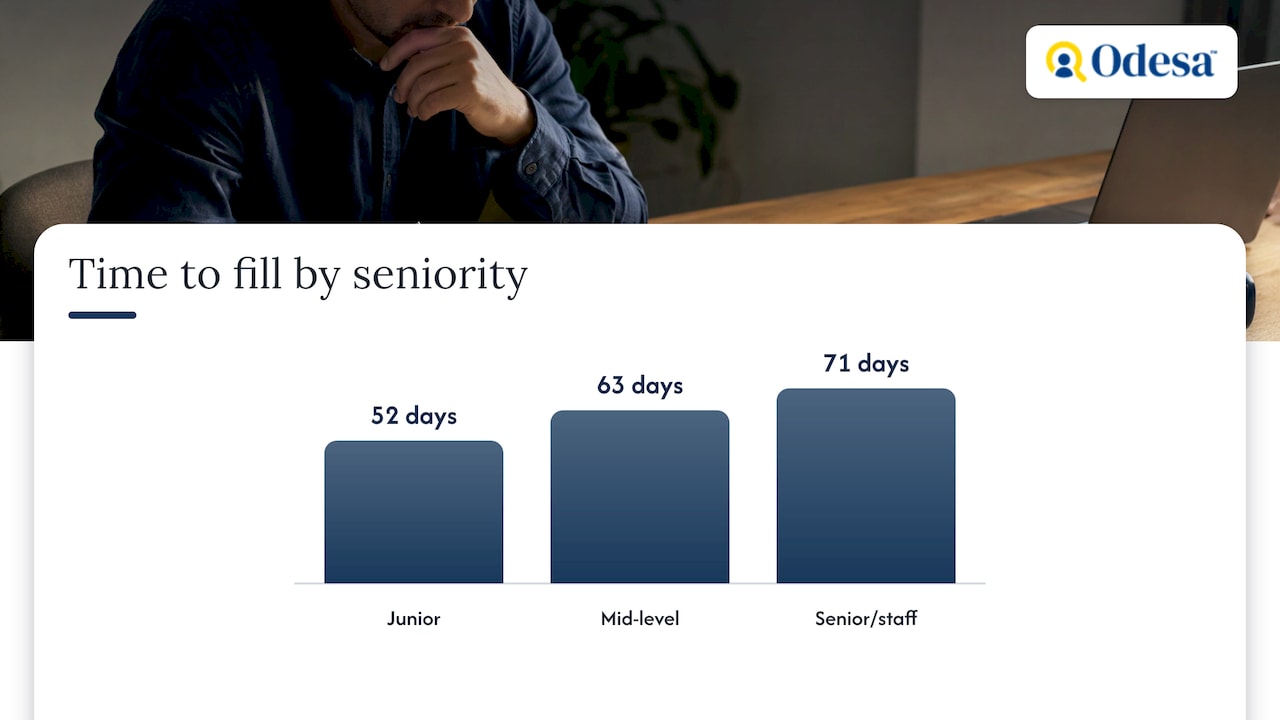
Seniority adds weeks. Ashby’s 2026 data, as summarized by BusFactor, shows a median of 52 days to first fill for junior roles, 63 for mid-level and 71 for senior and staff roles. Senior roles take 37% longer than junior ones.
Several things sit behind that gap:
- A smaller pool. Experienced engineers are mostly employed and not applying. Sourcing means outreach, not job posts.
- Heavier interview loops. Formation reports that the full process at most top tech companies runs four to eight weeks from application to offer. Faster companies compress it to two to three weeks, and rigorous senior or staff processes stretch to 10 to 12 weeks.
- More interviews per hire. SHRM’s 2025 benchmarking, as reported by SQ Magazine, found about 20 interviews per hire, up about 42% from 14 in 2021. Every extra interview is a scheduling problem.
- Negotiation. Senior candidates often hold more than one offer, so the last step is where a slow company loses.
Where the days go: a stage-by-stage view
The benchmarks give totals. In practice, a developer search breaks into stages, and the delay is rarely spread evenly.
Intake and role definition
This is the stage most companies leave out of their own metrics, because the clock “hasn’t started” in time-to-hire terms. It still counts toward time to fill. If the stack, level and must-have skills are argued over after the job goes live, expect the search to restart halfway.
Sourcing and screening
This is where time to fill and time to hire diverge. Referred candidates move faster: according to Ashby’s 2026 data in the BusFactor article, 52% of referred candidates pass the initial screen against 35% overall. A first screen that waits on one busy engineer’s calendar can add a week on its own. For a practical view of how to run this stage, see our guide to technical screening for developers.
Interviews
The loop itself is typically two to three weeks at a fast company and longer elsewhere. The average interview-to-offer ratio is about 3:1, based on SHRM 2025 data reported by SQ Magazine. That means for each offer you make, you have run about three final-stage conversations. Each of those has a calendar cost.
Offer and acceptance
This is where finished work is lost. Gem’s 2024 data, cited by BusFactor, puts offer acceptance for Engineering at 76%, the lowest of any department. The average across roles is about 82%, per SHRM 2025 figures in the SQ Magazine summary. A candidate you wanted for six weeks can go elsewhere in the three days it takes you to get approvals.
How to shorten the timeline without lowering the bar
Speed and quality conflict only when speed is bought by skipping evaluation. Most saved time comes from waiting less, not from evaluating less. BusFactor’s advice, published in September 2026, is to fix the longest wait before touching the interviews. These steps follow that logic.
- Write the scorecard before the job opens. List the three to five things the hire must be able to do and how each will be judged. It prevents re-scoping mid-search and makes debriefs short.
- Put one engineer on call for screens each week. A fixed slot beats ad hoc scheduling. Candidates get an answer in days, not weeks.
- Debrief within a day of the last interview. Memory fades, and so does candidate interest.
- Start with referrals. The screen pass rate above is the reason. Referred tech candidates also accept offers at 84% against 76% for sourced ones, according to the same Ashby data.
- Give every round one job. If two rounds test the same thing, drop one. Our framework for evaluating developers shows how to map each stage to a single question.
- Decide the offer in advance. Agree the salary band, the approver and the turnaround before the final interview, so the offer goes out the same day or the next.
- Have the paperwork ready. The agreement is the last place a closed candidate gets lost. If you plan to bring someone on as a contractor, having a template for a freelance developer agreement ready means legal review does not add a week at the end.
If you also want to see what a slow search costs beyond the calendar, our breakdown of the cost of hiring a US software developer covers salary, benefits and the hidden expenses.
Estimating your own timeline
Use benchmarks to set expectations, then build your own estimate from the stages you control.
- Count the days from the moment you decide to hire to the day the job goes live. Include approvals.
- Add the realistic sourcing window: for senior roles, plan on weeks, not days.
- Add the interview loop length, using your actual number of rounds and the scheduling gaps you saw in the last hire.
- Add offer, negotiation and notice period. A US engineer who is currently employed often gives two weeks of notice, and that start date counts toward when the work begins, even though it falls outside time to hire.
Then compare your total with the 56 to 75 day range for technical time to fill. If your plan shows 30 days, it is probably missing a stage. If it shows 110, find the longest single wait and fix that first.
One caution on cross-checking: a benchmark from a different period or definition will mislead. The SHRM all-role average rose from 33 days in 2021 to 44 days in 2025, and a later SHRM report cited by LatestRemote shows 39 days for nonexecutive roles. Numbers move year to year, so quote the year when you quote the figure.
When the role cannot wait
Some searches cannot absorb two or three months: a launch is committed, a key engineer has left, or a customer deadline is fixed. Then the question is who does the sourcing and who carries the risk while it runs. The main options are:
- Run the search in-house and accept the benchmark timeline.
- Use a recruiter and pay a placement fee, which hands over sourcing but not your interview loop.
- Bring in augmented engineers who join your team and work under your direction while you hire in parallel or instead.
- Outsource a defined project when the work can be scoped and handed off.
Our comparison of staff augmentation vs. recruitment and our look at in-house vs. outsourcing lay out how to choose between them. If remote engineers are part of the plan, the practical guide to hiring remote developers covers the process.
What we have seen: speed comes from the match
We start from a different place than most hiring advice. The days in a developer search are not lost in the interviews. They are lost before the right person is in front of you, when a role is described loosely and a pipeline fills with the wrong profiles.
That is why our founder talks directly with every client before anyone is proposed. We want to understand the stack, the team’s working style and the level the role needs. Our network consists of senior, pre-vetted engineers from Eastern Europe, so the conversation is about fit, not about starting a search from zero.
We offer three routes depending on how urgent and how permanent the need is: staff augmentation for engineers who join your team, recruitment for a permanent direct hire, and custom development when the work is a scoped project. Our model is designed to cost up to 53% less than local hiring rates and to keep engineers with clients over the long term, which matters because a fast hire who leaves in a year puts you back at day one.
The principle we apply is the same one in the benchmarks: fix the longest wait first, and keep the standard of evaluation high.
Editorial Team
How Odesa can help
If your search is already running long, we can take sourcing and matching off your plate. Staff augmentation starts from $45 per hour, and engineers work as part of your team. If you want a permanent employee, tech recruitment is $7,999 one-off per successful hire. For teams that want to compare both, the hiring overview on our home page is the place to start.

Tell us the role, the stack and the date you need someone productive, and we will propose engineers matched to that brief.
FAQ
What is the average time to hire a software engineer in the US?
The median time to hire, from first contact to offer letter, is reported at 42 days for US software engineers, based on Criteria’s 2024–2025 benchmark report. Time to fill, which includes the work before candidates enter the pipeline, is longer: 56 days in Workable’s benchmark and 75 days in Ashby’s 2026 data for technical roles.
Why does hiring a senior developer take longer than a junior?
The candidate pool is smaller and mostly already employed, so sourcing takes longer, and senior loops include more rounds. Ashby’s 2026 figures put senior and staff roles at a median of 71 days against 52 for junior roles, according to BusFactor.
How can I hire a developer faster without lowering quality?
Remove waiting, not evaluation. Write the scorecard before the role opens, schedule screens in a standing weekly slot, debrief within a day and prepare the offer before the final interview. Referrals are also worth starting with, since they pass the first screen at a higher rate than the overall pool.
Is time to hire the same as time to fill?
No. Time to fill runs from the opened requisition to the accepted offer, while time to hire runs from the moment the eventual hire enters the pipeline to the accepted offer, as Greenhouse explains. Use the matching benchmark for whichever one you track.
What should I do if I need an engineer in weeks, not months?
Separate the urgent work from the permanent hire. Bring in augmented engineers to cover the immediate need and run a direct search in parallel if you want a permanent employee. Which fits depends on how long you need the capacity and how much management you want to carry.
Sources
- HR KPI Benchmarks: Time-to-Fill, Turnover, Cost-per-Hire
- Average Time to Hire a Software Engineer in 2026, by Level
- Average Time to Hire a Software Engineer (2026 Data)
- Software Engineer Job Search Timeline
- Key hiring metrics: Useful benchmarks for tech roles
- What is time-to-fill?
- The Software Engineer Interview Process Explained
- AI Recruitment Statistics 2026: Hiring Trends & Data
Recommended
- Cost of Hiring a US Software Developer
- How to Evaluate Developers: A Framework for Hiring Managers
- In-House vs Outsourcing Developers: The Hidden Cost of Speed
- How to Hire Remote Developers: A Practical Guide
This article may have used AI tools in the writing process. Facts, figures, and recommendations can be wrong or out of date. Do not treat this as professional advice.