
Choose in-house talent for strategic, IP-critical product work where long-term control matters most. Choose outsourcing or staff augmentation when speed, specialized skills, or short-term capacity drive the decision. Choose a hybrid model when your roadmap needs both, which Deloitte’s 2025 survey finds to be increasingly the norm. The right call depends on your timeline, how sensitive the work is to intellectual property exposure, and how mature your internal hiring and management functions already are.
TL;DR:
- A bounded, low risk feature suits staff augmentation or fixed scope outsourcing, while proprietary algorithms call for in house ownership or tightly controlled development.
- Hiring can take weeks to months; external teams often start within one to three weeks, though coordination and integration add costs.
- Protect intellectual property with signed ownership terms and limited code access; distributed teams need shared hours, a responsive product owner, and clear exit milestones.
- A long term platform can pair a lean internal core with specialists for migrations or security audits; test new outsourcing relationships through a pilot.
Table of Contents
- In-House vs Outsourcing: Weighing the Practical Trade-Offs
- Decision Criteria: How to Choose for Your Project
- Cost and Timeline: What In-House Hiring and Outsourcing Actually Cost
- Managing the Risks: Security, IP, and Agile Delivery
- Hybrid Models: Staff Augmentation, GICs, and the BOTT Approach
- Implementing Your Chosen Model: A Practical Sequence
- How Odesa Fits Into the Sourcing Decision
- How Sourcing Model Shapes Team Culture and Communication
- Managing Remote and Distributed Developer Teams Well
- Evaluation Metrics and KPIs Across Sourcing Models
- Legal and Compliance Considerations Beyond the Contract
- The Real Question Behind In-House vs Outsourcing
- Ready to Scale Your Engineering Team?
- FAQ
- Sources
In-House vs Outsourcing: Weighing the Practical Trade-Offs
Every sourcing decision trades one set of strengths for another, and the comparison looks different depending on what you are building and how fast you need it built.
In-house teams offer advantages that compound over time:
- Direct control over priorities, code quality standards, and architectural decisions.
- Institutional knowledge that stays inside the company instead of walking out the door with a vendor contract.
- Tighter product focus, since in-house engineers live with the consequences of their own decisions.
- Long-term alignment with company strategy, culture, and incentive structures.
Outsourcing and staff augmentation offer a different set of advantages:
- Faster time to capacity, since vetted engineers can often start within weeks rather than months.
- Access to specialized skills that would be expensive or slow to build internally.
- A variable cost structure that scales up or down with project needs instead of carrying fixed headcount.
Neither model is free of friction. Outsourcing introduces transaction costs that rarely show up on the invoice: writing detailed specs, monitoring vendor performance, and absorbing the integration work needed to merge external code into existing systems. Industry analysis from Computerworld notes that these hidden costs often erase the apparent savings of a lower hourly rate when contracts are poorly managed. In-house hiring carries its own hidden costs, mainly the time and expense of recruiting, plus the risk of losing momentum when a key engineer leaves and takes undocumented knowledge with them.
A significant majority of organizations have selectively insourced parts of previously outsourced work within the past several years, according to Deloitte’s 2024 Global Outsourcing Survey, a sign that pure outsourcing is losing ground to blended approaches. At the same time, Statista’s data on worldwide IT outsourcing revenue shows the outsourcing market remains large and economically significant, meaning the shift toward hybrid models is a rebalancing, not a retreat from external talent.
The practical reading: outsourcing wins on speed and specialist access, in-house wins on control and continuity, and the gap between the two narrows considerably once you factor in management overhead on both sides.
Decision Criteria: How to Choose for Your Project
Before picking a model, run your project through a short set of questions that map directly to the trade-offs above.
- How strategic is this work? Core product differentiation generally favors in-house ownership; supporting features tolerate more external help.
- What is your time-to-market pressure? A tight deadline often rules out a multi-month hiring cycle.
- Is your budget fixed or variable? Fixed-scope budgets fit outsourced contracts better; open-ended roadmaps favor salaried teams.
- How sensitive is the intellectual property? Highly proprietary algorithms or data models call for tighter access controls than a standard web app.
- Do you have the management capability to run an external team well? Vendor relationships still need active oversight, not a hands-off handoff.
- How much technical debt and product maturity are you working with? A mature, stable codebase is easier to hand to an outside team than a fast-changing early-stage product.
Applied to three common scenarios, the pattern holds up consistently. A small feature addition, like adding a reporting dashboard to an existing app, is a strong candidate for staff augmentation or a fixed-scope outsourced contract, since the work is bounded and the risk is low. A brand-new product built around a proprietary algorithm usually belongs in-house or under a tightly controlled custom development engagement, since the core logic is the company’s main asset. A long-term platform that will run for years benefits from a hybrid structure: a lean in-house core team supplemented by outsourced specialists for bursts of work like a major migration or a security audit.
Pro Tip: Run the six-question checklist for every major project, not just once a year, since the right sourcing model can shift as a product matures from prototype to platform.
When the checklist produces mixed signals, which it often does, that is usually the clearest sign a hybrid model fits better than an either-or decision.
Cost and Timeline: What In-House Hiring and Outsourcing Actually Cost
The sticker price of an hourly outsourced rate versus a full-time salary tells only part of the story. Timelines diverge just as sharply as costs.
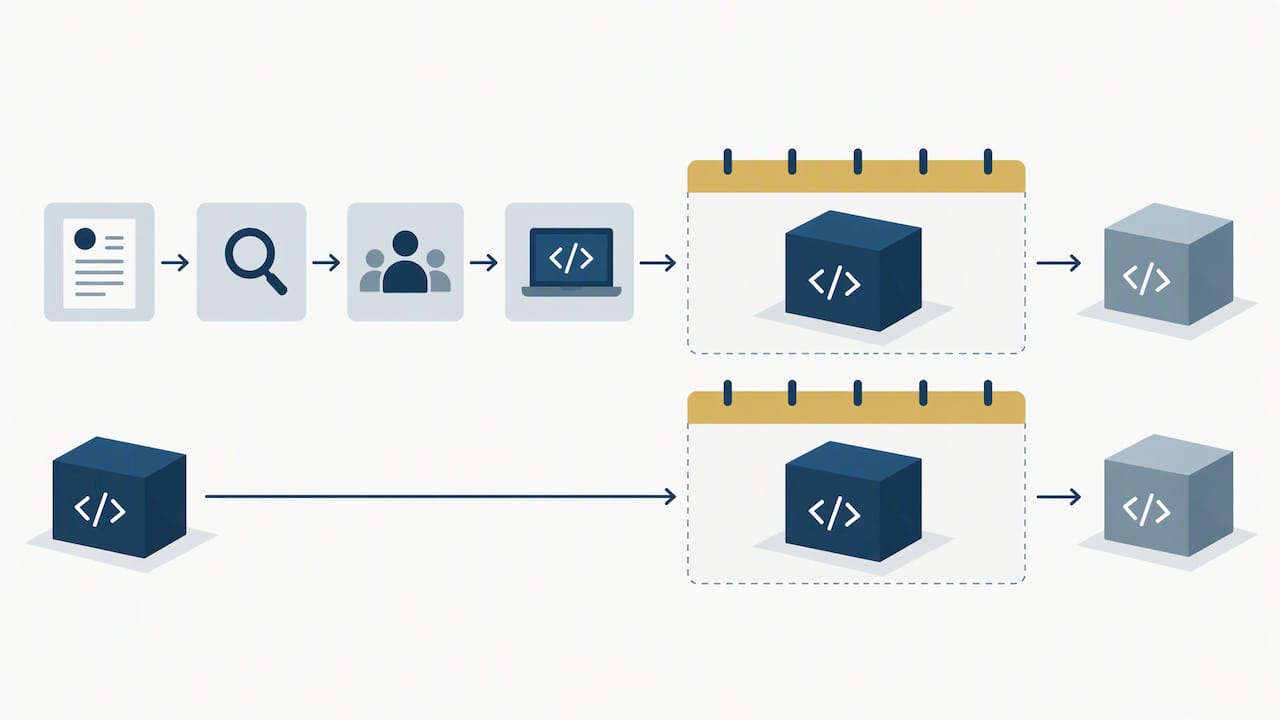
Full-time in-house hiring for a mid-level or senior engineer commonly takes several weeks to a few months once you account for sourcing, interviewing, offer negotiation, and notice periods, and that clock resets every time a hire falls through. Staff augmentation or outsourced teams can typically start within one to three weeks because the vendor has already handled the vetting.
Several cost drivers separate the two models:
- Base salary and benefits, which include healthcare, payroll taxes, and retirement contributions on top of the quoted salary.
- Vendor markup, the premium an outsourcing or staffing partner charges above the engineer’s own rate.
- Recruitment and onboarding costs, including job postings, recruiter time, and the ramp-up period before a new hire is fully productive.
- Management overhead, the ongoing time a manager or product owner spends coordinating work, whether the engineer sits in-house or offshore.
The U.S. Bureau of Labor Statistics describes software development as fundamentally collaborative work, done in teams rather than in isolation, which explains why both hiring models carry coordination costs that rarely appear in a simple rate comparison. A deeper breakdown of the true cost of hiring a US developer walks through how benefits and overhead stack on top of base pay.
Say a company needs a senior engineer for a six-month project. A full-time hire carries recruiting costs and a multi-month ramp before full productivity, plus the sunk cost if the role is eliminated after the project ends. A staff augmentation engagement avoids the recruiting cycle and scales down cleanly once the project wraps, which is why short, defined engagements tend to favor the outsourced model on a pure cost-and-speed basis.
Managing the Risks: Security, IP, and Agile Delivery
Sourcing decisions carry operational risk that good governance can manage but never fully eliminate.
Protecting intellectual property and data starts before the first line of code is written:
- Signed NDAs and IP assignment agreements that clearly state the company owns all work product.
- Limited, role-based access to source code, credentials, and customer data.
- Periodic security audits of any external team with access to production systems.
Outsourcing also changes how agile delivery works in practice. Computerworld’s analysis of outsourced agile projects points out that real-time collaboration and product-owner responsiveness suffer when a team is distributed across time zones and companies, which can quietly erode the speed advantage that justified outsourcing in the first place. The practical fix is rewiring governance rather than abandoning agile: schedule synchronous daily or weekly rituals, assign a dedicated product owner who stays engaged with the external team, and keep a high-trust service-level agreement that spells out responsiveness expectations.
Vendor management adds a final layer of protection. Break large engagements into smaller, independently deliverable chunks with clear exit points at each milestone, a practice Computerworld’s build-versus-buy guidance recommends specifically to reduce vendor lock. Defined SLAs, a documented transition plan, and appropriate liability insurance round out a governance structure that keeps an outsourced relationship accountable without requiring daily micromanagement, a balance covered in more depth in this guide to managing offshore developers.
Pro Tip: Write exit criteria into every outsourcing contract before signing, not after a relationship turns sour.
Hybrid Models: Staff Augmentation, GICs, and the BOTT Approach
Staff augmentation places individual engineers inside an existing team under the client’s own management, while managed outsourcing hands an entire scope of work to a vendor’s own team and process. A global in-house center, often called a GIC or captive center, sits between the two: the company opens its own office abroad, staffed with its own employees, to get offshore cost advantages without handing control to a third party.
Some organizations use the BOTT model, which stands for build, operate, transfer, and transform, to stand up a GIC gradually: a partner builds and operates the center initially, then transfers it to full company ownership once it matures. This path costs more upfront than simple outsourcing but gives a company a permanent, wholly owned offshore team rather than a rented one.
Deloitte’s 2025 Global Business Services Survey describes organizations increasingly blending insourcing and GICs with continued outsourcing, rather than committing fully to one model. The logic is straightforward:
- GICs and selective insourcing let companies retain strategic knowledge and eliminate recurring vendor markup.
- Outsourcing and staff augmentation remain the faster, lower-commitment option for functions that do not justify a permanent offshore presence.
- Gartner’s build-versus-buy framework adds that AI coding assistants are starting to make selective insourcing more viable, since internal teams with sufficient maturity can now absorb work that once required an external vendor.
Implementing Your Chosen Model: A Practical Sequence
Once you have picked a model, execution follows a predictable sequence regardless of whether you are hiring, augmenting, or standing up a hybrid team.
- Define scope and milestones before engaging any recruiter or vendor, with measurable deliverables tied to each phase.
- Run procurement or hiring in parallel tracks if comparing in-house and outsourced options, so you are not locked into one path by default.
- Onboard deliberately, granting access incrementally and pairing new engineers with an internal point of contact.
- Set a governance cadence, typically weekly check-ins plus a monthly review against milestones.
- Track KPIs and report consistently, using the same metrics regardless of sourcing model.
- Plan the exit or transition in advance, including documentation handoff and knowledge transfer.
Insist on contract clauses covering IP assignment, defined exit terms, and measurable milestones rather than vague “ongoing support” language. A step-by-step hiring guide for remote developers covers onboarding specifics in more detail. For timeline planning, a 3 to 6 week pilot suits a first outsourcing engagement, a 90-day staffed pod fits a defined feature build, and a 6 to 12 month commitment is realistic for standing up a full in-house or hybrid product team.
Pro Tip: Treat the pilot phase as a trial of the working relationship, not just the code quality, since communication habits are harder to fix later than technical gaps.
How Odesa Fits Into the Sourcing Decision
Our services map directly to the scenarios above: staff augmentation for fast capacity, tech recruitment for permanent hires, custom development for scoped builds, and Human QA for release confidence. Before choosing, check that any partner offers that same level of direct, personal matching.
How Sourcing Model Shapes Team Culture and Communication
The sourcing model you choose quietly shapes how your team communicates long before anyone notices a culture problem. In-house teams share context automatically: hallway conversations, shared history with past decisions, and a common understanding of unwritten priorities. That context takes real effort to replicate with an outsourced team, especially one spread across time zones.
Outsourced and augmented teams tend to default to more formal, scheduled communication, since the casual channels that carry so much information in-house simply do not exist across a vendor relationship. This is not automatically a weakness. Structured updates and written documentation, forced into existence by distance, often produce clearer records than the informal habits of a fully in-house team.
The risk shows up when a company treats an outsourced team purely as a task queue rather than as collaborators. Engineers who never hear the reasoning behind a decision tend to execute literally rather than thoughtfully, which shows up later as rework. The fix is including external engineers in the same planning conversations as internal staff, even if that means an extra half hour of overlap in a shared time zone. Hybrid teams face the sharpest version of this challenge, since they need to run two communication styles, informal and structured, at once without letting either group feel like a second-class contributor.
Managing Remote and Distributed Developer Teams Well
Distributed teams succeed or fail based on a handful of operational habits, regardless of whether the engineers are employees or outsourced contractors.
Overlapping working hours matter more than any tool. Even two or three hours of shared availability each day is usually enough for a daily standup and quick clarifications, which prevents the multi-day delays that come from pure asynchronous handoffs. Written documentation needs to carry more weight than it would in a co-located office, since there is no hallway conversation to fall back on when a decision is unclear.
A few practices consistently help:
- Asynchronous-first documentation for decisions, so no one depends on catching someone live to understand context.
- A single source of truth for project status, whether a shared board or a weekly written update.
- Defined response-time expectations, so “distributed” does not quietly become “unavailable.”
Trust builds faster when managers set clear, measurable expectations early rather than monitoring activity closely, a point covered in detail in this guide to managing offshore developers without micromanaging. The goal is a team that functions the same whether everyone is in one building or spread across four countries.
Evaluation Metrics and KPIs Across Sourcing Models
Measuring developer performance the same way across in-house and outsourced talent keeps comparisons honest and avoids penalizing one group for structural differences in how they work.
A few metrics translate well across both models:
- Cycle time, the span from starting a task to shipping it, which flags process friction regardless of where an engineer sits.
- Defect rate, the number of bugs found after release relative to the size of the work shipped.
- Milestone adherence, how often agreed deadlines are met without scope creep explaining the miss.
- Code review turnaround, since slow reviews often signal a collaboration gap rather than a skills gap.
Metrics that work well internally sometimes need adjusting for outsourced engagements. A vendor team measured only on raw output, like lines of code or tickets closed, tends to optimize for the wrong thing. Tying KPIs to business outcomes, like a feature’s adoption rate or a reduction in support tickets, keeps both in-house and outsourced contributors focused on the same goal. Reviewing these metrics on the same cadence for every engineer, in-house or outsourced, also prevents a two-tier system where external talent gets less rigorous feedback simply because they are easier to overlook.
Legal and Compliance Considerations Beyond the Contract
A signed contract covers the basics, but compliance obligations extend well past the document itself, particularly once engineers or data cross borders.
Labor classification is the most common blind spot. Engaging an individual contractor directly, rather than through a staffing partner or an Employer of Record, can expose a company to misclassification risk if that person works full-time hours under close direction, since labor authorities in many jurisdictions look at the working relationship, not just the contract label. Using an EoR or PEO structure for cross-border hires shifts that compliance burden to a specialist familiar with local labor law, which is one reason region-specific services exist for compliant hiring in markets like South Africa.
Data protection adds another layer. Any outsourced team touching customer data needs to operate under the same privacy obligations the hiring company is subject to, whether that means GDPR for European user data or sector-specific rules like HIPAA for health information. That typically means data processing agreements with the vendor, clear data residency terms, and restrictions on which engineers can access production data versus a sandboxed environment. None of this replaces a well-drafted contract, but a contract alone will not catch a misclassified worker or an unmonitored data transfer. Treat legal and compliance review as a separate step from contract negotiation, not a subset of it.
The Real Question Behind In-House vs Outsourcing
The honest answer is rarely one model exclusively. Control your core IP in-house, extend capacity externally for scale and specialized skills, and let Deloitte and Gartner’s own data on blended sourcing guide the balance.
Ready to Scale Your Engineering Team?
Whichever balance of in-house and outsourced talent fits your roadmap, getting the staffing piece right faster than a traditional hiring cycle allows makes every other decision easier. We connect companies with senior, pre-vetted Eastern European engineers through flexible staff augmentation or direct recruitment, with personal involvement in matching talent to client needs.
If your next step is adding capacity without a multi-month hiring cycle, explore staff augmentation options and get a shortlist built around your project.
FAQ
What are the pros and cons of in-house versus outsourcing?
In-house teams offer stronger control, institutional knowledge, and long-term product alignment, but they take longer to build and cost more to maintain full-time. Outsourcing offers faster access to capacity and specialized skills at a variable cost, though it carries integration friction and a higher risk of knowledge walking out the door when an engagement ends.
What does in-house manufacturing mean, and does it apply to software?
In-house manufacturing refers to producing goods using a company’s own facilities and employees rather than a third-party factory. The software equivalent is building with your own salaried engineering team rather than contracting external developers, and the same control-versus-speed trade-off applies in both contexts.
Is outsourcing considered a form of BPO?
Business process outsourcing, or BPO, is one category of outsourcing focused on specific business functions like customer support or payroll processing. Software development outsourcing is a related but distinct practice, typically centered on building or maintaining technical products rather than running a back-office function.
Should a company handle IT in-house or outsource it?
The right answer depends on how strategic the IT function is and how mature the internal team already is. Gartner’s build-versus-buy framework suggests evaluating readiness and business value function by function rather than applying one answer across an entire IT department, since core systems often warrant in-house control while routine maintenance tolerates outsourcing.
How much does staff augmentation typically cost compared to a full-time hire?
Staff augmentation engagements through Odesa start from $45 per hour, while a direct-hire placement through tech recruitment runs a flat 7999 USD one-off fee per successful hire. The right choice depends on whether the role is a temporary capacity need or a permanent addition to the team.
Sources
- 2024 Global Outsourcing Survey
- Tool: Build vs. Buy Application Decisions for AI Development or SaaS
- Software developers, quality assurance analysts, and testers (BLS)
- Statista: worldwide revenue of IT outsourcing
Recommended
- The Cost of Hiring a US Developer: A Complete Budget
- Secure Vendor Access for Offshore Teams: A Checklist
- Eastern European vs Latin American Developers: A Data-Driven Comparison for US Companies
Reviewed by Val Narodetsky, founder of Odesa.co.