
Yes, outsourcing often reduces operating costs, but only when you measure vendor pricing against a full, burdened in-house baseline and factor in transition and governance costs. Headline savings estimates vary widely across surveys and audits. Net savings depend less on the sticker price of a vendor and more on how carefully you define the baseline and manage the engagement afterward.
TL;DR:
- True cost savings from outsourcing require including full baseline costs such as indirect labor, governance, onboarding, and ongoing quality monitoring.
- Transition, scope creep, wage escalation, and weak baseline accounting often erode projected savings within the first year.
- Fixed-price contracts are predictable but risk vendor corners cutting if scope expands, while outcome-based and relational models better handle uncertainty.
- Savings estimates vary widely depending on the baseline measurement and the management of post-contract governance and performance.
- Effective cost control depends on staged transitions, clear SLAs, quarterly reviews, and aligning contracts with the task’s clarity level.
Table of Contents
- How outsourcing reduces costs
- What the evidence says about typical outsourcing savings
- What to include in a full cost baseline
- Contract types and pricing models that shape realized savings
- Risks and hidden costs that erode projected savings
- How to model expected net savings
- Practical steps to make outsourcing savings stick
- Outsourcing as a capability decision, not just a cost cut
- How Odesa helps you turn the model into real savings
- FAQ
- Sources
How outsourcing reduces costs
Outsourcing lowers costs through several concrete mechanisms, and understanding each one helps you map savings to your own operations rather than accepting a generic percentage.
- Labor arbitrage: paying a contractor or offshore team a market rate below your local, fully burdened salary cost for the same skill level.
- Facilities savings: fewer desks, less office space, and lower utility and equipment spend when work moves outside your walls.
- Avoided capital expense: vendors often supply their own hardware, software licenses, and infrastructure.
- Lower recruiting and training costs: a vendor absorbs sourcing, screening, and onboarding for roles you would otherwise staff yourself.
- Fixed-to-variable conversion: headcount becomes a flexible line item you can scale up or down instead of a permanent fixed cost.
These levers show up differently by function. IT and software development save mainly on wage differentials and specialized tooling. Customer support saves on facilities and shift staffing. Payroll and back-office work save on software licensing and compliance overhead that a specialized vendor already maintains across many clients.
What the evidence says about typical outsourcing savings
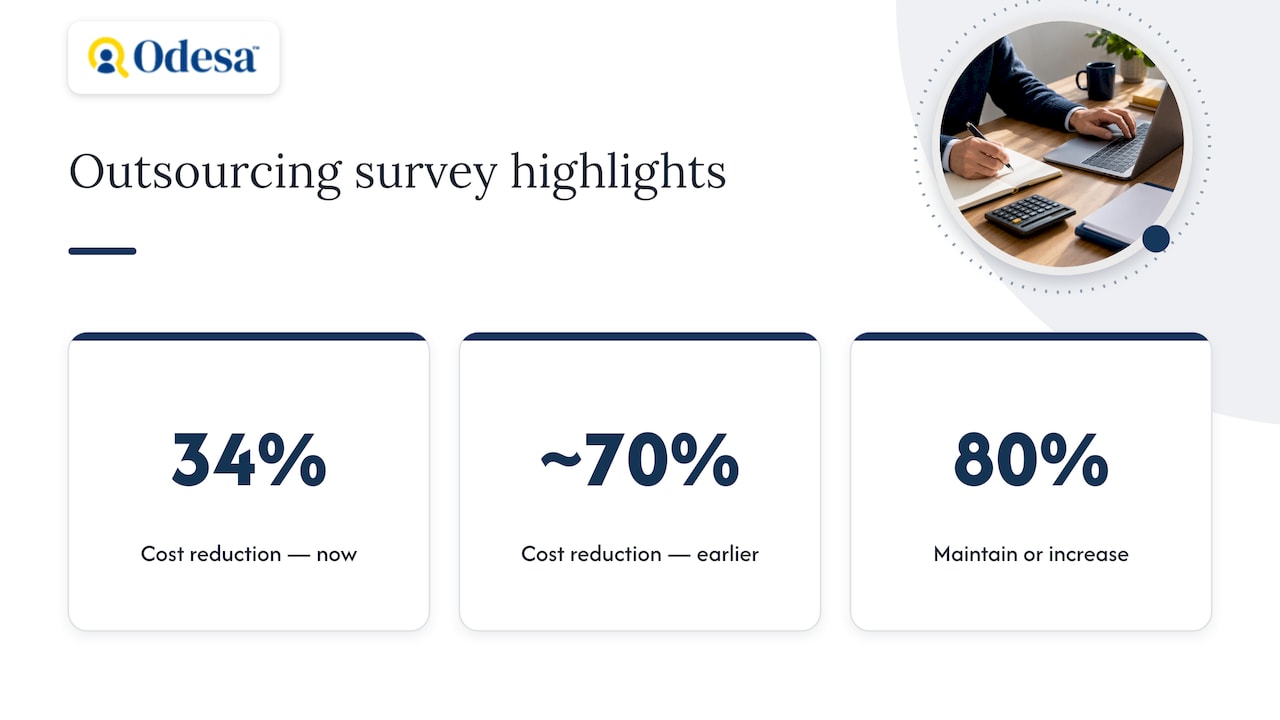
Survey data on outsourcing savings tells a more nuanced story than the round numbers that circulate in sales decks. The 2024 Global Outsourcing Survey from Deloitte found that only 34% of organizations now name cost reduction as a primary driver of outsourcing, down from roughly 70% several years earlier, while 80% plan to maintain or increase their outsourcing investment regardless. Government audits add a caution: a GAO review of DOD competitive sourcing studies found that reported savings were often imprecise because agency baselines omitted implementation and study costs.
Headline savings figures vary because every organization starts from a different baseline, absorbs different one-time transition costs, and changes the scope of the work along the way.
What to include in a full cost baseline
Comparing a vendor quote against your current payroll number understates your real cost and overstates projected savings. A defensible baseline includes:
- Direct labor: base salary plus payroll taxes and employer-paid benefits.
- Indirect labor: the time managers, HR staff, and recruiters spend supporting and replacing that role.
- Facilities and equipment: office space, utilities, hardware, and software licenses tied to the position.
- Onboarding and training: ramp-up time before the person reaches full productivity.
- Contract management and governance: the time spent writing, reviewing, and overseeing the vendor relationship.
- Ongoing quality monitoring and switching costs: audits, rework, and the cost of changing vendors if performance falls short.
Our breakdown of US developer hiring costs walks through how these line items add up for a single engineering hire, which is a useful template for building your own baseline before comparing it to any vendor quote.
Contract types and pricing models that shape realized savings
The pricing model you choose affects how much of the projected savings actually survives the first year. Guidance on IT outsourcing contract design from CIO recommends matching the contract type to task uncertainty and governance needs rather than defaulting to the lowest hourly rate.
- Hourly or time-and-materials: flexible for changing scope, but cost can run higher than planned without tight oversight.
- Fixed-price: predictable budgeting, though it creates pressure for vendors to cut corners if scope expands beyond the original estimate.
- Outcome-based pricing: aligns vendor incentives with your results, but requires mature metrics to define and verify the outcome.
Relational governance, built on information sharing and joint problem solving, tends to outperform rigid contractual enforcement on complex or uncertain work, according to transaction cost economics research on governance performance. The cheapest hourly rate can raise total cost over time if it comes with weak communication, high turnover, or frequent rework.
Pro Tip: Match your contract type to how well you can specify the work upfront: fixed-price for well-defined deliverables, outcome-based or relational governance for ambiguous, evolving scope.
Risks and hidden costs that erode projected savings
Several failure modes consistently show up in both audits and practitioner experience. Accounting for them upfront prevents an unpleasant surprise six months in.
- Transition costs: project management time, parallel running of old and new systems, and knowledge transfer before the vendor reaches full speed.
- Scope creep: change requests that weren’t priced into the original quote, common under fixed-price contracts.
- Wage and regulatory escalation: inflation and statutes like the Service Contract Act can raise vendor labor costs over a multi-year contract.
- Weak baselines: omitting indirect costs or governance time inflates the apparent savings before the engagement even starts.
Reported savings can be imprecise when baselines omit implementation and study costs, and agencies need full baseline accounting and post-transition measurement to validate the numbers.
That finding from the GAO review of DOD sourcing studies applies just as directly to a private company evaluating a vendor quote. Our overview of offshore development risks covers the operational side of these failure modes, including when re-insourcing becomes the more economical choice.
How to model expected net savings
A simple four-step worksheet turns a vague savings claim into a number you can defend to a finance team.
- Build your fully loaded in-house baseline: salary, benefits, payroll taxes, facilities, equipment, and management overhead for the role or function.
- Get a vendor cost estimate: include the quoted rate plus a contingency line for scope changes and ramp-up inefficiency.
- List one-time transition costs: project management, dual running, training, and expected timeline to full productivity.
- Calculate multi-year payback: compare cumulative in-house cost against cumulative vendor cost plus transition cost, then stress-test the result against wage inflation and volume changes.
Stress-test the model against attrition, defect rates, and vendor rate increases before treating any payback period as final. Our developer hiring cost calculator applies this same logic to engineering hires specifically, which is a practical starting point if you want a number before building a full spreadsheet.
Practical steps to make outsourcing savings stick
Savings that look good on paper only hold up with the right governance in place around them.
- Build in price-review and SLA clauses: lock in performance expectations and renegotiation points before signing, not after a problem surfaces.
- Match contract type to task uncertainty: use the governance principles from transaction cost economics research to choose between strict contractual terms and a more relational, collaborative structure.
- Phase the transition: start with a pilot scope before committing to full-volume work, which limits exposure if the vendor underperforms.
- Protect knowledge continuity: engineer turnover on a vendor team creates rework and ramp-up costs that quietly erase savings. Retention in a placed team is one of the larger hidden-value levers in any staff augmentation arrangement.
Pro Tip: Set a quarterly cost-and-performance review for the first twelve months of any outsourcing engagement, since most hidden costs surface in that window, not at signing. Our guide to managing offshore developers without micromanaging covers the operational side of keeping a remote team productive without adding governance overhead that eats the savings.
Outsourcing as a capability decision, not just a cost cut
Outsourcing often reduces cost, but treating a savings percentage as a forecast rather than an estimate is where plans go wrong. The stronger frame is capability: access to talent and speed you cannot build in-house fast enough, with cost reduction as one benefit among several. Run measured pilots, track real performance, and judge vendor partnerships on outcomes, not just the rate card.
— Editorial Team
How Odesa helps you turn the model into real savings
Once you have a baseline and a payback model, the next step is finding engineering capacity that doesn’t erode the numbers through turnover or quality gaps. We provide staff augmentation with senior, pre-vetted Eastern European engineers, direct recruitment for permanent hires, white-label development capacity for agencies, and Human QA release checks that catch defects before they turn into costly rework.
If you want a clearer picture of what a staff augmentation or recruitment engagement would look like for your team, start a conversation with us about your current hiring costs and goals.
FAQ
How efficient is outsourcing at cutting costs?
Outsourcing efficiency depends on how the baseline is measured: when compared against a fully loaded in-house cost, including benefits, facilities, and training, outsourcing often reduces total spend. The 2024 Deloitte Global Outsourcing Survey found that organizations increasingly weigh talent access and agility alongside cost, so efficiency gains now come from the combination, not price alone.
Is outsourcing a strategy to reduce labor costs?
Outsourcing can reduce labor costs through wage arbitrage and by converting fixed headcount into variable spend, but labor-cost reduction is no longer the only reason companies choose it. Only 34% of executives in the Deloitte 2024 survey now cite cost reduction as a primary driver, with talent and speed cited as growing priorities.
What is the main benefit of outsourcing?
The main benefit varies by organization, but commonly includes faster access to specialized talent, lower fixed costs, and the ability to scale a team up or down without the overhead of a full-time hire. For engineering specifically, staff augmentation models often add retention and direct founder involvement in matching as additional benefits beyond raw cost reduction.
What costs do companies often forget when calculating outsourcing savings?
Companies frequently omit indirect costs such as management oversight time, contract governance, transition project costs, and ramp-up inefficiency during the first months of an engagement. The GAO review of DOD sourcing studies found that omitting these items is a recurring reason reported savings turn out to be overstated.
Sources
- Global outsourcing survey 2024 | Deloitte Global
- DOD Competitive Sourcing: Results of A-76 Studies Over the Past 5 Years (GAO-01-20)
- Taking IT outsourcing to the next level | CIO
- A transaction cost economics model for estimating performance effectiveness of relational and contractual governance
Recommended
- 7 Toptal Alternatives: Compare Developer Hiring Options
- Developer Hiring Cost Calculator
- 5 Offshore Development Risks and How to Reduce Them
- Cost of Hiring a US Software Developer
This article may have used AI tools in the writing process. Facts, figures, and recommendations can be wrong or out of date. Do not treat this as professional advice.