
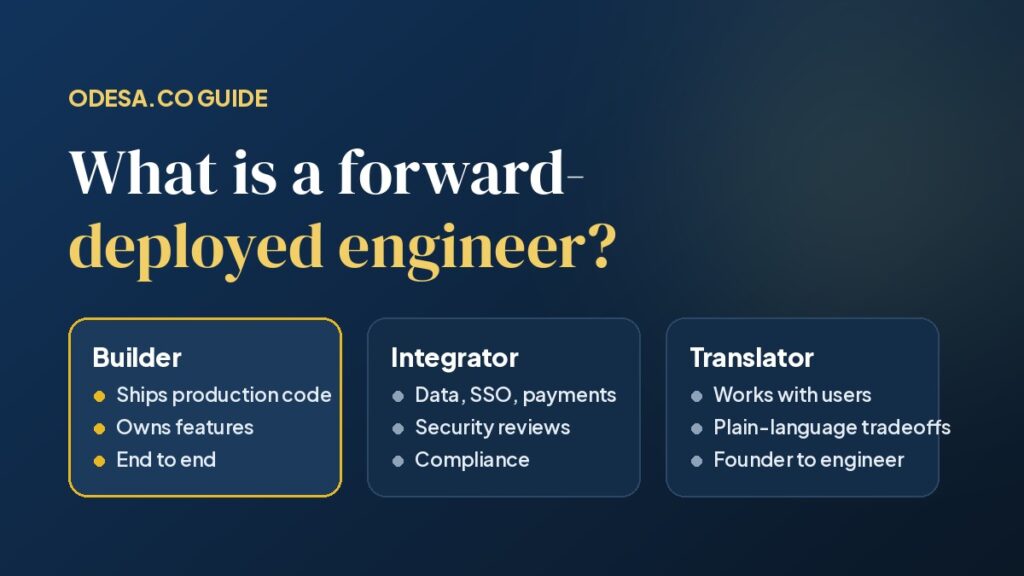
A forward-deployed engineer (FDE) is a software engineer who works directly with a customer’s team and users to make software work in their real environment. The role combines three jobs: builder, integrator and translator. FDEs write production code, connect it to real data, systems and security requirements, and turn what users need into technical decisions. Hire one when a working demo has to become a product that holds up with paying customers.
TL;DR:
- A forward-deployed engineer builds, integrates and translates, working close to users.
- Palantir popularized the title; AI companies now hire FDEs to move customers from pilots to production.
- The role matters more now because AI coding tools make demos fast, while production still needs security, a sound data model, audit trails and integrations.
- An FDE differs from a staff augmentation engineer, who adds capacity to planned work, and from a consultant, who advises without shipping code.
- Hire one when paying users, enterprise buyers or compliance questions arrive before your product is ready for them.
What does a forward-deployed engineer do?
The title comes from deploying an engineer forward, into the customer’s world. In practice the job has three parts.
Builder
An FDE writes and ships production code. That includes features, data pipelines, integrations and the fixes that come from watching real people use the product. The code goes through your review process and lives in your repositories.
Integrator
Software rarely fails on its own. It fails where it meets everything else: a customer’s identity provider, a payment system, a CRM, a data warehouse or a security review. The FDE owns those seams, so the product works inside the customer’s environment and passes the questions their security and compliance teams ask.
Translator
FDEs spend time with users, buyers and founders. They turn requests into technical decisions, explain tradeoffs in plain language and bring what they learn back to the rest of the engineering team. That context is often worth as much as the code.
Why the role matters now: the demo-to-production gap
Tools such as Lovable, Bolt, Replit, v0, Cursor and Claude Code have made it fast to build a convincing demo. A founder can show a working product to investors or pilot customers in days. The hard part starts when real customers, real data and real regulations arrive. Here is what typically separates a demo from a product that survives them:
- Authentication and access. Sessions that expire correctly, roles and permissions, single sign-on for enterprise customers, and row-level security so one customer never sees another’s data.
- The data model. Tables designed for the demo rarely fit the product a year later. Migrations, backups and restore tests matter once the data belongs to customers.
- Audit trails. Who changed what, and when. Enterprise buyers and regulated industries ask for this early.
- Edge cases. Empty states, failed payments, slow third-party APIs, retries and rate limits. Demos follow the happy path; customers do not.
- Security. Secrets kept out of the code, dependencies scanned, common vulnerabilities such as those in the OWASP Top 10 reviewed and fixed.
- Compliance. Data retention, access logs and evidence for frameworks such as SOC 2, HIPAA or GDPR, depending on who your customers are.
- Operations. Staging environments, automated tests, monitoring, error tracking and a plan for when something breaks at 2 a.m.
None of these show up in a demo. All of them show up in a security questionnaire, a customer escalation or an outage. Closing that gap is the core of forward-deployed work.
Forward-deployed engineer vs staff augmentation vs consultant
| Forward-deployed engineer | Staff augmentation engineer | Consultant | |
|---|---|---|---|
| Main job | Ships production code and works with users and customers | Adds capacity to work your team has planned | Advises and recommends |
| Writes production code | Yes | Yes | Usually not |
| Works directly with users | Yes, often daily | Sometimes | Through workshops and interviews |
| Who sets priorities | Shared: your team plus what the FDE learns from users | Your team | The engagement scope |
| Best for | Taking a product from demo to production | Adding senior hands to a known roadmap | Strategy, audits and decisions |
| Typical engagement | Embedded for months, often after an audit and hardening sprint | Month-to-month per engineer | Fixed project or retainer |
The lines blur in practice. Many teams start with an audit, run a short hardening sprint and then keep one engineer embedded. If your roadmap is already clear and you only need more hands, staff augmentation is usually the simpler fit. If you need code shipped and decisions made close to customers, you need forward-deployed work.
When should you hire a forward-deployed engineer?
- Your prototype has paying users. It was built quickly, possibly with AI coding tools, and now real people depend on it.
- An enterprise buyer sent a security questionnaire. Questions about SSO, data handling, audit logs and penetration testing arrive before you have answers.
- Integrations are eating the founder’s week. Every new customer needs a connection to their systems, and nobody owns that work.
- Your data needs a real model. Reporting is unreliable, records are duplicated or a migration feels risky.
- Your engineers are far from customers. The team builds what it is told, while feedback from users gets lost on the way.
What to look for when you hire one
- Production experience. Ask about systems they kept running after launch, incidents they handled and what they changed afterward.
- Breadth across the stack. FDEs move between frontend, backend, data and infrastructure. Depth in one area plus working knowledge of the rest is the usual profile.
- Security and compliance judgment. Ask how they would answer a customer’s security questionnaire about your product today.
- Communication. Ask them to explain a technical tradeoff to a non-technical founder. Clear, short answers are a good sign.
- Comfort with AI-built code. Ask how they would assess a codebase generated with an AI tool: what they check first, and how they decide what to keep and what to rebuild.
How Odesa approaches demo to production
Odesa works in three steps. First, a senior engineer runs a production-readiness audit of the codebase, data model, security and integrations, and gives you a prioritized fix list. Second, a hardening sprint fixes what blocks launch, with Human QA testers walking your critical journeys on real devices before customers do. Third, a forward-deployed engineer stays embedded on a monthly basis to ship features, onboard customers and keep the product reliable.
Our engineers work remotely from Latin America, the EU and Eastern Europe, with overlap on US hours agreed before the start. You contract with Odesa.co, a US company in Lighthouse Point, Florida.
Odesa.co
Have a demo that needs to survive real customers?
Odesa places senior forward-deployed engineers from Latin America, the EU and Eastern Europe, starting with a production-readiness audit and a hardening sprint with Human QA built in.
Frequently asked questions
Is a forward-deployed engineer the same as a solutions engineer?
No. A solutions engineer usually supports sales: demos, technical discovery and proof-of-concept work before a deal closes. A forward-deployed engineer works after the deal, shipping production code and making the product work in the customer’s environment. Some companies blend the two roles.
Do forward-deployed engineers only work at large companies?
The title started at companies such as Palantir, but the work fits startups well. A small team with a promising demo and its first serious customers often needs exactly this mix of building, integrating and translating.
Can a forward-deployed engineer work remotely?
Yes. Being close to users means regular contact and shared context, which works over video calls, shared channels and overlapping working hours. Some roles add occasional on-site visits for key customers.
Should I rebuild my AI-generated app from scratch?
Usually not. Many AI-built apps can be hardened in place. An audit shows which parts are sound and which need rebuilding, so you change what matters and keep what works.