
For most companies, the right default is a hybrid or composable approach: buy the commodity layers and build only what creates genuine competitive advantage. Pure build makes sense when a capability is core to your differentiation and defensible as intellectual property. Pure buy makes sense when a function is commoditized or regulated and requires certified compliance you cannot replicate internally. The decision framework below walks through how to weigh cost, time-to-market, and differentiation to land on the right answer for your specific project.
TL;DR:
- Building or customizing solutions for core proprietary features can be justified when they directly differentiate your product from competitors.
- Total cost of ownership over three to five years for SaaS solutions can reach 150% to 200% of the list price once integration, training, and customization are included.
- High reliance on senior engineers reduces the risk of project overruns, with early architectural design and phased delivery being key mitigation strategies.
- A hybrid approach, purchasing commodity functions and building differentiators, is now common and often the most cost-effective split for enterprise software.
- AI accelerates development but amplifies risks, making rigorous testing, staged delivery, and senior review essential to avoid project failure.
Table of Contents
- A practical framework for weighing build vs buy software decisions
- TCO and break-even: how to model 3 to 5 year economics
- Project risk, failure causes, and realistic timelines
- Structuring a hybrid, composable architecture
- Run this workshop: a step-by-step decision process
- Hiring senior engineers as a risk-reduction tactic
- The pragmatic default, and why most teams overthink this
- Get senior engineering support for your build, buy, or hybrid project
- FAQ
- Sources
A practical framework for weighing build vs buy software decisions
Most build vs buy debates fail because they treat the decision as binary. Forrester’s 2026 guidance recommends moving past that framing entirely: customize what you can, compose modular components where they fit, and reserve custom builds for the parts of your product that actually set you apart.
A useful framework scores each candidate project against eight criteria:
- Strategic differentiation: does this function directly shape why customers choose you over competitors?
- Total cost of ownership: what does the option cost across three to five years, not just at signing?
- Time-to-market: how fast do you need this live, and what does delay cost you?
- Technical complexity: does the problem require novel architecture or well-understood patterns?
- Security and compliance: does the function touch regulated data or require certifications you do not hold?
- Operability and maintenance: who keeps this running at 2 a.m. when it breaks?
- Talent availability: can you staff this reliably, internally or through a partner?
- Vendor lock-in risk: how painful would it be to leave this vendor in two years?
Score each criterion from 1 to 5, where a high score favors building and a low score favors buying. A growth-stage startup chasing product-market fit should weight time-to-market and differentiation heavily, often doubling their point value, because speed and a defensible feature set matter more than marginal cost savings. A regulated enterprise, by contrast, should weight security, compliance, and operability most heavily, since a compliance failure costs far more than a slower rollout.
Once scored, a simple heuristic translates totals into a recommendation band. A function scoring high on differentiation and talent availability but low on compliance complexity points toward build. A function scoring low on differentiation and high on compliance burden points toward buy. Anything that splits evenly across the eight criteria, which is the common outcome for most real projects, points toward the hybrid path: buy the surrounding infrastructure and build the piece that actually matters to your roadmap.
This scoring exercise works best as a group activity with your product, engineering, and finance leads in the room together, because the weighting choices reveal disagreements about strategy that are worth surfacing before any code gets written or any contract gets signed.
TCO and break-even: how to model 3 to 5 year economics
A license price is not a budget. The real cost of either path only shows up once you list every line item and project it across several years.
For a bought solution, the full TCO includes:
- License or subscription fees, plus renewal inflation that typically compounds each year.
- Integration work to connect the tool to your existing systems.
- Data migration from legacy platforms.
- Staff training and change management.
- Customization fees charged by the vendor or implementation partner.
For a built solution, the full TCO includes:
- Engineering salaries or contractor rates for the build phase (see typical custom software development cost ranges).
- Cloud hosting and infrastructure from day one onward.
- Ongoing maintenance and bug fixes, typically running 15% to 20% of the original build cost each year according to industry analysis summarized by Computer Weekly.
- Security patching and dependency updates.
- The opportunity cost of engineers who could be working on something else.
Break-even timing depends heavily on how these two cost curves cross. A bought tool often has low upfront cost and a rising cost curve as renewal inflation compounds, while a built tool has high upfront cost and a flatter curve once it stabilizes. AI-assisted development is shifting that crossover point earlier for some teams, since generated boilerplate and test scaffolding reduce initial build time, though the maintenance curve on the back end does not shrink at the same rate.
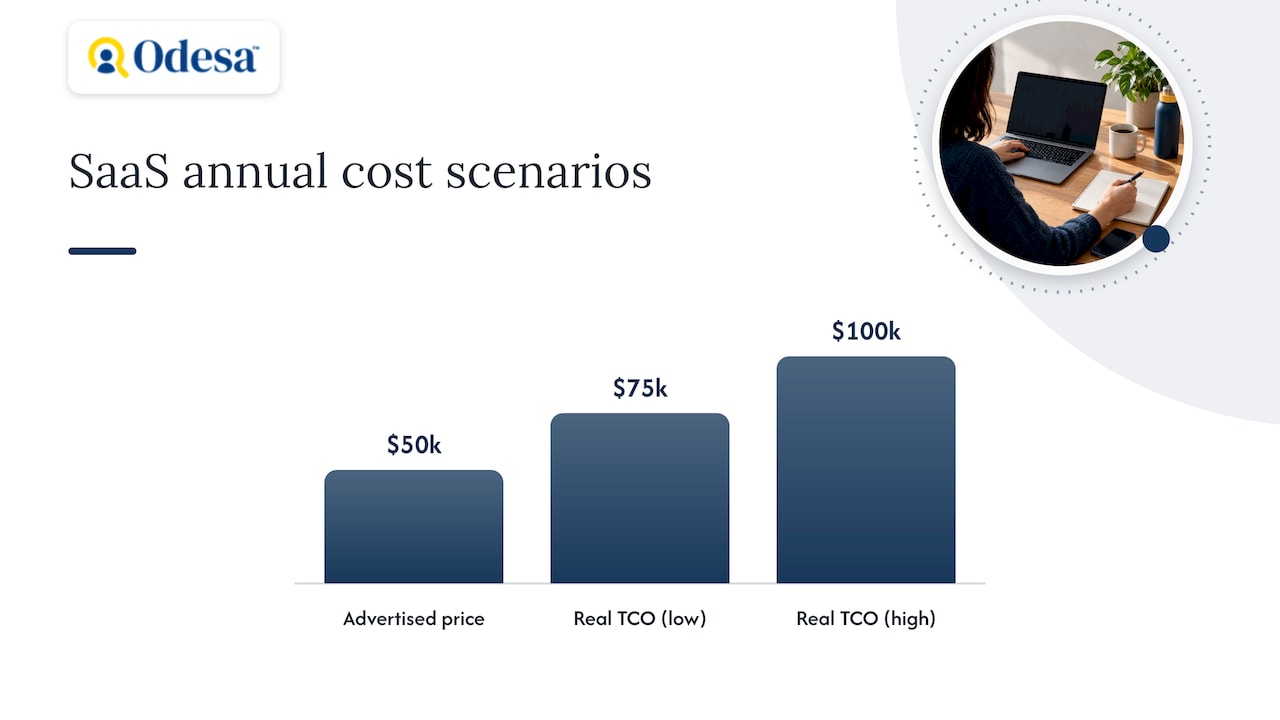
One figure worth modeling explicitly: Computer Weekly’s analysis finds that real-world SaaS total cost of ownership can reach 150% to 200% of the advertised list price once integration, training, and customization are included. A tool quoted at $50,000 a year can realistically cost $75,000 to $100,000 once those hidden costs land, which changes the break-even math against a build option significantly.
Two levers are worth stress-testing in any model you build. First, SaaS renewal inflation: vendors routinely raise prices at renewal, so model a 5% to 15% annual increase rather than assuming flat pricing. Our developer hiring cost calculator is a useful starting point for modeling the labor-cost side of a build estimate before you commit engineering time to a full build. For the effort side, a software project estimation built from a work breakdown structure gives you a number you can defend.
Computer Weekly’s piece also flags a practical warning sign: extensive customizations to a bought product can transform it functionally into a custom build, while potentially compromising control and increasing costs. That threshold is worth tracking in any vendor relationship that keeps expanding in scope.
Project risk, failure causes, and realistic timelines
Building software carries real risk, and the data on custom projects is sobering enough to plan around rather than ignore. Industry analysis cited by Computer Weekly points to average budget overruns of 66% on large software projects, with 17% of projects running severe enough to threaten the business that commissioned them. Those numbers argue strongly for staged delivery and conservative scoping on anything you choose to build rather than buy. The contract type matters too; see time and materials vs fixed price.
AI-assisted development changes this picture, but not in the simple way vendors often pitch it. The 2025 DORA report finds that AI adoption is now close to universal, with about 90% of organizations using it somewhere in their delivery pipeline, and that AI acts as an amplifier: it speeds up both good practices and bad ones. Teams with strong automated testing and platform engineering see real throughput gains. Teams without those foundations see AI-generated code accelerate instability rather than reduce it. That single finding reframes the build decision: AI lowers the barrier to starting a build, but it raises the bar for the engineering discipline needed to finish one safely.
Pro Tip: Treat any AI-accelerated build estimate as a floor, not a target, and keep senior engineers in the loop to review architecture and security decisions that AI tools tend to skip.
Practical mitigations that reduce build risk include:
- Shipping a minimum viable version before committing to the full feature set.
- Staging delivery in phases with clear go or no-go checkpoints.
- Investing in automated testing before scaling feature velocity.
- Building internal platform capabilities rather than ad hoc infrastructure per team.
- Bringing in senior engineers for architecture review even on projects staffed mostly by junior talent.
Our engineering hiring content covers how external senior engineers get folded into existing teams specifically to catch these architectural risks early, before they compound into the kind of overrun the Computer Weekly data describes.
Structuring a hybrid, composable architecture
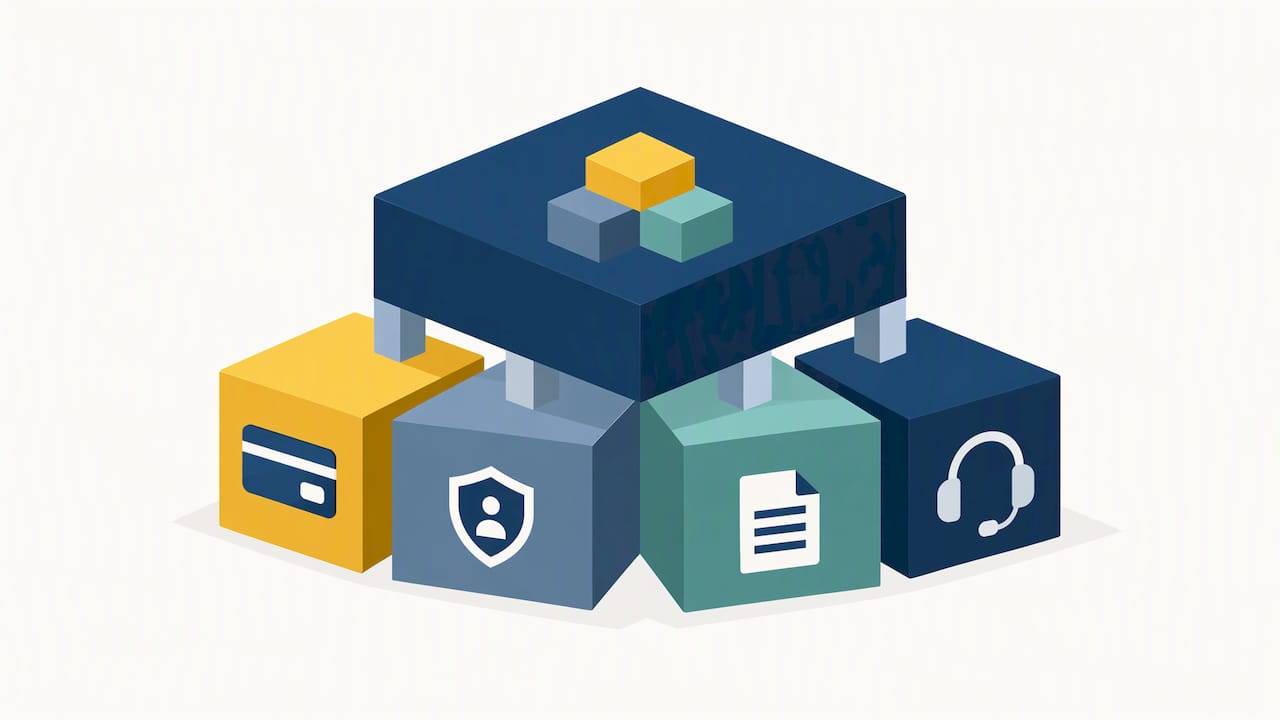
The practical version of “buy commodity, build differentiators” follows a rough 80/20 split. Payments processing, authentication, content management, and customer support tooling are solved problems: buying them is almost always cheaper and safer than rebuilding what a dozen vendors have already hardened over years of production use.
ThoughtWorks’ guidance on low-code platforms makes a related point about the middle ground: low-code and composable tools speed up delivery but are not a shortcut around good architecture. Before committing to any composable piece, ThoughtWorks recommends evaluating governance, version control, and the platform’s exit strategy, since the ease of adopting a low-code tool is rarely matched by the ease of leaving it later.
A working hybrid architecture needs a few governance pieces in place regardless of which specific tools you choose:
- A canonical data model that defines what a customer, order, or transaction means across every bought and built system.
- A clear system of record for each entity, so two tools never claim ownership of the same data.
- Documented API contracts between components, versioned deliberately rather than changed silently.
- Monitoring that spans both bought and built pieces, since an outage in a vendor’s API is still your outage.
Pure buy still wins outright in a few specific cases: when regulatory requirements demand certifications you cannot reasonably obtain in-house, such as payment card industry compliance, or when the project scope and budget are simply too small to justify any custom engineering. Pure build still wins when the function is so central to your IP that no vendor relationship would ever be acceptable, such as a proprietary matching or risk model that defines your entire product.
Run this workshop: a step-by-step decision process
A half-day workshop with the right people in the room produces a better build vs buy decision than weeks of asynchronous debate. Here is a structure that works for most product and engineering teams.
Before the session, assemble:
- Vendor pricing quotes for every buy candidate, including renewal terms.
- A map of integration points between the candidate system and your existing stack.
- Current process documentation for whatever workflow the new system will replace.
- An honest estimate of internal engineering capacity for the next two quarters.
During the workshop, run through four stages:
- Scoring session: apply the eight-criteria framework from earlier in this guide to each candidate project, as a group, with disagreements discussed openly rather than averaged away.
- Risk heatmap: plot each option by likelihood and impact of failure, using the overrun data as a baseline for anything scored toward build.
- Timeline alignment: compare the realistic delivery date for build against the vendor’s implementation timeline for buy, not the optimistic version either side pitches.
- Recommendation drafting: turn the scores into a one-page recommendation suitable for a board or leadership review.
The workshop should produce three concrete deliverables: a completed decision scorecard for each project in scope, a prioritized list of MVP features if the recommendation leans toward build, and a recommended engagement model that specifies whether you need staff augmentation, a direct hire, or a fixed-scope custom development engagement to execute the decision. Our staff augmentation vs recruitment guide is a useful reference once the workshop lands on build or hybrid and you need to decide how to staff it.
Hiring senior engineers as a risk-reduction tactic
Every build decision carries execution risk, and the single biggest lever for reducing that risk is the seniority of the engineers doing the work. We provide senior engineering services across staff augmentation, direct recruitment, custom development, Human QA testing, and white-label development for agencies, and each of those services maps to a different point in the build vs buy decision.
For teams that land on hybrid, the most common engagement pattern we see is bringing in a senior architect early to design the system and set the integration contracts, then augmenting the delivery team with additional senior engineers to execute against that design. This keeps architectural decisions, the ones most likely to cause the overruns described earlier, in experienced hands, while still letting the core team scale delivery capacity without a lengthy direct-hire process.
Our services that map most directly to build vs buy outcomes include:
- Staff augmentation for teams that need senior engineering capacity fast, without a long hiring cycle.
- Custom development for scoped build projects that need a dedicated delivery team.
- Human QA testing to catch the kind of instability risk that DORA’s research associates with AI-accelerated but under-tested code.
- White-label development for agencies that need to extend their own delivery capacity without expanding headcount.
That gap matters directly in the TCO modeling covered earlier: senior engineering talent is one of the largest line items in any build estimate, and the rate at which you source it changes the entire break-even calculation.
The pragmatic default, and why most teams overthink this
The loudest voices in the build vs buy debate tend to argue for extremes: build everything to avoid vendor risk, or buy everything to avoid engineering overhead. Both positions ignore how differentiation actually works. Most of what makes a product good to use is commodity infrastructure that a vendor has already solved better than a fresh internal build ever will in its first two years. The parts worth building are narrow, and the discipline required to identify them correctly is worth more than any framework score on its own.
The next steps are straightforward: run the scoring workshop with your actual leadership team, model three to five years of TCO rather than a single year of license cost, and treat senior engineering talent as a lever you can pull quickly rather than a six-month hiring project. Teams that skip the modeling step consistently underestimate both the maintenance burden of what they build and the renewal inflation of what they buy.
Get senior engineering support for your build, buy, or hybrid project
Whichever way your framework scores out, execution is where most build vs buy decisions actually succeed or fail. If the workshop points toward building a differentiating piece in-house, staff augmentation gets senior engineers integrated into your team without the months-long cycle of a direct hire, and our founder is personally involved in matching engineers to your specific technical needs.
If you need a scoped project delivered end to end rather than embedded staff, our custom development engagements handle that, and our Human QA services catch the instability risk that comes with AI-accelerated delivery before it reaches production. Reach out through Odesa to talk through your specific project and get a quote on the engagement model that fits.
FAQ
What is the difference between build vs buy software decisions?
A build decision means developing custom software in-house or through a contracted team, while a buy decision means licensing an existing product. Most real decisions land somewhere between the two, combining bought commodity tools with built components for the features that differentiate your product.
When does it make sense to build software instead of buying it?
Building makes sense when a capability is core to your competitive differentiation and defensible as proprietary logic, such as a pricing engine or matching algorithm. It also tends to make sense when no vendor offers a close fit and customization costs would approach the cost of a build anyway.
How do I calculate the total cost of ownership for software?
Add license or salary costs to integration, migration, training, and ongoing maintenance over a three to five year window rather than looking at year-one pricing alone. Computer Weekly’s analysis finds real SaaS TCO can reach 150% to 200% of list price once those hidden costs are included.
Does AI make building custom software cheaper?
AI-assisted development speeds up routine coding and test scaffolding, which lowers the cost of starting a build. The 2025 DORA report notes that AI amplifies both strengths and weaknesses, so the savings only hold if you invest in strong automated testing and platform engineering alongside it.
What is a hybrid or composable software approach?
A hybrid approach means buying commodity functions, like payments or authentication, and building only the components that create competitive differentiation. Forrester’s 2026 guidance notes that 76% of enterprise software spend already flows into these blended stacks rather than pure build or pure buy setups.
Sources
- Announcing the 2025 DORA Report | Google Cloud Blog
- Forrester predictions: 2026 AI moves from hype to hard-hat work
- Software kaufen oder selbst entwickeln? Der Vergleich | Computer Weekly
- Low code connoisseurship: choosing the right platform | ThoughtWorks
Recommended
- Developer Hiring Cost Calculator
- The Cost of Hiring a US Developer: A Complete Budget
- 7 Toptal Alternatives: Compare Developer Hiring Options
- Direct Hire vs Contract: An Employer Checklist and a Third Path
Reviewed by Val Narodetsky, founder of Odesa.co.