

Most custom software projects land between $25,000 for a lean MVP and $500,000 or more for enterprise systems, while mid-market platforms typically run $200,000 to $500,000. Scope and complexity, not the developer’s location or hourly rate, drive more than 80% of the final number. If you’re planning a build, the first move is a scoped discovery estimate, not a full proposal.
TL;DR:
- Projects with minimal features like MVPs typically cost between $25,000 and $75,000, focusing on core workflows and basic security.
- More complex mid-market platforms usually fall within $200,000 to $500,000, including dashboards, integrations, and automation over six to twelve months.
- Cost drivers include project size, technical complexity, data migration, design effort, security needs, testing depth, and team seniority.
- An accurate estimate combines multiple methods such as bottoms-up, analogous, and three-point, with schedule adjustments for larger builds.
- Post-launch costs often surpass initial expenses, covering hosting, maintenance, training, and eventual system migration or retirement.
Table of Contents
- What Does Custom Software Development Cost by Project Tier?
- What Factors Actually Drive Custom Software Costs?
- Fixed-Price, Time and Materials, or Staff Augmentation?
- How Do Estimators Build a Number You Can Trust?
- What Does the Software Cost After Launch?
- How Can You Reduce Custom Software Development Costs?
- Why Vendor Selection Matters More Than the Quote
- Get a Scoped Estimate Before You Commit a Budget
- Sources
- FAQ
What Does Custom Software Development Cost by Project Tier?
The industry’s tiered pricing structure holds up across most vendor quotes, and it gives you a fast way to sanity-check any proposal you receive. Practitioner benchmarks put the bands like this:
- MVP ($25,000: $75,000): A single core workflow, basic authentication, minimal integrations, and a small team of two to three engineers working eight to twelve weeks. Our MVP development cost guide breaks this tier down further.
- Small business app ($75,000: $200,000): Multiple user roles, a handful of third-party integrations, and a four to six month build with a designer added to the mix.
- Mid-market platform ($200,000: $500,000): Custom dashboards, workflow automation, API integrations across several systems, and a six to twelve month timeline with five to eight specialists.
- Enterprise system ($500,000+): Multi-tenant architecture, compliance requirements, legacy data migration, and a twelve-plus month roadmap with a full cross-functional team.
Hourly rates shift these totals as much as scope does. Rate benchmarks show North American developers commonly billing well above nearshore and offshore engineers, though the gap narrows once you factor in communication overhead, onboarding time, and rework from lower-context teams. A cheaper hourly rate doesn’t always produce a cheaper project. Our developer hiring cost calculator can help you model that tradeoff before committing to a vendor.
What Factors Actually Drive Custom Software Costs?
Seven variables account for nearly all the swing between a $50,000 quote and a $500,000 one. Walk through each before you sign anything.
- Project size. More user roles, more screens, and more workflows multiply development hours in a fairly linear way.
- Technical complexity. Real-time features, AI models, and machine learning pipelines cost substantially more than standard CRUD applications.
- Integrations and data migration. Every third-party API you connect to adds testing overhead, and migrating legacy data is often underestimated by first-time buyers.
- Design and UX effort. A custom interface built from scratch costs more than adapting a proven component library, but it also differentiates the product.
- Security and compliance. HIPAA, SOC 2, or PCI requirements add audits, encryption layers, and access controls that a standard app doesn’t need.
- Testing and QA depth. Automated test suites plus manual QA cycles can add 15 to 25% to total build cost, depending on how mission critical the software is.
- Team seniority and specialist roles. A solutions architect, dedicated project manager, or security specialist adds day rate cost but usually reduces expensive rework later.
Pro Tip: Ask any vendor to break their quote into these seven categories line by line. If they can’t, the estimate probably wasn’t built bottom-up, and you’re looking at a guess dressed up as a number.
Fixed-Price, Time and Materials, or Staff Augmentation?
The contracting model you choose changes who absorb the risk when scope shifts, and scope always shifts.
- Fixed-price: Predictable budget upfront, but change requests trigger renegotiation, and vendors often pad estimates to cover their own risk.
- Time and materials (T&M): You pay for actual hours worked, which suits projects with evolving requirements, though it requires active budget monitoring.
- Hybrid (fixed discovery + T&M build): A fixed-price discovery phase followed by T&M execution gives you accurate early scoping and flexibility once the build starts.
- Staff augmentation: You hire senior engineers directly into your team and control priorities day to day, which works well for ongoing or iterative work rather than one-off builds.
Our own recommendation, echoed in the Grow Wild analysis, is to fix the price on discovery, then shift to T&M or staff augmentation once you know what you’re actually building. Locking a fixed price on an undefined scope just moves the risk into hidden padding.
How Do Estimators Build a Number You Can Trust?
Credible estimates rarely come from a single method. Experienced teams triangulate using several approaches and treat the first number as a hypothesis, not a promise. Our software project estimation guide walks through building one from a work breakdown structure.
- Analogous estimation: Comparing the project to similar past builds, useful for quick ballpark figures early on.
- Bottoms-up estimation: Breaking the project into individual tasks and estimating each one, which produces the most defensible number but takes longer to build.
- Three-point estimation: Averaging optimistic, pessimistic, and most-likely scenarios to account for uncertainty.
- Model-based estimation: Using historical data and parametric formulas, which works best for organizations with a track record of similar projects.
NASA’s own guidance on cost estimation recommends combining multiple methods and keeping a database of past estimates to sharpen accuracy over time. Large, complex projects also need a schedule adjustment: U.S. DOT Volpe Center guidance suggests scaling effort-based schedules by roughly 1.3 on multimillion-dollar builds to account for dependencies that always surface once work starts.
Confidence in an estimate and accuracy of that estimate are two different things. Galorath’s 2025 industry study found many U.S. Re-estimating at major milestones, especially around the 50% complete mark, catches drift before it compounds.
What Does the Software Cost After Launch?
The build price is only part of the bill. Total cost of ownership (TCO) captures everything that happens after launch, and WalkMe’s TCO framework shows maintenance and operations often outweigh the original development spend over a multi-year horizon.
Budget for:
- Hosting, monitoring, and backup infrastructure, typically billed monthly on cloud platforms.
- Maintenance and patching, generally 15 to 20% of the original build cost annually.
- Training, vendor management, and third-party license renewals.
- Eventual retirement or migration costs when the platform reaches end of life.
That total is usually the number that should drive a build-versus-buy decision, not the sticker price alone.
How Can You Reduce Custom Software Development Costs?
Cutting cost without cutting outcomes comes down to sequencing and contract discipline.
- Run a fixed-price discovery phase first. A scope document, typically 10 to 15% of total project cost, sharpens every quote that follows.
- Scope strictly for MVP. Resist adding features that don’t validate the core hypothesis.
- Reuse proven component libraries and managed cloud services instead of building infrastructure from scratch.
- Use staff augmentation for long-term iterative work to avoid paying agency margins on every sprint.
- Write acceptance criteria, a change-order process, and burn-rate reporting into the contract before work begins.
Pro Tip: If a vendor resists defining acceptance criteria upfront, treat that as a warning sign. Vague criteria are how scope creep gets billed as “extra work” later.
Why Vendor Selection Matters More Than the Quote
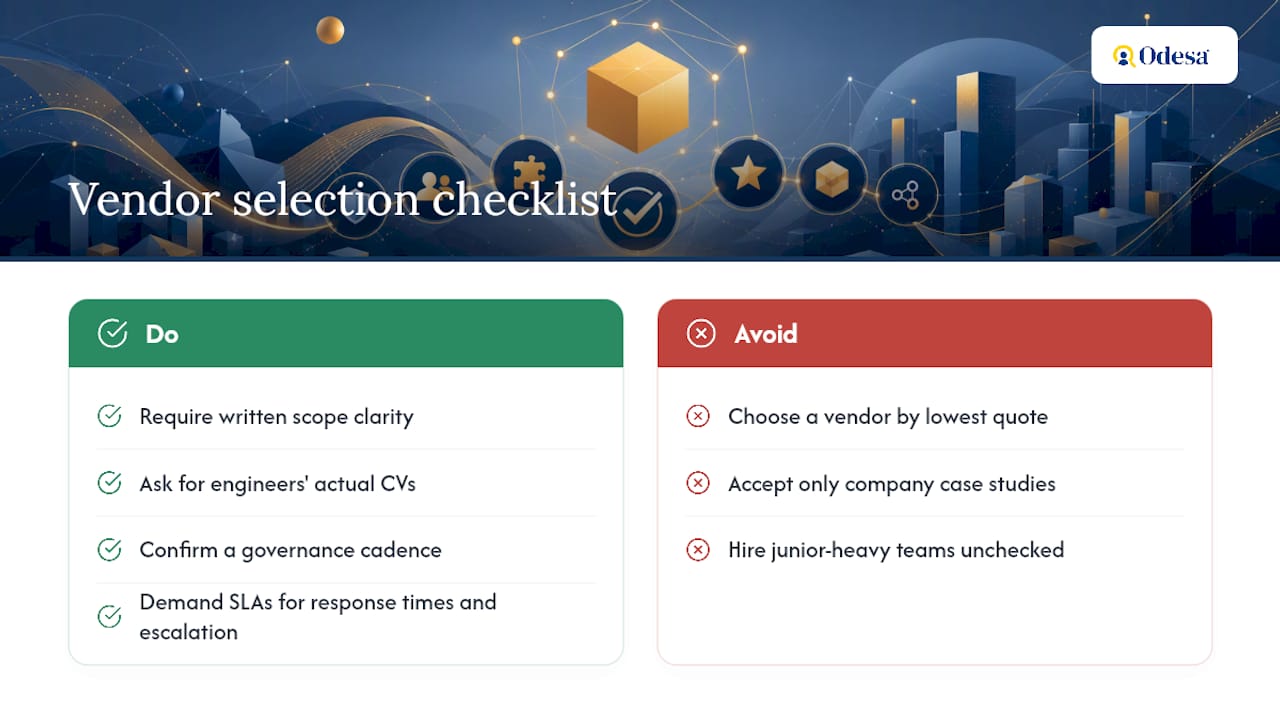
The number on a proposal tells you less than who’s delivering it. Senior engineers make fewer architectural mistakes, which means fewer expensive rewrites six months in. Junior-heavy teams often produce lower initial quotes and higher total costs once rework is counted.
Before signing anything, check for scope clarity in writing, actual CVs of the engineers assigned (not just company case studies), a defined governance cadence, and SLAs that specify response times and escalation paths. Staff augmentation and structured discovery phases exist specifically to reduce this risk before it becomes a budget overrun.
Get a Scoped Estimate Before You Commit a Budget
Most cost overruns trace back to one decision: hiring based on rate instead of experience. Odesa.co places senior, pre-vetted engineers from Latin America, the EU and Eastern Europe directly into your team, from $45/hr, without sacrificing the seniority that keeps projects on budget.
If you’re staffing an ongoing build, staff augmentation starts at $45 per hour and puts a senior engineer to work on your priorities within weeks, not months. If you need a full team scoped for a defined project, our custom development services can walk you through discovery before any fixed price gets locked in. And if quality assurance is the gap in your current process, Human Release Check starts at $1,500 per release and catches the defects that turn into expensive post-launch fixes. Reach out to scope your project and get a number you can actually plan against.
Sources
- 2025 U.S. Cost Estimation Report: Confidence Outpaces Performance | Galorath
- Software Cost Estimation guidance | U.S. DOT Volpe Center
- Custom software development cost in 2026: What to actually budget | Grow Wild
FAQ
How Much Does It Cost to Develop Customized Software?
Most custom builds fall between $25,000 for a basic MVP and $500,000 or more for enterprise systems, with mid-market platforms typically landing between $200,000 and $500,000. SaaS products have their own cost profile; see our SaaS development cost guide. The final number depends far more on feature count and integration complexity than on which vendor you choose.
How Much Does It Cost to Install Custom Software?
Installation costs are usually folded into the development contract rather than billed separately, since custom software is deployed rather than “installed” like off-the-shelf products. Ongoing hosting and infrastructure costs, covered under total cost of ownership, are the recurring expense to plan for after deployment.
How Much Should Software Development Cost?
There’s no single correct number. A defensible budget comes from bottoms-up estimation validated against a discovery phase, with 10 to 20% contingency built in and re-estimation scheduled at major milestones, as Galorath’s governance research recommends.
How Much Does It Cost to Develop a Piece of Software?
It depends entirely on scope: a simple internal tool might cost under $75,000, while a compliance-heavy platform with legacy data migration can exceed $500,000. Requesting a scoped estimate from a team offering staff augmentation or fixed-price discovery gives you a number specific to your project instead of a generic range.
Recommended
Reviewed by Val Narodetsky, founder of Odesa.co.