

Most MVPs cost between $15,000 and $150,000 depending on scope, and scope is the single biggest lever a founder controls. Feature complexity, integrations, and platform choice move the estimate more than any other variable. A short discovery sprint before you sign a contract, plus a maintenance reserve for after launch, protects the budget you set today from becoming unrecognizable a year from now.
TL;DR:
- Feature complexity and platform choice are the primary drivers of MVP costs, with simple builds starting around $15,000 and complex solutions exceeding $150,000.
- A fixed-price scope with proper discovery and a maintenance reserve prevents budgets from unexpectedly inflating, especially for features like real-time functions or compliance.
- Off-the-shelf no-code tools may be cost-effective initially but can become expensive to rebuild if custom logic or native features are later required.
- Outsourcing to offshore teams or using staff augmentation can significantly reduce costs compared to US-based agencies, but may require more oversight.
- Budgeting for post-launch maintenance at 15% to 25% of development costs is essential for sustaining and updating the MVP after deployment.
Table of Contents
- What does an MVP typically cost by scope?
- What actually drives the cost of an MVP up or down?
- How should you split an MVP budget across phases?
- Which sourcing model fits your budget and bandwidth?
- How long does an MVP take, and what costs continue after launch?
- How do you build a realistic MVP budget before signing anything?
- What does a practical, cost-aware MVP engagement look like?
- What most founders get wrong about MVP budgeting
- How Odesa fits into your MVP budget
- Sources
- FAQ
What does an MVP typically cost by scope?
Cost bands split cleanly into three tiers, and matching your idea to the right one before talking to vendors saves weeks of renegotiation.
A simple MVP, built around one core user flow, basic authentication, and roughly 6 to 10 screens, typically runs $15,000 to $25,000. Think of a single-purpose booking tool or a niche content app: one job to do, one path to do it, minimal admin tooling. These builds usually ship in 8 to 10 weeks and are the right choice when the goal is validating a single hypothesis, not launching a platform. For larger builds, see our breakdown of custom software development cost by project tier.
A standard MVP adds user accounts, payment processing, a basic admin panel, and a handful of third-party integrations. This tier lands at $25,000 to $40,000 and covers most marketplace, subscription, and service-booking products. It is the most common starting point for founders who have already validated demand and now need a product real customers can pay for. If the product is a subscription business, our SaaS development cost guide covers what changes after the MVP.
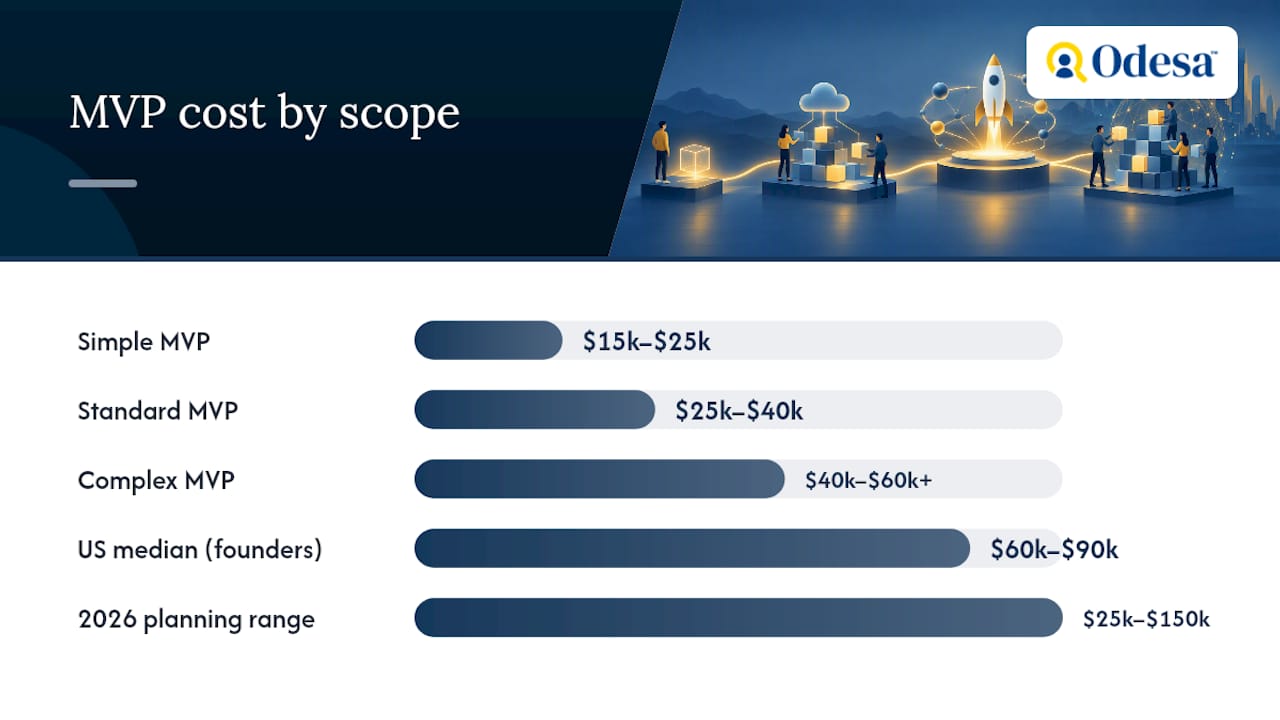
A complex MVP involves multiple user roles, real-time features such as chat or live tracking, native mobile apps for iOS and Android, or regulatory requirements like healthcare or financial compliance. These builds often exceed $40,000 to $60,000 and can climb well past that when compliance audits or custom infrastructure enter the picture. Broader industry benchmarking places the full 2026 range founders should plan around at $25,000 to $150,000, with the median for a US-based team often landing near $60,000 to $90,000.
What each tier typically buys:
- Simple: single user flow, login, 6 to 10 screens, no payments or admin panel.
- Standard: accounts, payments, basic admin dashboard, two to four integrations.
- Complex: multiple roles, real-time features, native apps, compliance-ready architecture.
None of these numbers are fixed. They shift the moment you add a feature, change platforms, or bring on a different kind of team, which is exactly what the next section breaks down.
What actually drives the cost of an MVP up or down?
Five variables move an estimate more than anything else, and founders who understand them can trim a budget without gutting the product.
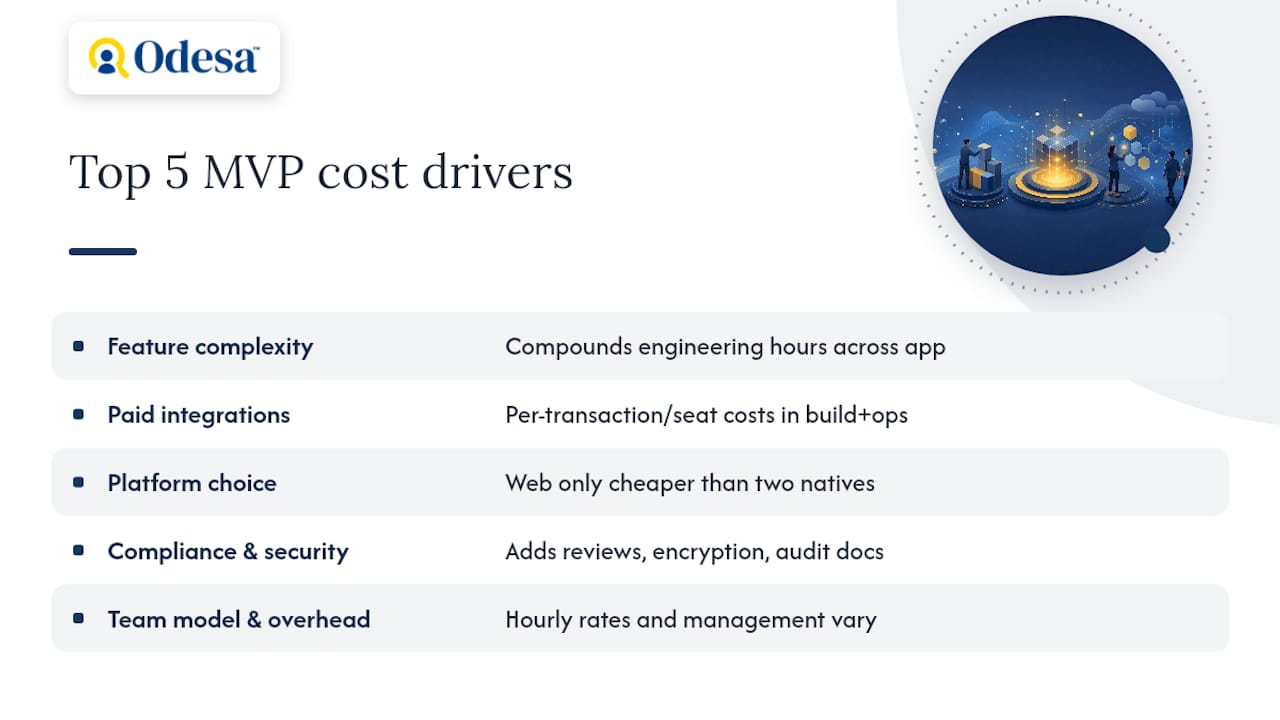
Feature complexity is the largest factor. Every additional user role, permission layer, or real-time function (chat, live location, instant notifications) adds engineering hours that compound rather than add. A messaging feature is rarely “one more screen”: it touches infrastructure, testing, and edge cases across the whole app.
Paid integrations and APIs carry their own line item. Payment processors, mapping services, SMS providers, and analytics platforms often bill per transaction or per seat, and those costs show up both in build time and in ongoing operating expenses.
Platform choice is a decision founders sometimes make too late. A single responsive web app is cheaper to build and maintain than two native apps for iOS and Android, since native development effectively doubles the engineering surface for the same feature set.
Compliance and security requirements add real cost when they apply. Products handling health data, payments, or personal financial information may need HIPAA or SOC 2 alignment, which brings in additional review cycles, encryption work, and audit-ready documentation. Recent analyst reporting on GenAI-assisted development notes that security and code-review practices are shifting as AI-assisted tools enter more toolchains, which changes how teams budget for review and hardening work.
Team model and hourly overhead round out the list: a US-based agency, a boutique studio, and an augmented senior engineering team carry different hourly rates and different management overhead, covered in more detail further down.
AI-assisted tooling and mature no-code platforms are reshaping where 2026 MVP budgets go. Gartner’s analysis of software engineering trends points to low-code and AI-assisted development shifting spend away from raw coding hours and toward design, integration, and monitoring work, meaning a well-scoped MVP today often spends less on writing code and more on the surrounding decisions.
How should you split an MVP budget across phases?
A top-line number is not a plan. Breaking it into phases shows where the money actually goes and where cutting corners creates the most risk.
The exact split shifts with complexity, but engineering should never consume the entire budget with nothing left for testing.
Several costs fall outside this table and catch first-time founders off guard:
- Legal and compliance review: terms of service, privacy policy, and data agreements, often handled outside the dev budget.
- App store and marketplace fees: platform registration and annual developer fees for iOS and Android distribution.
- Analytics and monitoring tools: usage tracking, error monitoring, and uptime alerts that start billing from day one.
On contract structure, fixed-price agreements work best when scope is locked after discovery, since they protect the budget from creep. Time-and-materials arrangements suit products still evolving mid-build, but they require closer oversight to avoid drift. Either way, discovery should happen before you sign, not during. Our time and materials vs fixed price guide compares the two in detail.
Which sourcing model fits your budget and bandwidth?
The same MVP scope can cost three times as much or take three times as long to manage, depending on who builds it.
- US-based agencies charge the highest hourly rates and carry the lowest management overhead for the founder, since they typically bring their own project managers.
- Boutique studios sit slightly below agency pricing with more founder involvement expected in day-to-day decisions.
- Freelancer platforms offer the lowest sticker price but the highest coordination risk, since quality and availability vary engineer to engineer.
- Offshore and nearshore teams or augmented senior engineers typically land in the middle on cost with moderate oversight needs, and current US pricing benchmarks show agency and local rates running substantially higher than offshore or augmented alternatives for comparable output.
- No-code platforms work well for validating a single flow cheaply and quickly, but they hit a ceiling fast once you need custom logic, real-time features, or native performance.
Investor optics matter less than founders assume. What investors actually check is whether the team shipped something real on budget, not which logo is on the contract.
Pro Tip: Run your riskiest, most technical feature past a paid engineer before committing to a no-code build, since the platform that looks fastest today can become the most expensive rebuild later.
Founders weighing hiring against contracting often underestimate the true fully loaded cost of a US-based hire once benefits, equipment, and ramp-up time are included, which changes the comparison against augmented or contract models considerably.
How long does an MVP take, and what costs continue after launch?
Timeline and cost track closely together, since every extra week of engineering is extra burn regardless of team model.
A simple MVP typically ships in 8 to 10 weeks, a standard MVP in 10 to 14 weeks, and a complex MVP in 14 to 20 weeks or more, with design and engineering phases usually overlapping rather than running strictly in sequence. Rushing any of these tiers by compressing the timeline tends to increase cost rather than reduce it, since parallel work requires more people, not less time from the same people.
The cost that surprises most first-time founders is what happens after launch. Annual maintenance is commonly budgeted at roughly 15% to 25% of the initial development cost, covering bug fixes, security patches, and small feature updates. Year one tends to run higher than that baseline, since early users surface issues a closed beta never catches.
- Hosting and infrastructure: cloud hosting, database costs, and content delivery scale with usage, not with a fixed monthly fee.
- Third-party subscriptions: payment processing, email delivery, and SMS services bill monthly regardless of how many customers you have.
- Monitoring and support tools: error tracking and customer support software add recurring costs most first budgets omit entirely.
Building a maintenance reserve into the original budget, rather than treating it as a surprise expense six months post-launch, keeps the product funded through its most volatile stretch.
How do you build a realistic MVP budget before signing anything?
A defensible MVP budget starts before a single line of code, and the steps below apply whether you are hiring an agency, a freelancer, or an augmented team.
- Run a paid discovery sprint first. A one to two week scoping engagement converts a vague idea into a fixed feature list, and it is the single most effective way to prevent expensive change orders mid-build.
- Set a contingency buffer. Add 15 to 20% on top of the engineering estimate for unknowns that discovery did not catch.
- Reserve for maintenance separately. Set aside a maintenance line, weighted toward the higher end in year one, so post-launch fixes do not compete with your marketing budget.
- Draft a line-item template. List discovery, design, engineering, QA, DevOps, legal review, and monthly recurring tools as separate lines with percent allocations, not one lump “development” figure.
- Ask vendors specific questions. Request a phase-by-phase quote, not a single number, and ask what happens to cost if a feature is added mid-build.
Watch for these red flags during vendor calls:
- A quote with no discovery phase or scoping call included.
- Reluctance to break the estimate into design, engineering, and QA separately.
- No mention of post-launch maintenance or support terms.
A hiring cost calculator can help model the gap between hiring in-house and contracting a team before you commit either way.
What does a practical, cost-aware MVP engagement look like?
A certain service provides senior engineering talent to growth-stage companies through a network of pre-vetted engineers based in Eastern Europe, matched personally by the founder rather than through an automated queue. That matching process, combined with flexible engagement options across staff augmentation, direct recruitment, and custom development, is built specifically for teams that need experienced developers without a lengthy local hiring cycle.
Odesa also documents this cost dynamic directly: the Vantex AI case study describes a four-engineer pod delivered materially below typical US-based cost for a comparable team. Founders typically start with a scoping conversation, move into a small pilot pod to test fit, and expand into a longer retainer once the working relationship is proven.
What most founders get wrong about MVP budgeting
The biggest mistake is not overspending. It is underspending on discovery and overspending on features nobody asked for. A founder who skips scoping to save two weeks often loses two months to rework once the first version reveals gaps that a scoping call would have caught for a few thousand dollars.
The second mistake is treating maintenance as optional. A budget that stops at launch day is not a real budget, since the first few months of live usage generate more bug reports than the entire build phase combined.
A few rules hold up across most MVP builds:
- Fund discovery before engineering, not after.
- Budget maintenance as a fixed reserve, not an afterthought.
- Match your sourcing model to how much oversight you can realistically give it.
- Launch the smallest version that tests your core assumption, then iterate with real usage data.
- Treat a vendor’s refusal to break down phase costs as a warning sign, not a formality.
Before signing anything, confirm the phase breakdown, the maintenance terms, and what happens if scope changes mid-build. Those three questions catch most of the expensive surprises before they happen.
How Odesa fits into your MVP budget
If your MVP needs senior engineering capacity without the time and cost of a local hire, staff augmentation gets a vetted engineer or small pod working on your build within a matter of weeks, priced from $45 per hour. For teams that want a fully scoped build handled end to end, custom development covers the engagement from discovery through launch. And once you ship, Ongoing Human QA, priced from $3,500 per month, catches the issues that automated testing tends to miss.
- Start with a scoping call to size your MVP before committing to a team model.
- Test fit with a small pilot pod before expanding into a longer retainer.
- Add a Human Release Check, priced at $1,500 one-off, before any major launch.
Book a scoping conversation through Odesa’s staff augmentation page to get a real cost estimate against your specific feature list.
Sources
- Cost to Build an MVP: Real Numbers by Scope
- Gartner: top strategic trends in software engineering for 2025 and beyond
- 2025 GenAI code security report
- MVP Development Cost in 2026: US Pricing Guide
FAQ
How much does MVP cost?
Most MVPs cost between $15,000 and $150,000, depending heavily on feature complexity, platform choice, and team model. A simple single-flow product sits near the bottom of that range, while a complex build with compliance requirements or native apps sits near the top.
How much does it cost to pay someone to develop an app for you?
Costs vary by scope and sourcing model, but a standard MVP with accounts, payments, and a handful of integrations typically runs $25,000 to $40,000. Hourly rates differ widely between agencies, freelancers, and augmented engineering teams, so the same feature set can cost very different amounts depending on who builds it.
How much does it cost to develop a mobile app in 2026?
A native mobile app generally costs more than a responsive web app for the same feature set, since building for both iOS and Android roughly doubles the engineering surface. Complex apps with real-time features or compliance needs often exceed $40,000 to $60,000, while simpler single-platform apps can stay closer to the lower end of that band.
What is MVP development services?
MVP development services cover the discovery, design, engineering, and QA work needed to build a minimum viable product, the smallest version of a product that tests a core assumption with real users. Services range from full custom builds to staff augmentation models, where senior engineers join an existing team to execute a scoped MVP, such as the staff augmentation and custom development options Odesa offers.
Recommended
- Hire AI/ML Engineers
- Developer Hiring Cost Calculator
- Direct Hire vs Contract: An Employer Checklist and a Third Path
Reviewed by Val Narodetsky, founder of Odesa.co.