
Most founders should plan for $40,000 to $90,000 to build a focused MVP, $90,000 to $250,000 for a production-ready product with real integrations, and $250,000 to $750,000 or more for an enterprise-grade platform with compliance and AI workloads. The single biggest swing factor is scope paired with labor mix: who builds it, where they are based, and how tightly the feature set is controlled. Before committing a budget, validate scope through a short discovery phase or a staffed trial engagement.
TL;DR:
- Engineering often consumes 60% to 70% of build costs; reserve 10% to 15% of engineering hours for QA and 8% to 12% of labor for management.
- Use loaded labor costs for employees, adding 20% to 30% for benefits, taxes, and overhead; seniority and location can shift quotes sharply.
- Choose pooled tenancy to lower per tenant infrastructure costs, but meter usage and set quotas before launch, especially when customers can run heavy AI workloads.
- Plan for annual maintenance equal to 15% to 20% of the original build budget, and reserve 6 to 9 months of runway for customer acquisition.
Table of Contents
- How to Think About SaaS Costs: A Work-Breakdown Model
- Phase-by-Phase Cost Breakdown With Role-Level Effort
- Typical Dollar Ranges by Product Complexity
- Cloud Infrastructure, Tenancy Models, and Operating Costs
- Budgeting Tactics to Keep Development Costs Predictable
- Post-Launch and Hidden Costs to Include in Total Cost of Ownership
- How Staff Augmentation and Recruitment Fit a SaaS Budget
- Why Discipline Matters More Than Speed
- Get Control Over Your SaaS Build Budget
- FAQ
- Sources
How to Think About SaaS Costs: A Work-Breakdown Model
Founders who estimate SaaS development cost accurately do not start with a single number. They start with a work-breakdown structure (WBS) that turns a product idea into line items, then price each line item separately. This is the same discipline that agencies and in-house teams use, and it works whether you are scoping a weekend project or a multi-year platform. Our custom software development cost guide applies the same approach to non-SaaS builds.
A useful WBS for a SaaS application generally includes:
- Discovery and requirements definition, including user research and technical feasibility
- UX/UI design and a reusable design system
- Frontend development for the application interface
- Backend development, including the data model and business logic
- Third-party integrations such as payment processors, email, and analytics
- Billing and subscription logic, often tied to a payment platform
- Security and access control, including authentication and data protection
- Quality assurance and testing across devices and edge cases
- DevOps, cloud infrastructure setup, and observability tooling
- Launch preparation, including monitoring and rollback plans
Each line item carries a mix of cost types: labor (salaries or contractor rates), third-party services (payment processing fees, email providers), licenses (design tools, monitoring platforms), and cloud spend (compute, storage, data transfer). Treating these as separate buckets avoids the common mistake of lumping everything into “engineering cost” and losing visibility into where money actually goes. For each third-party line item, a build vs buy check tells you whether to license it or write it yourself.
Timeline matters as much as headcount. A six-month build with four engineers does not cost the same as a twelve-month build with two, even though total person-months are similar, because longer timelines add coordination overhead, more design iterations, and a higher chance of scope creep. Stripe’s guidance on SaaS economics makes the point directly: engineering is only one cost center, and founders who underfund their contingency buffer often end up cutting corners on QA or launch readiness instead.
Phase-by-Phase Cost Breakdown With Role-Level Effort
Breaking a SaaS build into phases lets you assign realistic effort and translate labor benchmarks into dollar figures. The U.S. Bureau of Labor Statistics reports median annual pay for software developers at about $133,080 as of May 2024, with the lowest 10% earning under $79,850 and the highest 10% earning over $211,450. That spread alone explains why two teams can quote wildly different numbers for the same scope.
- Discovery and validation: typically 2 to 4 weeks, covering user interviews, technical architecture decisions, and a prioritized backlog. Cost drivers here are founder and product-lead time plus any paid research.
- Design: 3 to 6 weeks for UX flows, UI design, and a basic design system. Mid-tier and enterprise products need more design-system investment because they support more screens and more edge cases.
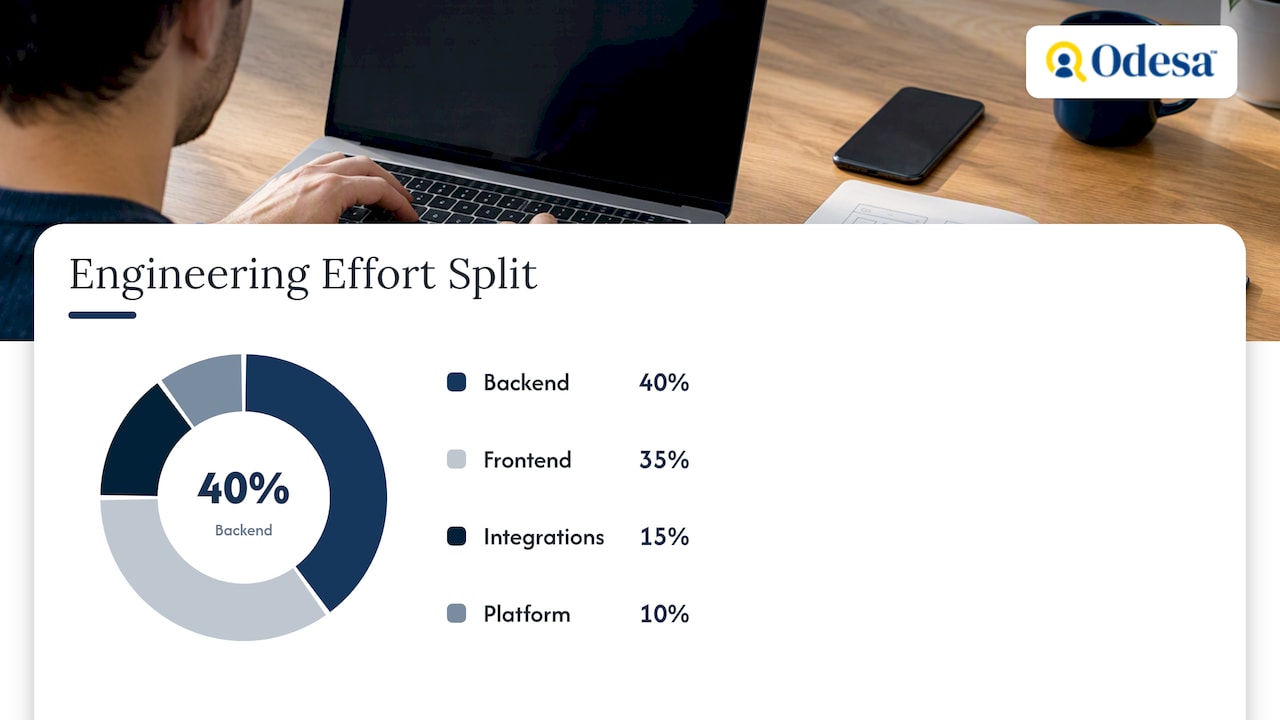
- Engineering: the largest phase by far, often 60% to 70% of total build cost. A rough effort ratio is 40% backend, 35% frontend, 15% integrations, 10% platform and tooling, though this shifts with product type.
- QA, security, and DevOps: QA typically runs parallel to engineering, not after it, and should get 10% to 15% of engineering hours. Security review and DevOps setup (CI/CD, environments, monitoring) are often underbudgeted and should get dedicated hours, not leftover time.
- Project management: for distributed or remote teams, budget 8% to 12% of total labor cost for coordination, sprint planning, and communication overhead, higher if the team spans multiple time zones.
BLS occupational wage data shows the median developer wage at roughly $132,270 with a mean of $138,110, and a 25th-to-75th percentile range of about $101,200 to $167,540. Use percentile data, not just the median, when staffing a mixed-seniority team, since a junior-heavy team and a senior-heavy team can differ by tens of thousands of dollars per engineer per year.
Pro Tip: Build your phase budget using loaded labor cost, not advertised salary; add 20% to 30% on top of base pay for benefits, taxes, and overhead when estimating in-house hires. The developer hiring cost calculator models the US vs remote cost of the same team.
Contingency belongs in every phase, not just at the end.
Typical Dollar Ranges by Product Complexity
Once you have a phase breakdown, you can map it to a realistic total. These ranges assume a mixed team of two to six engineers plus design and QA support, built over three to twelve months.
- MVP ($40,000 to $90,000): a focused feature set, single-tenant or simple multi-tenant data model, one or two core integrations (payments, email), and minimal customization. Timeline is usually 3 to 5 months. Our MVP development cost guide looks at this tier more closely.
- Mid-tier product ($90,000 to $250,000): expanded features, basic multi-tenant architecture, several integrations, role-based permissions, and a more mature design system. Timeline typically runs 5 to 9 months.
- Enterprise-grade ($250,000 to $750,000 or more): scale-ready architecture, compliance requirements (SOC 2, HIPAA, or similar), advanced security review, and often AI or data-heavy workloads that add both engineering and infrastructure cost. Timeline commonly extends past 9 to 12 months.
These figures assume a blended labor rate reflecting a mix of seniority and location. A team built entirely from senior in-house hires in high-cost markets will land at the top of each range or above it, while a well-managed staff augmentation model with experienced engineers can deliver comparable scope nearer the lower end, because you are paying for delivery time rather than full-time overhead, benefits, and recruiting cost. The hiring model you choose does not change the engineering work required, but it does change how much of your budget goes to labor rate versus employer overhead. If you would rather hand a defined scope to one team, Odesa’s custom software development service starts with a written proposal within 5 business days.
Cloud Infrastructure, Tenancy Models, and Operating Costs
Architecture decisions made in the first few months determine your cost structure for years. The AWS Well-Architected SaaS Lens describes three common tenancy models: silo (each tenant gets dedicated infrastructure), bridge (a mix of shared and dedicated components), and pool (fully shared infrastructure with logical separation). Each has tradeoffs:
- Silo tenancy simplifies compliance and isolation but raises per-tenant infrastructure cost
- Pool tenancy lowers cost per tenant but requires careful metering to avoid one tenant consuming a disproportionate share of resources
- Bridge models let you isolate sensitive tenants while keeping most of the base on shared infrastructure
AWS recommends building tenant-level consumption attribution from day one rather than retrofitting it later, because without that visibility you cannot price tenants accurately or spot a runaway cost source. This becomes urgent fast if your product includes AI features: a single tenant running heavy inference workloads can consume more compute than many pooled tenants combined, making usage metering and quotas a pre-launch requirement rather than a later optimization.
Staff augmentation can save up to 53% on hiring costs compared to local rates, a saving that becomes more meaningful once you factor in that infrastructure decisions, not just labor, determine long-term margin.
Practical first steps: turn on AWS Cost Explorer before launch, tag every resource by environment and tenant, and set a budget alert tied to expected baseline spend. AWS’s cost and pricing model guidance specifically cautions against locking into long-term Savings Plans until usage patterns stabilize, since early-stage products often change their resource footprint faster than a one- or three-year commitment can absorb.
Budgeting Tactics to Keep Development Costs Predictable
Cost predictability comes from decisions made before the first sprint, not from tracking spreadsheets harder once the project is underway.
- Run a short discovery phase before committing to a full build. Two to four weeks of scoping work costs far less than discovering a core assumption is wrong three months into engineering.
- Release iteratively rather than building the full vision before launch. Smaller releases surface usage data earlier and let you redirect budget toward features customers actually use.
- Choose staff augmentation over a full in-house hire when speed and flexibility matter more than long-term headcount. Augmentation shortens time-to-start, avoids recruiting and benefits overhead, and lets you scale the team up or down as scope shifts, an advantage especially visible during an MVP or mid-tier build where requirements are still settling.
- Apply cloud cost quick wins early. Tag all resources, turn off non-production environments outside working hours, right-size instances based on actual usage, and hold off on Savings Plans until your workload is stable.
- Budget commercial runway alongside engineering runway. Customer acquisition cost, support staffing, and ongoing iteration need their own line items; a product that is cheap to build but expensive to sell has not actually saved you money.
Pro Tip: Treat your first three months of cloud spend as a baseline-gathering period: review Cost Explorer weekly, not monthly, so a pricing mistake gets caught in days rather than in a quarterly bill.
Post-Launch and Hidden Costs to Include in Total Cost of Ownership
Development cost is only part of what a SaaS product actually costs to run. Founders who plan only for the build phase routinely underfund the months after launch.
- Ongoing maintenance and technical debt servicing typically consumes 15% to 20% of the original build budget annually, covering dependency updates, bug fixes, and refactoring work deferred during the rush to ship.
- Support, onboarding, and customer success costs scale with user count, not with code complexity, and are easy to underestimate when a team has only ever shipped internal tools.
- Monitoring, security, and compliance audits carry both tooling costs and the engineering time needed to produce evidence for audits like SOC 2, which recurs annually rather than once.
- Marketing and CAC-driven engineering work, such as building analytics instrumentation, onboarding flows, and billing changes to support new pricing tiers, often gets treated as a separate budget from “the build,” even though it draws from the same engineering capacity.
Stripe’s guidance for SaaS founders is blunt about this: building the product is necessary but not sufficient, and growth depends on acquisition, conversion, and retention work that competes for the same engineering hours as the next feature release.
How Staff Augmentation and Recruitment Fit a SaaS Budget
We built our staff augmentation and recruitment model around the budgeting problem founders actually face: engineering cost is the largest line item, and getting the staffing mix wrong is expensive in both dollars and time. Our founder-led matching process pairs you directly with pre-vetted senior engineers from Eastern Europe, so the search-and-vet cycle that normally eats weeks of a discovery budget happens before you ever see a candidate.
- Discovery and MVP phases usually benefit most from augmentation, since scope is still shifting and a flexible contract avoids the sunk cost of a full-time hire.
- Mid-tier and enterprise builds often mix augmentation for surge capacity with direct recruitment for roles you expect to stay in-house long term.
- Evaluating a partner quickly comes down to three checks: can they start a trial engagement fast, what retention track record do they have with placed engineers, and how transparent is their pricing before you sign anything.
Why Discipline Matters More Than Speed
The temptation in SaaS development is to treat engineering speed as the only variable worth optimizing, but the founders who control cost well are the ones who treat scope discipline and cost-aware architecture as equally important. Overbuilding before validating demand is the single most common way a reasonable MVP budget turns into an enterprise-sized bill with no enterprise-sized customer base to justify it.
Our recommended checklist: run a real discovery phase, decide your staffing model deliberately rather than by default, set up cloud cost visibility before launch, and keep 6 to 9 months of runway earmarked for customer acquisition, not just engineering.
Get Control Over Your SaaS Build Budget
Predictable SaaS development cost starts with staffing flexibility, and that is where we focus. Staff augmentation lets you bring in a senior engineer from $45 per hour without the recruiting cycle or long-term commitment a full-time hire requires, which matters most during the discovery and MVP phases when scope is still moving.
- Need a permanent hire instead? Our tech recruitment service places a senior engineer for a 7,999 USD one-off fee per successful hire.
- Ready to ship with confidence? Human Release Check starts at 1,500 USD one-off, with ongoing QA available from 3,500 USD per month.
- Running an agency and need extra capacity? White Label Development starts at $45 per hour.
Reach out through our services page to discuss a trial engagement and see pricing before you commit to a team structure.
FAQ
What does SaaS stand for?
SaaS stands for Software as a Service, a delivery model where customers access software over the internet on a subscription basis rather than installing it locally. The provider handles hosting, maintenance, and updates centrally.
What are 5 common startup costs?
Common early-stage startup costs include product development (engineering, design, QA), cloud infrastructure, legal and incorporation fees, marketing and customer acquisition, and payroll or contractor payments. For a SaaS product specifically, development typically ranges from $40,000 for a focused MVP to $750,000 or more for an enterprise-grade platform, depending on scope and compliance needs.
Is ChatGPT considered SaaS?
ChatGPT, when accessed through a web browser or subscription plan rather than run on local hardware, fits the SaaS model because it is delivered as a hosted service with subscription-based access. The underlying AI model itself is not SaaS, but the product wrapped around it for end users is.
What is the average customer acquisition cost for SaaS businesses?
There is no single universal figure for SaaS customer acquisition cost, since it varies heavily by market, pricing tier, and sales model. Stripe’s guidance for SaaS founders recommends budgeting acquisition cost alongside development cost from the start rather than treating it as an afterthought, since underpricing a product to offset high CAC can undercut margin long after launch. Tools like a SaaS churn calculator can help model how acquisition cost interacts with retention over time.
Sources
For deeper numbers on wages, cloud cost attribution, and SaaS economics, consult the Bureau of Labor Statistics, AWS Well-Architected SaaS guidance, and Stripe’s founder resources directly.
- Software Developers, Quality Assurance Analysts, and Testers : Occupational Outlook Handbook : U.S. Bureau of Labor Statistics
- Expenditure awareness: AWS Well-Architected SaaS Lens
- The business of SaaS: Stripe
Recommended
- The Cost of Hiring a US Developer: A Complete Budget
- 7 Toptal Alternatives: Compare Developer Hiring Options
- Developer Hiring & Engineering Service Pricing
Reviewed by Val Narodetsky, founder of Odesa.co.