

White-label development is a ready-made, rebrandable software product you license and customize to launch faster than building from scratch. It suits founders, agencies, and product managers who need to enter a market quickly without carrying the full cost of a build. If your priority is speed and lower upfront investment, white label is usually the better fit; if you need full ownership of the code and a unique feature set, custom development is the stronger route.
TL;DR:
- White-label development offers faster market entry and lower initial costs but limits deep customization of core features.
- Licensing agreements should clarify configurability, source code access, and sublicense rights to ensure long-term flexibility.
- Projects typically progress through discovery, branding, integration, testing, and deployment, with delays often caused by scope uncertainty or complex data migration.
- Costs range from $45 per hour for minor branding tweaks to sums approaching custom development for extensive modifications.
- White-label is best for testing demand or reselling, while custom development suits proprietary workflows and full ownership needs.
Table of Contents
- What white-label development actually means
- Benefits and typical use cases for white-label development
- How white-label development works: from contract to launch
- How to evaluate and choose a white-label development partner
- Cost and timeline expectations for white-label projects
- Odesa’s white-label experience and a case study highlight
- Where white-label wins and where custom is the better call
- How Odesa can help you launch a rebrandable product
- Sources
- FAQ
What white-label development actually means
White-label development is the practice of licensing a pre-built software product, then rebranding and customizing it for your own market. The underlying codebase is developed once, by a vendor, and sold or licensed multiple times to different businesses that each apply their own logo, color scheme, and in some cases feature configuration. It commonly appears in three forms: white-label mobile apps (delivery, fitness, or booking apps sold to multiple retailers), white-label SaaS (helpdesk or CRM platforms rebranded for agencies to resell), and white-label plugins or modules that plug into a larger platform.
It differs from adjacent models in a few important ways:
- Custom development builds a product from a blank slate around your specific requirements, giving you full ownership and no licensing dependency.
- OEM licensing typically applies to hardware or embedded software, where a manufacturer’s product is sold under another company’s brand with limited software rebranding.
- Reseller or affiliate models let you sell someone else’s product under their own brand, earning commission without any rebranding rights at all.
White-label sits between these two extremes. You get a working product faster than custom development allows, and you retain more brand control than a straight reseller arrangement gives you. Agencies pitching multiple clients on the same underlying app category, retailers wanting a fast entry into a niche vertical, and founders testing a market before committing to a full build tend to prefer white label. Companies building a defensible, differentiated product around a proprietary algorithm or workflow usually need custom development instead, since white-label licenses rarely allow the deep structural changes that kind of differentiation requires.
Benefits and typical use cases for white-label development
The appeal of white-label development comes down to time and capital. Instead of specifying, building, and testing a product over many months, you start from something that already works and spend your budget on the pieces that make it yours: brand identity, a handful of custom features, and go-to-market execution. That trade-off means lower engineering overhead but also less flexibility, since most white-label licenses cap how far you can restructure the core product.
In practice, this model shows up in a few recurring scenarios:
- Agencies license a white-label app framework once and resell customized versions to multiple retail or service clients.
- Retailers launch a niche vertical app, such as a loyalty or booking tool, without hiring an internal engineering team.
- Founders validate an MVP quickly, using a white-label base to test demand before investing in a fully custom build.
- SaaS vendors offer a white-label version of their platform so partners can resell it under their own brand, expanding distribution without added sales headcount.
Pro Tip: Before signing a white-label agreement, ask the vendor exactly which UI elements and backend settings are configurable versus fixed. That answer tells you more about your real flexibility than any marketing page will.
Speed to market is the clearest advantage: a founder validating demand in a new vertical can go from contract to a rebranded, functioning product in weeks rather than the many months a from-scratch build typically requires. That speed comes at the cost of some differentiation, since your competitors could be licensing the same underlying platform.
How white-label development works: from contract to launch
Most white-label engagements follow a similar sequence, though vendors vary in how much they formalize each step. Understanding the order helps you spot gaps in a vendor’s process before you sign anything.
- Discovery and product selection. You review the vendor’s existing base products and pick the one closest to your use case, then define the scope of customization you need, from cosmetic branding only to added features or third-party integrations.
- Branding and UI customization. The vendor applies your logo, color palette, and typography, and adjusts layouts or navigation where the license allows.
- Integration work. This is where most of the real engineering happens: connecting payment processors, analytics tools, CRM systems, or other APIs your business already relies on.
- Data migration. If you are replacing an existing system, the vendor migrates your existing customer or product data into the new platform, a step that often takes longer than founders expect.
- Licensing and legal setup. You finalize rebrand rights, confirm whether sublicensing to your own clients is permitted, and clarify whether source code access is included or reserved to the vendor.
- Testing. Functional and security testing confirm the customized build performs correctly under your branding and with your integrations in place.
- Deployment. For mobile apps, this means submission to app stores under your developer account; for SaaS, it means provisioning your own domain and hosting environment.
- Ongoing maintenance. The vendor or an internal team handles updates, bug fixes, and security patches, with the division of responsibility spelled out in the contract.
The licensing step deserves particular attention. Whether you can sublicense the product to your own customers, whether you have any claim to the underlying source code, and whether the vendor’s trademark must appear anywhere in your rebranded product all affect your long-term flexibility. The Federal Trade Commission’s Informal Staff Advisory Opinion 05-2 addresses a related question: licensing arrangements that provide only incidental support and do not require use of the licensor’s trademark are less likely to meet the definitional elements of a franchise under the Franchise Rule. That distinction matters if your agreement involves ongoing fees or centralized control that could resemble a franchise relationship rather than a straightforward software license.
How to evaluate and choose a white-label development partner
Choosing a white-label partner is closer to vetting a long-term supplier than buying off-the-shelf software. The contract you sign will shape what you can change, what it costs to change it, and what happens if the relationship ends.
Start with technical fit. Confirm the vendor’s stack is compatible with your existing systems, ask how many extension points the platform actually exposes, and check the maturity of its API documentation. A platform with a thin, poorly documented API will cost you far more in integration work than the license fee suggests.
Commercial terms need the same scrutiny:
- License scope: does it cover one product instance, unlimited rebrands, or a set number of end clients?
- Fee structure: one-time customization fee, ongoing subscription, or a revenue-sharing arrangement.
- Renewal terms: what happens to your rebranded product if you do not renew, and can you keep operating it.
Operational assurances are just as important as the price tag. Ask about service-level agreements for uptime and support response times, how often the vendor pushes updates, and whether you get visibility into their product roadmap or are simply notified after changes ship.
Security and compliance checks round out the list: confirm who legally owns customer data collected through the rebranded product, what encryption standards apply, and what the vendor’s breach notification process looks like. These answers matter more than they seem at signing time, since they determine your exposure if something goes wrong after launch.
Watch for a few recurring red flags:
- Source code is fully locked with no access option, even at a premium.
- Timelines are vague or repeatedly described as “it depends” without a concrete range.
- Support is limited to email with no stated response window.
- The contract is silent on what happens to your data or your customers if the vendor shuts down.
Pro Tip: Ask directly who owns derivative work created during your customization. Vendors that hesitate on this question are usually the ones planning to restrict your exit options later.
On an initial discovery call, a short list of direct questions saves weeks of back-and-forth later: What exactly can we customize versus what is fixed? What is included in the license fee, and what triggers additional charges? What is your average time from contract to launch for a project like ours? Who owns the code after customization, and can we get access to it? What does your support response time look like after launch, and is it in writing?
Cost and timeline expectations for white-label projects
White-label pricing generally follows one of three models: a one-time customization fee for branding and minor adjustments, a recurring subscription or license fee that covers ongoing access and updates, or a revenue-sharing arrangement where the vendor takes a cut of what you earn from the rebranded product. Which model applies usually depends on how much ongoing support the vendor provides after launch.
Cost scales directly with how much you change. A minor customization limited to logo, colors, and basic settings sits at the low end of any vendor’s pricing, since it requires little engineering time. Moderate customization, such as adding a new integration or adjusting core workflows, sits in the middle. Heavy customization, where you are effectively asking the vendor to build new functionality on top of their base product, can approach the cost of a scoped custom project and often makes more sense as one.
One industry roundup notes that vendor selection criteria commonly include technical expertise, specialization, project management practices, and pricing model transparency, factors that directly affect both cost and timeline predictability on a white-label engagement.
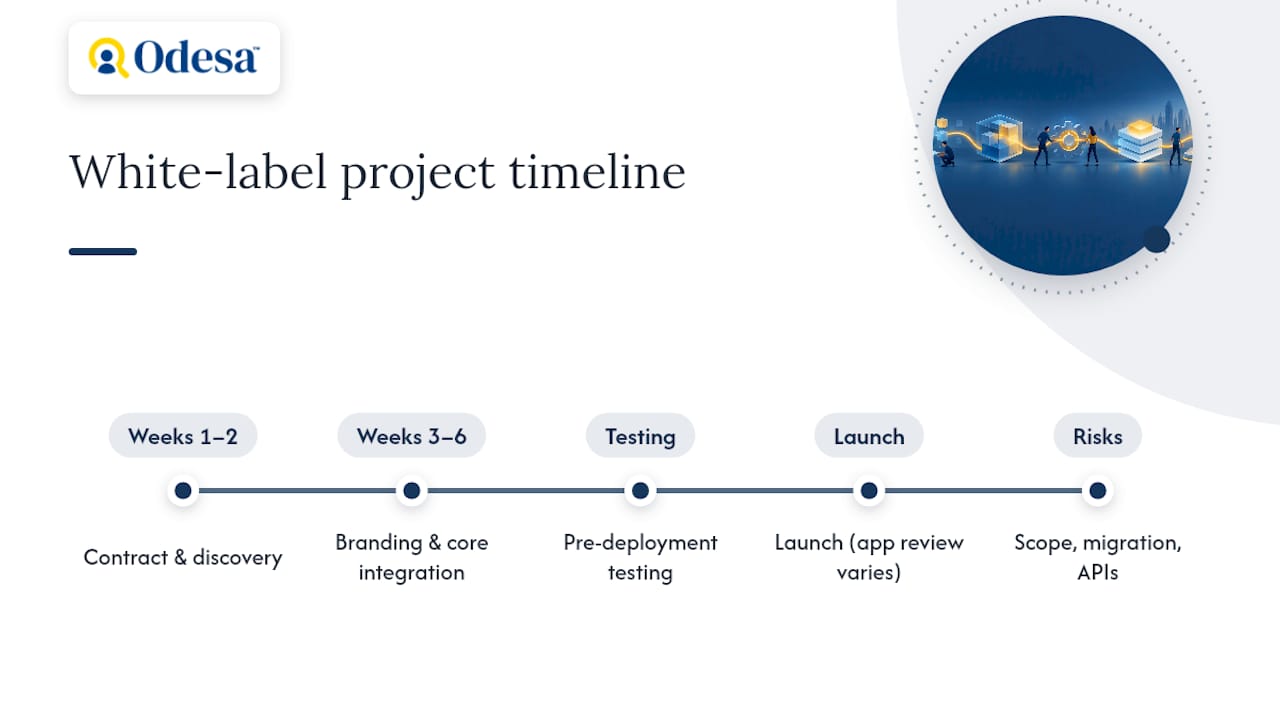
Timelines typically move through a few predictable milestones: contract signing and discovery in the first one to two weeks, branding and core integration work over the following several weeks, testing before submission or deployment, and a launch window that depends heavily on app store review times for mobile products. Projects stall most often over unclear customization scope agreed at the start, data migration complexity that was underestimated, or third-party integrations that require more back-and-forth with external APIs than anyone planned for.
Odesa’s white-label experience and a case study highlight
Odesa works with agencies and growth-stage companies that need senior engineering capacity to deliver white-label projects without the delay of a traditional hiring cycle. The company’s white-label development service pairs pre-vetted, senior Eastern European engineers with agencies that need to deliver rebrandable products for their own clients, alongside staff augmentation and custom development for teams that need engineering capacity under other terms.
A case study illustrates what that model looks like in practice: a telehealth platform rebuild completed in 16 weeks, a timeline demonstrating how senior, pre-matched engineering talent can compress a project schedule that might otherwise stretch well beyond that window. For agencies juggling multiple client deadlines, that kind of delivery speed is often the deciding factor between taking on a new white-label contract or turning it down.
A few situations point clearly toward this kind of model:
- An agency has signed a white-label contract with a tight deadline and needs engineering hands immediately rather than after a multi-month hiring search.
- A founder wants senior-level code quality on a customization project but does not want to carry full-time engineering salaries.
- A growth-stage company needs to scale delivery capacity temporarily without restructuring its permanent team.
Odesa’s approach centers on direct founder involvement in matching engineers to a project, which tends to matter most when the engagement is time-sensitive and requires someone senior enough to work with minimal ramp-up.
Where white-label wins and where custom is the better call
White-label development earns its place when speed matters more than differentiation. Three scenarios make the case clearly: testing demand for a new vertical before committing capital, an agency reselling the same app category to several clients, and a retailer that needs a functional app fast rather than a distinctive one.
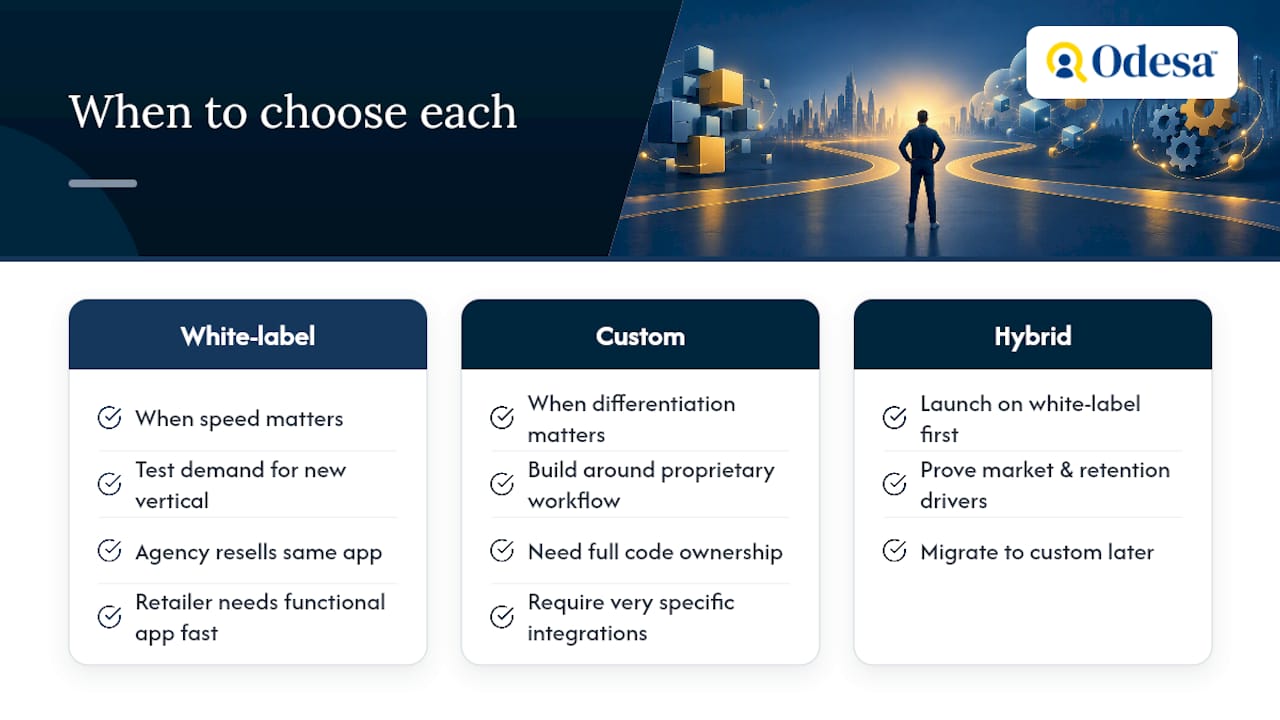
Custom development earns its place just as clearly in the opposite scenarios: building a product around a proprietary workflow or algorithm, needing full ownership of the code for investor or acquisition purposes, or requiring integrations so specific that no existing white-label base will accommodate them without heavy rework.
A hybrid path often makes the most sense in practice. Launch on a white-label base to prove the market, then migrate to a fully custom build once you understand exactly which features drive retention and revenue. That sequencing protects your early capital while keeping the door open to full ownership later.
— Editorial Team
How Odesa can help you launch a rebrandable product
If you are weighing white-label against custom development, the deciding factor is often not the software itself but who is available to build it on your timeline. Odesa’s White Label Development service is competitively priced per hour and gives agencies and founders access to senior Eastern European engineers who can take on rebranding, integration, and customization work without the delay of a full hiring cycle.
For teams that need to scale delivery capacity around a white-label project rather than replace it entirely, staff augmentation fills gaps on existing teams, and custom development covers projects that outgrow a white-label base. An initial discovery call typically starts with a walkthrough of your project scope and timeline, followed by a matched engineer proposal within days rather than weeks. If your next step is figuring out whether white-label or a custom build fits your launch, start with a conversation on the white-label development page.
FAQ
What is white-label development?
White-label development is the practice of licensing a pre-built, rebrandable software product and customizing it under your own brand rather than building from scratch. It typically covers mobile apps, SaaS platforms, and plugins that a vendor develops once and licenses to multiple businesses.
What are the most profitable white-label products to sell in 2026?
There is no single verified ranking of the most profitable white-label products for 2026, and profitability depends heavily on your market, pricing model, and distribution reach. Categories commonly built as white-label products include booking and scheduling apps, helpdesk and CRM SaaS tools, and loyalty or e-commerce plugins, though results vary by vendor and market.
Is white labeling illegal?
White labeling itself is a standard, legal licensing practice used across software and consumer goods industries. The FTC’s Informal Staff Advisory Opinion 05-2 notes that licensing arrangements can avoid franchise-style disclosure requirements when they provide only incidental support and do not require use of the licensor’s trademark, so the specific structure of your agreement is what determines any regulatory obligations.
How much does it cost to white label a product?
Cost depends on how much customization you need, from minor branding changes at the low end to heavy feature development that approaches the cost of a custom build. Odesa’s White Label Development service, for example, is priced from $45 per hour, with total cost scaling based on project scope.
Recommended
- CertaPet Case Study: 16-Week Telehealth Platform Rebuild
- Custom Software Development Services
- Vantex AI Case Study: 4-Engineer Pod, 52% Below US Cost
This article may have used AI tools in the writing process. Facts, figures, and recommendations can be wrong or out of date. Do not treat this as professional advice.