

White label for agencies means outsourcing service delivery (SEO, development, PPC, or reporting) to a partner that fulfills the work while your agency keeps the client relationship and the invoice. It makes sense the moment you have more demand than delivery capacity, but only after you’ve confirmed the partner’s security practices, contract terms, and reporting quality. If you can’t get a signed SOW, a data protection agreement, and a sample report before you commit, run a small pilot first instead of a full handoff.
TL;DR:
- Agencies should verify a partner’s security practices, including signed data protection agreements and audit reports, before committing to a white-label arrangement.
- Operational and contractual safeguards, such as clear IP ownership, non-solicitation clauses, and defined exit procedures, are essential to protect the client relationship and data.
- Starting with services in high demand from existing clients, like SEO or PPC, helps reduce risk and ensures real-world testing during pilots before scaling.
- Pricing should include a transparent markup over wholesale costs, with attention to hidden platform or seat fees that could erode margins.
- Maintaining brand consistency and direct client communication on reports and onboarding processes is crucial to preserve trust and retain ownership of the client relationship.
Table of Contents
- What Is White Label for Agencies, and Which Services Fit the Model?
- Reseller, Managed White Label, or SaaS White Label: What’s the Difference?
- How Do You Vet a White-Label Partner Before Signing?
- What Does White Label Cost, and How Should You Price It?
- How Do You Keep Client Ownership While Outsourcing Delivery?
- What Are the Most Common White-Label Mistakes?
- How Do You Keep Brand Consistency Across White-Label Partners?
- Does White-Labeling Help or Hurt Client Retention?
- How Do You Fold White-Label Services Into Existing Workflows?
- Why White-Label Development and Senior Engineering Make Sense for Agencies
- Start a White-Label Development Pilot With Odesa.co
- Sources
- FAQ
- Why Most Agencies Get White-Label Vetting Backwards
What Is White Label for Agencies, and Which Services Fit the Model?
White label for agencies is a fulfillment arrangement: a specialized partner does the work, and it ships to the end client under your agency’s name, logo, and reporting format. The client never sees the subcontractor. Your agency owns the strategy conversation, the invoice, and the relationship, while the partner owns execution.
Not every service is equally suited to this model. Some channels are commodity enough that a partner can plug in fast with minimal ramp time. Others require deep client context that makes white-labeling riskier unless the partner gets real onboarding.
Services agencies most commonly white-label:
- SEO technical audits, link building, and content production, since these follow repeatable playbooks
- PPC and paid media campaign build and optimization across Google Ads and Meta, especially at scale across many small accounts
- Web development and hosting from landing pages to full custom builds, often the most technically demanding category
- Email automation sequence design and platform management (Klaviyo, Mailchimp, HubSpot)
- White-label reporting branded dashboards pulling from ad platforms, CRMs, and analytics tools
- Social media management content calendars, scheduling, and community response
- SMS and CRM automation workflow builds inside platforms clients already pay for
- Landing pages and conversion rate optimization
- QA and testing pre-launch checks before anything ships to the client
SEO, PPC, and programmatic work get white-labeled most often because the deliverables are standardized and the tooling is mature. A good white-label reporting tool can pull data from a dozen platforms into one branded dashboard, which is often the easiest place to start because it requires no strategic handoff, just infrastructure.
If you’re deciding where to begin, start with whatever service your current clients already ask for and you keep turning down. That’s the clearest signal of unmet demand, and it gives you a live pilot instead of a speculative one.
Reseller, Managed White Label, or SaaS White Label: What’s the Difference?
Three models get lumped together under “white label,” and they carry very different levels of control and risk. Our guide to how white label software development works covers the mechanics in more detail.
- Reseller model. You resell a productized service, often with light or no customization. Margins are predictable, but branding flexibility is limited, and the partner’s process largely dictates what the client experiences.
- Managed white label. The partner executes custom work under full agency branding, following your SOWs and reporting formats. You retain more strategic control here, but it demands tighter coordination and clearer documentation upfront.
- SaaS white label. You license software under your own domain and login, such as a white-labeled reporting or automation platform. This path works best once you already have repeatable onboarding and a defined niche; without that, a SaaS white-label commitment can become an expensive distraction rather than a growth lever.
Regardless of model, your agency should retain three things: the strategy conversation with the client, the client-facing invoice, and the relationship itself. Everything else is negotiable in the SOW.
A typical onboarding sequence looks like this: kickoff call to align on scope and access, credential handoff under controlled permissions, fulfillment against a documented SOW, then delivery of branded reports back to you for client presentation. Build in overlap hours for time-zone coordination during onboarding. Hidden coordination costs tend to show up in week one, not week four.
How Do You Vet a White-Label Partner Before Signing?
Vetting is where most agencies underinvest, and it’s where the real risk sits. A partner that looks polished on a sales call can still lack basic data-handling discipline.
Security evidence to request before signing anything:
- A signed data protection agreement (DPA) covering how client data is stored, processed, and deleted
- Documented encryption practices for data in transit and at rest
- Access control policies (who on the partner’s team can see client credentials, and how that access gets revoked)
- A written breach notification procedure with defined timelines
- Audit reports such as SOC 2 or an equivalent independent assessment
The FTC’s guidance on vendor security is blunt on this point: businesses remain responsible for their subcontractors’ security practices, which means you can’t outsource the liability along with the work.
Contract essentials your SOW or MSA needs:
- Explicit non-solicitation language preventing the partner from poaching your client
- IP assignment or work-for-hire clauses so deliverables belong to you, not the partner
- A defined process for revoking access when the engagement ends
- Clear deliverables and acceptance criteria, not vague scope language
- Liability and indemnity terms, plus data retention and deletion rules
Operational checks before you commit budget:
- Sample branded reports and dashboards, not just a sales deck
- Stated SLA turnaround times for standard requests
- A defined communication channel (Slack, a shared project tool) rather than ad hoc email
- References you can actually call, plus a case study you can verify
Pro Tip: Ask for a signed pilot SOW covering a narrow, low-risk deliverable before handing over a flagship account. A four-to-six-week trial tells you more about a partner’s reliability than any sales call ever will.
The FTC’s guide to protecting personal information recommends verifying a vendor’s security claims directly rather than taking their word for it. Ask for documentation, not assurances.
What Does White Label Cost, and How Should You Price It?
Wholesale-to-retail margin is the mechanic that makes white-labeling viable, and understanding it prevents two common mistakes: underpricing your markup or getting blind sided by hidden fees.
Partners typically price one of three ways: a flat wholesale retainer, a per-deliverable fee (per report, per landing page, per campaign build), or per-seat licensing for SaaS white-label tools. Your agency then sets retail pricing on top, and markup ranges vary meaningfully by channel.
- SEO and content often support markups in the 2x to 3x range because clients pay for outcomes and expertise, not hours
- PPC management typically runs a smaller multiple since ad spend is transparent and clients can benchmark it
- Development work varies widely depending on complexity, but custom builds generally support stronger margins than templated work
- Reporting and dashboards often get bundled at low or no incremental markup, since they function as a retention tool rather than a profit center
Billing approaches fall into three patterns: a bundled service retainer where the white-label cost disappears into your overall fee, a pass-through line item the client sees directly, or a blended retainer combining multiple white-labeled services under one number. Watch for platform or seat fees that partners tack on separately. These hidden costs erode margin fast if they’re not baked into your retail pricing from day one.
How Do You Keep Client Ownership While Outsourcing Delivery?
The single biggest risk in white-labeling isn’t quality. It’s losing the client relationship because the reporting feels generic or the partner’s cadence doesn’t match yours.
Reports need to lead with outcomes, not vanity metrics. Leads generated, calls booked, revenue attributed. Not impressions or “engagement” numbers that don’t translate into a business conversation. Insist on formats that are presentation ready so you’re not rebuilding a partner’s raw export into a client-facing deck every month.
Your SLA with the partner should specify:
- Turnaround time for standard reports and ad hoc requests
- A defined revision window before a deliverable is considered final
- An escalation path when something breaks or slips
- Uptime commitments if the partner hosts anything client-facing
Run client calls yourself, using the partner’s output as source material rather than handing over the call itself. That single practice is what keeps the client relationship yours instead of the partner’s.
What Are the Most Common White-Label Mistakes?
The failures that show up most often are structural, not tactical. They stem from contracts written too loosely at the start.
Frequent pitfalls include skipping a non-solicitation clause (leaving your client exposed to direct poaching), unclear IP ownership over what the partner builds, inconsistent reporting quality that erodes client trust, and uncontrolled ad spend or platform access that leaves you unable to see what’s actually happening in an account.
Mitigations belong in the contract, not in a verbal understanding:
- Explicit assignment of every deliverable and who owns the resulting IP
- A signed DPA covering data handling end to end
- Clear credential and access rules, with revocation on exit
- Audit rights letting you verify the partner’s practices, not just trust them
- A documented exit plan with knowledge transfer built in
Agencies remain legally responsible for how their subcontractors handle client data. A partner’s own security failure becomes your liability the moment that data belongs to your client relationship, which is why a template with services-for-hire, IP assignment, and non-solicitation clauses matters more than a handshake agreement ever will.
How Do You Keep Brand Consistency Across White-Label Partners?
Brand consistency breaks down fastest at the reporting layer, so that’s the first thing to standardize. Build one report template your agency controls, and require every partner to populate it rather than sending you their own format to reformat manually every month.
Voice and visual consistency matter just as much on anything client-facing, from landing pages to email sequences. Give partners a written brand guide (tone, terminology, visual assets) rather than assuming they’ll infer it from a few examples. Ambiguity here is where “close enough” work slips through.
Set a single point of contact on your side who reviews deliverables before they reach the client. This catches inconsistencies early and keeps your team, not the partner, as the last checkpoint before anything client-facing ships. It also means your client never has to know how many hands touched the work.
Finally, treat your brand guidelines as a living document. Update them as you standardize new services, and require partners to confirm they’re working from the current version at the start of each engagement. A stale brand guide is how agencies end up with three slightly different logo treatments across three different partner-produced decks in the same year.
Does White-Labeling Help or Hurt Client Retention?
Done well, white-labeling improves retention because it lets you say yes to expanded scope without a corresponding drop in quality or turnaround time. Clients notice when an agency can suddenly deliver development work alongside their existing SEO retainer. They notice less about who actually built it.
The retention risk shows up when the seams show. Inconsistent formatting between your team’s work and a partner’s, a slower response time on white-labeled deliverables, or a client who somehow finds out a third party is involved. Any of those can shake confidence fast, particularly if the client feels the relationship was less transparent than they assumed.
Growth follows a similar pattern. White-labeling lets an agency take on more clients, or expand deeper into existing accounts, without proportionally growing headcount. That flexibility is the core economic argument for the model. The agencies that get the most growth benefit from it are the ones that treat partner selection with the same rigor as a hire, checking security practices and operational fit before scaling volume through any single vendor.
How Do You Fold White-Label Services Into Existing Workflows?
Integration failures usually come from treating a white-label partner as an external vendor rather than an embedded part of the delivery team. That distinction shapes everything from communication cadence to how work gets assigned.
Put the partner inside your existing project management tool rather than running a separate system just for them. A partner working in their own tracker, disconnected from your internal workflow, creates a translation layer that slows everything down and hides problems until a client asks about status.
Define handoff points explicitly: who briefs the partner, who reviews before client delivery, and who owns the final quality check. Ambiguity here is where deliverables slip through without proper review, not because the partner did bad work, but because nobody on your side was clearly accountable for catching issues.
Schedule a recurring sync, even a short one, separate from any single project. This is where you catch drift early: a partner’s reporting format sliding out of alignment, a turnaround time creeping past your SLA, a channel silently changing hands on the partner’s side.
Finally, document the workflow itself once it’s stable. A written playbook (who does what, in what order, with what tools) makes it far easier to onboard a second partner later or replace one that isn’t working out.
Why White-Label Development and Senior Engineering Make Sense for Agencies
Development is one of the hardest services to white-label well, because clients notice quality gaps in shipped code faster than they notice a slightly generic SEO report. That’s precisely where a productized engineering partner earns its keep.
A strong white-label development model includes personalized matching, where the founder or senior team member is directly involved in understanding what an agency needs before assigning engineers. That matters because agency projects vary wildly, and a mismatched engineer costs you client trust, not just your own time.
The CertaPet case study is a useful proof point here: a 16-week telehealth platform rebuild delivered under the client’s own brand, with no indication to the end customer that a specialized partner handled execution. That’s the standard a white-label development engagement should be held to.
Choose this kind of partnership when you need engineering capacity promptly, without a lengthy hiring cycle. If your need is longer-term and strategic (a permanent hire who becomes part of your core team), direct recruitment may fit better than a white-label arrangement.
Start a White-Label Development Pilot With Odesa.co
This service is a direct option for agencies that need engineering capacity without adding headcount.
For agencies weighing white-label development against building an internal team, three services map directly to that need. White Label Development starts from $45 per hour and covers full project fulfillment under your brand. Staff Augmentation, also from $45 per hour, adds senior engineers into your existing workflow when you need capacity rather than a full outsourced build. And Ongoing Human QA, from $3,500 per month, catches issues before anything reaches your client.
On an introductory call, ask specifically about the matching process, how retention gets handled over the life of an engagement, what a pilot scope looks like, and how pricing adjusts as the relationship grows. Those four questions will tell you more about fit than any sales deck. If the answers hold up, starting with a narrow, well-scoped pilot is the lowest-risk way to find out whether this partnership works for your agency long term.
Sources
- FTC: Cybersecurity for small business: vendor security
- Terms
- AgencyAnalytics: Best white-label marketing tools (2026)
FAQ
What Are White-Label Agencies?
A white-label agency is a company that performs services (development, SEO, PPC, or design) which get delivered to end clients under a different agency’s brand. The end client typically never knows a third party was involved, since all reporting and communication carries the reselling agency’s identity.
How Much Does White Label Cost?
Costs vary by service and pricing model, ranging from flat wholesale retainers to per-deliverable fees to per-seat SaaS licensing. For development specifically, Odesa.co’s White Label Development starts from $45 per hour, with retail pricing then set by your agency on top of that wholesale rate.
What Are the Top White-Label Agencies?
Rather than a fixed ranking, agencies should evaluate white-label partners by channel fit, security documentation, and verifiable case studies rather than by name recognition alone. For development work, look for a partner offering personalized matching and documented client outcomes, since quality gaps in code show up fast once work ships to your client.
What Are Examples of White Label Services?
Common examples include white-label SEO and link building, PPC campaign management, branded reporting dashboards, email automation setup, and full custom software development delivered under the hiring agency’s brand. Development and QA are among the more technically demanding categories, since deliverable quality is immediately visible to the end client.
How Do You Choose Between Reseller and Managed White Label?
Choose a reseller model when you want predictable, productized delivery with minimal customization, and choose managed white label when your clients need custom work executed under close agency control. The right choice mostly depends on how much strategic oversight your agency wants to retain versus hand off.
Why Most Agencies Get White-Label Vetting Backwards
Most guidance on white-label partnerships focuses on finding the right service category and pricing model, treating security and legal protection as a footnote you handle once you’ve already picked a partner. That order is backwards, and it’s why so many agencies end up in a bad contract they can’t easily exit.
The uncomfortable truth is that a subcontractor’s data breach becomes your liability the moment your client’s information touches their systems. The FTC’s guidance doesn’t offer agencies an exemption for outsourced work; the responsibility travels with the data, not with whoever happens to be handling it that week. Yet most agency owners spend far more time evaluating a partner’s portfolio than their DPA, largely because a portfolio is easy to assess in ten minutes and a security posture requires asking questions most sales reps aren’t equipped to answer.
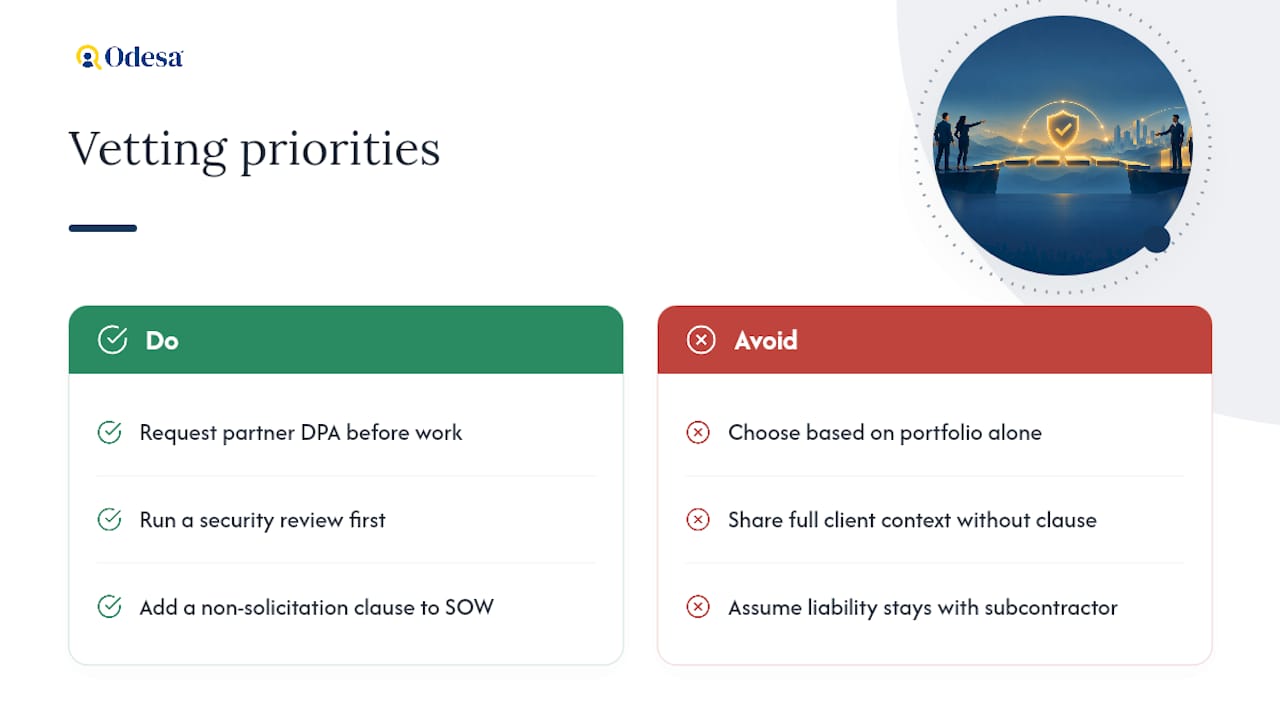
The second underestimated risk is the non-solicitation gap. Agencies hand over full client context (goals, budgets, internal contacts) to a partner with no contractual barrier preventing that partner from approaching the client directly once the relationship sours. This is not a rare event. It’s a predictable outcome of skipping a clause that takes one paragraph to add to any SOW.
If there’s one shift worth making, it’s this: treat the first white-label engagement as a security and contract review with a services conversation attached, not the other way around. The agencies that get burned aren’t the ones who picked a mediocre partner. They’re the ones who never asked to see the paperwork before the work started.
Recommended
Reviewed by Val Narodetsky, founder of Odesa.co.