
White label SaaS development means building a software product so that other companies can put their own brand on it and sell or deliver it to their customers. You can do it in two ways: build the product yourself and license it to resellers, or hire a development partner to build it under your brand. Either way, the real work is not the logo swap. It is the architecture that keeps each partner’s data, branding and configuration separate, and the engineering team that can maintain it for years.
This guide covers both sides of the market, what the build involves, what it costs, how to protect yourself, and how to choose a team.
TL;DR
- White label SaaS is one codebase presented as many branded products. Tenant isolation, theming and partner-level configuration are the hard parts, not the interface.
- Budget realistically: Clutch’s pricing data puts specialized white-label platform builds at roughly $40,000 to $250,000+, driven by the branding engine, reseller tiering and compliance needs.
- Require secure development attestations from any vendor, following the NIST Secure Software Development Framework.
- Senior, pre-vetted engineers on a staff augmentation or white label basis are usually cheaper than a US in-house team and faster to start than recruiting.
Table of Contents
- What white label SaaS development actually covers
- The architecture decisions that decide your costs
- What white label SaaS development costs
- Build, buy or commission: which route fits you
- Security and compliance: what to demand from a vendor
- Choosing a team location: nearshore or offshore
- Our perspective: why senior engineers matter more than the price list
- How to work with a white label development partner
- Getting partners and customers once the product exists
- Where Odesa fits
- Common mistakes to avoid
- FAQ
- Sources
What white label SaaS development actually covers
The phrase is used for three different things, and they have different budgets and risks.
- Building a white label product you will license. You are the software company. Partners rebrand your platform and resell it. You carry the roadmap, uptime and support.
- Reselling someone else’s SaaS under your brand. You are an agency or consultancy. You do not write the core product, but you configure it, integrate it and support clients.
- Commissioning a custom build under your brand. An agency or product company hires a development team that works invisibly, delivering code and features that appear as your own work.
If you are searching for a way to launch a product, the second option is the fastest and the third gives you the most control. The first is the most valuable if it works, and the most demanding to build. A related query, white label app development, usually refers to the third option for mobile products, and the same principles apply: one shared codebase, clean separation of brand assets, and a team that does not appear in front of your customers.
The architecture decisions that decide your costs
White label products fail in a predictable way. The first partner is onboarded by hand, the second needs a code change, and by the tenth every release risks breaking someone’s custom setup. One architecture write-up on white-label platforms for professional services software describes the tension well: a platform that is too rigid stops partners from differentiating, and one that is too open drives up support and governance costs.
These are the decisions to make before writing code.
1. Tenancy model
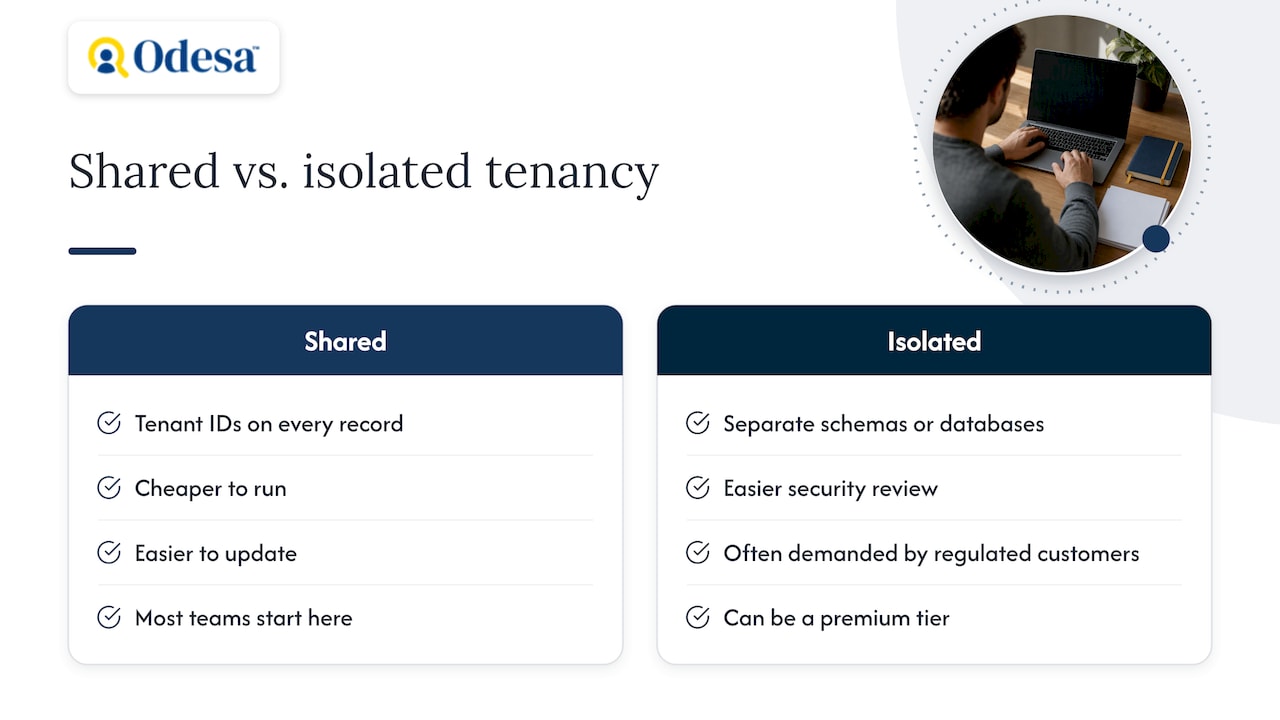
Decide whether partners share a database with tenant identifiers on every record, get separate schemas, or get fully separate databases and deployments. Shared models are cheaper to run and easier to update. Isolated models are easier to defend in a security review and are often demanded by regulated customers. Most teams start shared and offer isolation as a premium tier, but only if the data layer was designed for it from day one.
2. Branding engine
A basic version swaps logos and colors. A real one handles:
- Custom domains and SSL certificates per partner
- Branded transactional email, including sending domains and templates
- Theming through design tokens rather than hard-coded styles
- Branded mobile builds or progressive web app manifests
- White-labeled documentation and help content
Every one of these is a line of work that sales teams tend to forget when they promise full rebranding.
3. Reseller tiers and permissions
Partners often have their own customers, who need their own admin roles. That gives you at least three layers: your staff, the partner, and the partner’s end customer. Permissions, billing visibility and reporting must respect each layer. Retrofitting this later is among the most expensive rewrites in SaaS.
4. Billing and metering
Decide whether partners pay you per seat, per usage unit or a platform fee plus margin, and whether they set their own end-customer prices. Usage metering and invoicing for partners can rival the core product in complexity.
5. Integrations and APIs
If partners expect native-feeling features inside their own product, such as embedded signing, payments or messaging, you need a clean API and clear versioning. A guide to white-label e-signatures for SaaS illustrates the point: the goal is an experience that feels native rather than a tool that reminds users it belongs to someone else.
What white label SaaS development costs
Prices vary widely, so use ranges to frame the conversation, not to quote a project.
| Cost driver | Typical figure | Source |
|---|---|---|
| Offshore hourly rates (US market) | $25 to $75 per hour | Clutch |
| Nearshore hourly rates (US market) | $50 to $120 per hour | Clutch |
| Specialized white-label platform builds | $40,000 to $250,000+ | Clutch |
The build range moves with three things: how deep the branding engine goes, how many reseller tiers you support, and your compliance requirements. A single-brand MVP sits at the low end. A platform with custom domains, tenant isolation options, partner billing and audit logging lands much higher.
Two cautions apply. First, the headline number is only the first version. Maintenance, hosting, support and the partner onboarding tooling continue after launch. Our own breakdown, SaaS development cost for founders, explains why a $40,000 budget can fall short, and the build versus buy analysis shows how total cost of ownership grows beyond the first release. Second, the hourly rate is not the cost. A cheaper team that needs twice the hours, or whose code needs a rewrite, is more expensive than a senior team at a higher rate.
For a wider view of scoped project pricing, see custom software development cost.
Build, buy or commission: which route fits you
| Situation | Best route | Why |
|---|---|---|
| You are an agency that wants a software offering without a product team | Resell or commission a white label build | Fast start, low fixed cost, your brand on the client relationship |
| You have a validated product and want partners to distribute it | Build the multi-tenant platform in-house or with a dedicated team | You own the roadmap and margin |
| You need a branded product fast and have no engineers | Commission a build from a senior team | Predictable scope, less hiring risk |
| Your needs are standard (forms, signing, chat) | License an existing white label component | Cheapest and quickest, with limited differentiation |
The trade-off is control versus speed. A licensed component gets you to market in weeks, but you inherit the vendor’s roadmap and pricing. A custom build costs more, yet you own the code and can shape the product around your customers. If you are weighing hiring against outside help, in-house versus outsourcing developers covers the hidden costs of each.
Security and compliance: what to demand from a vendor
When another company writes the software your customers rely on, you inherit its security habits. The NIST Secure Software Development Framework (SP 800-218) gives you a common vocabulary: it describes secure development practices that can be added to any software development lifecycle model. In practice, ask any build partner for:
- A written description of how they secure their development environment and review code.
- Evidence of how they track third-party dependencies and respond to vulnerabilities.
- An attestation, signed by an accountable person, that they follow a recognized secure development framework. This matters most if your product touches health, financial or other regulated data.
- Clear rules on who holds production credentials and how access is revoked.
Supply chain risk deserves its own question. CISA’s guidance, Defending Against Software Supply Chain Attacks, recommends treating software products and services within a risk management program. For a white label product, that means knowing every library, hosting service and subcontractor in the chain, because your partners’ customers will hold you responsible for all of them.
When the team is remote or abroad, add access controls to the list. Our guide to offshore development risks and secure vendor access walks through least-privilege access, code ownership and offboarding.
Choosing a team location: nearshore or offshore
The same Clutch data shows nearshore teams in the $50 to $120 per hour range and offshore teams at $25 to $75. The gap matters, but so do time zone overlap, communication quality and seniority. A senior engineer who understands multi-tenant design will often avoid expensive mistakes that a junior team discovers only after launch. Our US guide to nearshore versus offshore development compares the two on cost, overlap and risk, and paying overseas developers covers contracts, taxes and payment methods for US teams.
Our perspective: why senior engineers matter more than the price list
We place senior, pre-vetted engineers from Eastern Europe with growth-stage companies and agencies, and white label work is one of the clearest cases where seniority pays off.
A white label product exposes every shortcut. A weak tenant model surfaces when a second partner signs. A rushed theming system surfaces when a partner asks for a custom domain. We have seen the pattern from the client side: the early budget conversation is about hourly rates, and the expensive conversation, six months later, is about rework. That is why we ask about architecture before we discuss a team.
Our approach is personal. The founder speaks directly with each client to understand the product, the team and the gaps, and then matches engineers to that need rather than sending a list of résumés. For agencies, white label development means the engineers work under your brand, inside your process, with your clients seeing only your name. We also think retention is underrated in this kind of work. A product that lives for years needs the same people who understand its tenancy model, not a rotating cast.
If you take one idea from this guide, take this: define your tenancy, branding and permissions model on paper first, then buy engineering hours against it.
— Editorial Team
How to work with a white label development partner
A clear process protects both sides. Use this sequence.
- Write the partner-facing requirements. List what a partner must be able to change alone (logo, colors, domain, email sender) and what always needs your team.
- Choose the tenancy model. Decide on shared or isolated data, and whether isolation is a premium option.
- Scope a first release. Pick one or two pilot partners and build only what they need. Reseller billing and advanced analytics can follow.
- Agree on ownership. Code, designs, documentation and infrastructure accounts should belong to you from the first commit. Confirm that the contract names the developers as working under your brand and under confidentiality.
- Set a security baseline. Ask for the attestations described above before work starts, not at delivery.
- Plan QA with real users. Automated tests do not catch the issues a partner’s staff find in their first week. Release checks by humans on the branded version, in the partner’s own domain and email setup, find the gaps that a single-brand test run misses. Our guide to UAT versus QA explains who should sign off at each stage.
- Document partner onboarding. Every manual step in onboarding becomes a cost and a delay for each future partner. Automate what you can early.
Agencies that want a structured way to evaluate a partner can use how agencies vet a white label development partner.
Getting partners and customers once the product exists
A white label product has two audiences: the partners who resell it and the end customers they serve. Discoverability matters for both. Content that explains your platform to potential partners, and that ranks for the questions they type, lowers the cost of acquiring each one. Teams planning that side of the launch can look at SaaS SEO for sustainable growth as one way to keep acquisition costs down while the product matures.
Equally important is a partner enablement kit: demo environments, documentation under the partner’s brand, and a clear escalation route for support. Partners who feel supported sell more, and partners who feel abandoned leave.
Where Odesa fits
If you are an agency or consultancy that needs engineering capacity under your own brand, our White Label Development service starts from $45 per hour. If you are a product company that needs senior engineers inside your own team to build the platform, staff augmentation is also available from $45 per hour, and the staff augmentation versus recruitment comparison helps you choose between contracting and a direct hire. For a scoped build, see our custom development options, and for the release stage, the Human QA service offers a Human Release Check at $1,500 one-off.
Common mistakes to avoid
- Treating rebranding as a skin. Logos are easy. Domains, email, mobile builds and documentation are not.
- Skipping tenant isolation tests. Test that one partner can never see another partner’s data, on every release.
- Hard-coding partner exceptions. Every special case in code becomes a permanent maintenance cost. Use configuration instead.
- Choosing on hourly rate alone. Compare total cost, including rework and management time.
- Leaving ownership vague. Without clear intellectual property terms, you may not control your own product.
FAQ
What is the difference between white label SaaS and reselling SaaS?
White label SaaS usually refers to software built by one company and sold under another company’s brand. Reselling can mean the same thing, but it can also mean selling the original vendor’s branded product for a commission. The practical difference is who controls the brand, the customer relationship and the support.
How long does white label SaaS development take?
It depends on scope, so we do not quote a universal timeline. A single-brand first release with a pilot partner is much faster than a full platform with custom domains, tiered permissions and partner billing. Agree a first release with a small scope and expand after the pilot.
Who owns the code in a white label build?
That is set by your contract, not by the model. Ask that code, designs and infrastructure accounts belong to you from the start, and that all developers sign confidentiality terms. Have a lawyer review the agreement before you sign.
Is white label development cheaper than building in-house?
Often, because you avoid recruiting time and US salary levels, but it depends on the team. Offshore and nearshore rates differ widely, as the Clutch figures show, and rework from a weak team can erase the savings. Compare total cost over the life of the product, not only the hourly rate.
How do I check that a vendor builds securely?
Ask for a written attestation that they follow a recognized framework such as NIST’s SSDF, plus details on dependency tracking and access control. Regulated industries should request this before contracting.
Sources
- Software Development Company Pricing Guide, Clutch
- NIST SP 800-218, Secure Software Development Framework Version 1.1
- CISA, Defending Against Software Supply Chain Attacks
- White-Label Platform Architecture for Professional Services Software Providers
- The Complete Guide to White-Label E-Signatures for SaaS
Recommended
- White Label Software Development: How It Works
- SaaS Development Cost for Founders: Why $40K Can Fall Short
- How Agencies Vet a White Label Development Partner
- White Label Development Services for Agencies
This article may have used AI tools in the writing process. Facts, figures, and recommendations can be wrong or out of date. Do not treat this as professional advice.